
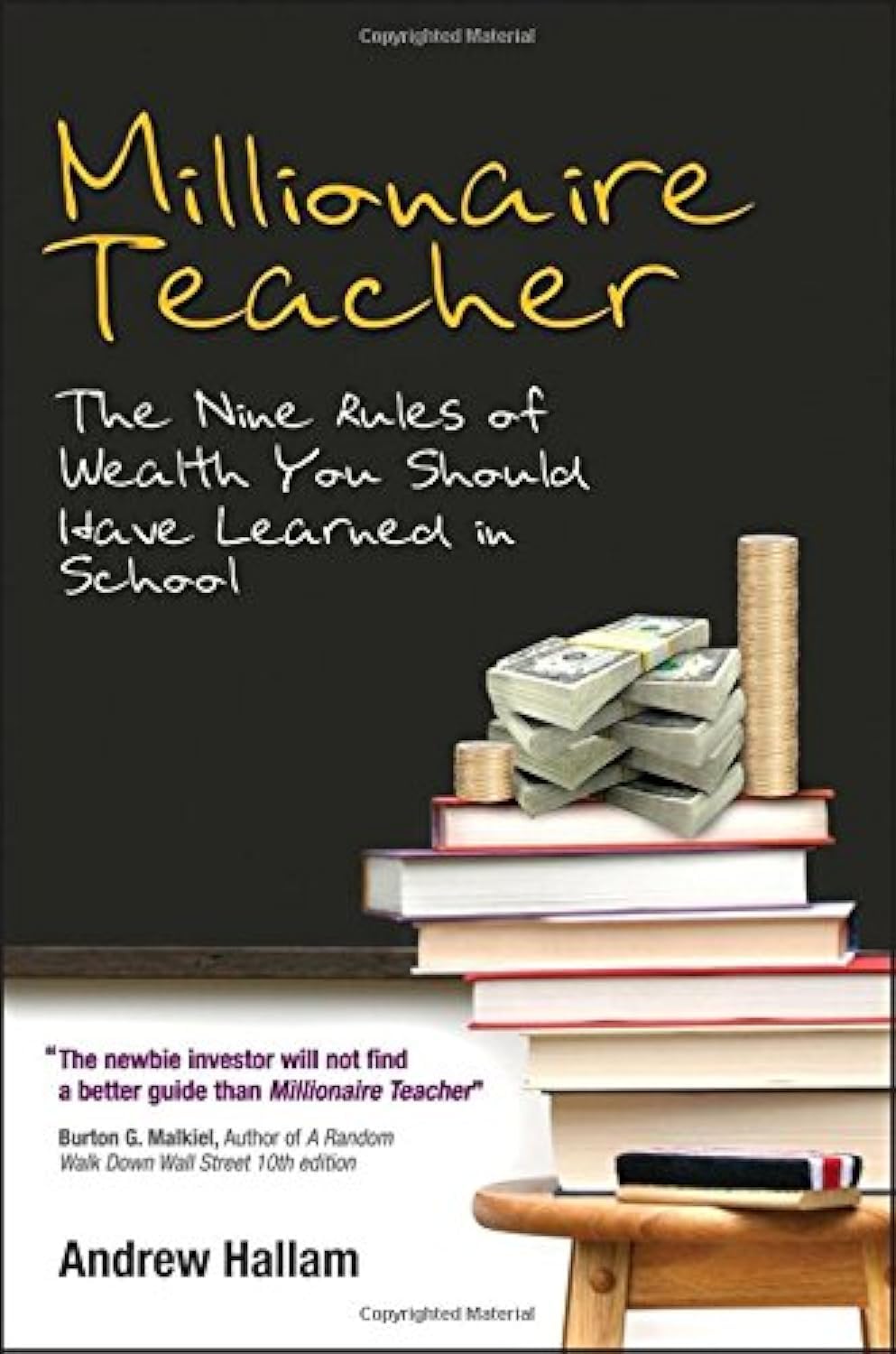
If I could pick one investing book that I want EVERY young person to read before purchasing their first stock, it would likely be Millionaire Teacher by Andrew Hallam.
Millionaire Teacher is one of the simplest and most practical personal finance books out there. It doesn’t teach you fancy Wall Street jargon or complex financial theories. Andrew Hallam wasn’t Wall Street hot shot or hedge fund manager. He was a regular school teacher who used investing and good money habits to retire early.
This is precisely why so many readers loved this book.
The advice Hallam gives is timeless because it’s realistic. It isn’t based on trying to time the market, trade every week, or pick the next biggest stock. Rather, the book teaches you about behavior, discipline, fees, diversification, and thinking with a long-term mindset.
Sure, the book is years old now. But the majority of his investing rules are still insanely relevant today as we’re flooded with social media posts about speculative investing ideas, meme stocks, crypto pumps, and “get rich quick” schemes.
In this Millionaire Teacher book review, I’ll cover the 9 rules of investing from the book, explain why they’re important, and give you my take on which rules still apply today.
- What Is Millionaire Teacher About?
- Rule #1: Avoid Financial Industry Salespeople
- Rule #2: Index Funds Beat Most Active Investors
- Rule #3: The Stock Market Rewards Patience
- Rule #4: Diversification Protects You From Disaster
- Rule #5: Ignore Short-Term Market Predictions
- Rule #6: Lifestyle Inflation Can Destroy Wealth
- Rule #7: Start Investing Early
- Rule #8: Simplicity Usually Wins
- Rule #9: Financial Freedom Matters More Than Status
- My Overall Thoughts on Millionaire Teacher
- Should You Read Millionaire Teacher?
- Final Verdict
Millionaire Teacher: The Nine Rules of Wealth You Should Have Learned in School

What Is Millionaire Teacher About?
Millionaire Teacher is simple in its premise:
You don’t have to be an investing guru to become financially successful.
True wealth over the long term is generally achieved by:
- Saving money
- Investing regularly
- Minimizing investment fees
- Avoiding emotional reactions to market fluctuations
- Remaining invested for the long term
Hallam achieved his own success through index fund investing and saving as an expat teacher at international schools.
Where the book shines is that it weaves together:
- Narrative
- History of the markets
- Behavioral finance
- Actionable advice
It is one of the few personal finance books that I would recommend to someone new to investing, as well as experienced investors who could use a refresher.
Rule #1: Avoid Financial Industry Salespeople
One big lesson from the book is that lots of “financial advisors” are really salespeople.
Hallam makes the case that large swaths of the financial industry make their money by selling:
- High-fee mutual funds
- Commission based products
- Opaque insurance products
- High-cost actively managed portfolios
This lesson starts to resonate even more once you learn about compound fees.
While 1–2% per year may not sound like much… when compounded over 30 years, fees will eat away at the lion’s share of your investment returns.
It’s a cruel math when you see how compounding works.
Tiny differences in investment returns result in massive differences decades down the road.
Which is another reason we’ve seen low-cost ETFs take over the world.
I think this lesson matters even more today than when this book was originally written. With social media we’ve seen the rise of “financial influencers” making a living off of selling courses, paid communities, stock tips, or promises they can’t possibly keep.
A modern take on this rule of thumb is:
Whoever benefits from your investing, needs to have your best interests in mind.
Rule #2: Index Funds Beat Most Active Investors
“This is probably the most well-known piece of advice from the book.”
Hallam has a great argument for investing in low-cost index funds over picking “winners.”
His logic is simple:
- Most active managers don’t beat the market over the long-term
- Fees make active investment even more difficult
- Consistency trumps genius
The philosophy behind indexing is hard to argue with on a statistical level.
Over time broad stock market indexes have performed extremely well historically.
For the majority of people buying diversified index funds consistently is likely your best bet for becoming wealthy.
With that being said I want to add a small nuance to this chapter.
Many young investors these days love picking individual companies. Researching individually stocks and businesses.
There is nothing wrong with this and some people will truly outperform through deep research, concentration, and patience.
The key distinction is:
The majority of people think they are above average investors.
Only a small minority truly are.
This is why Index Funds are such an effective “set it and forget it” strategy.
Some of the greatest investors like Warren Buffett tell people to buy low-cost index funds.
Warren Buffett has said time and time again that the majority of people are better off buying cheap S&P 500 Index Funds.
Rule #3: The Stock Market Rewards Patience
Perhaps the most valuable investing lesson in the book is not financial, but psychological.
Patience.
Hallam drills this into us over and over again.
The stock market will be incredibly volatile in the short term. But patient investors are rewarded over time.
It’s easy to understand this during good times in the market. But when everything crashes? That’s when this lesson is put to the test.
When stock portfolios plummet 20–40% overnight seemingly everyone starts panicking.
They sell their stocks near all-time lows and flee to cash.
The book teaches us that volatility is part of the investing journey. Volatility is what we pay for long-term gains.
This lesson rang true multiple times over for me:
- During the financial crisis of 2008.
- The COVID crash of 2020.
- The growth stock correction of 2022.
Time and time again, investors who stayed fully invested saw their portfolios recover and thrive.
Meanwhile “traders” who psych themselves out and try to time the market their whole lives hurt their own returns.
This might be the toughest investing lesson to learn:
Your emotions will be your biggest investing enemy.
Rule #4: Diversification Protects You From Disaster
Hallam was a big believer in international diversification. Don’t put all your eggs in one country basket.
This advice has stood the test of time.
Bull markets make investors greedy. They reach for concentrated bets like:
- AI stocks
- Tech stocks
- Crypto
- Single country
- Single theme
Sometimes going concentrated works great.
But for every success story, there are countless portfolios devastated by concentration.
Diversification is boring, but it helps prevent disasters.
The problem investors face today is that U.S. tech stocks have crushed international markets for a very long time.
That makes it really hard for younger investors to understand the value of diversification.
Why should I diversify if U.S. tech will just keep on winning? ?
Because nobody knows what happens next.
Market leadership changes throughout history.
Japan was king. Then China was king. The “Nifty Fifty” were kings.
Time and time again, history smacks down investors who think today’s leaders will remain leaders forever.
Rule #5: Ignore Short-Term Market Predictions
The financial media always attempts to predict:
- Recessions
- Interest rates
- Crashes
- Market tops
- Market bottoms
Hallam cautions investors against fixating on these predictions.
Hallam’s advice may actually be MORE relevant today given information inflation.
Investors are bombarded daily with:
- Breaking news alerts
- Viral hot takes on stocks
- Twitter chains
- YouTube calls
- DOOM
Much of it is just noise.
No one has a track record of predicting the markets over an extended period of time.
…
- Economists.
- TV analysts.
- “Influencers”.
- Hedge funds.
Top investors tend to care more about:
- Time in the market
- Company quality
- Long-term trends
- Portfolio consistency
- Rather than chasing the noise.
Rule #6: Lifestyle Inflation Can Destroy Wealth
Something I think gets overlooked about Millionaire Teacher is that investing isn’t the ONLY topic covered.
Hallam covers habits and lifestyle design too.
He discusses how many people who make a lot of money still find themselves broke.
Their spending increases with their income. This phenomenon is known as lifestyle inflation.
Some examples of lifestyle inflation:
- Purchasing new cars all the time
- Buying luxury items
- Spending money you don’t have on “keep up with the Joneses” items
- Accumulating debt unnecessarily
This message really resonates with me because of how SOCIAL MEDIA affects us.
Instagram, TikTok, and other platforms have made these lifestyles feel normal 24/7.
We are surrounded by highlight reels every single day.
But many people who are secretly rich have average or even modest lifestyles.
It’s one of the greatest secrets about wealth:
Wealthy doesn’t always look wealthy.
Rule #7: Start Investing Early
Compound interest is the single most powerful force in investing.
Even small amounts invested early in life can turn into large sums of money.
The younger someone starts investing the more time compounding has to work its magic.
That’s what gives young investors the biggest advantage that most people never realize.
That 25-year-old who invests $500 a month could very well end up with more wealth than someone who starts investing ten times that amount when they’re 35 or older.
The hard part is mental.
When you’re young:
- You retirement doesn’t feel real
- You enjoy spending more
- You don’t see returns from investing
But compound interest works whether you see it or not for decades to come.
That’s the power of books like Millionaire Teacher for young people.
One shift in mindset early on can change someone’s financial life forever.
Rule #8: Simplicity Usually Wins
Investors tend to believe complex strategies yield superior returns.
Yet time and time again Hallam demonstrates that simple beats complex.
Simple investment systems are easier to:
- Comprehend
- Manage
- Exercise discipline with
- Trade during market meltdowns
Deep money often tries to overengineer their portfolios at their own peril.
I love this point because our society thrives on making investing way more complicated than it needs to be.
We get fixated on:
- Daily macro calls
- Option gamedays
- Daily journaling about leveraged ETFs
- Charting setups
- “Optimizing” our portfolios every other day
All while the wealthy buy and hold investors:
- Buy good stuff
- Hold
- Reinvest
- Sit back and watch🔥
Simple is not easy.
But simple works.
Rule #9: Financial Freedom Matters More Than Status
Money isn’t about luxuries. Money is about freedom.
Freedom to…
- Quit horrible jobs
- Be there for your kids
- Travel
- Be less stressed
- Do work that matters
- Have flexibility
This is why Millionaire Teacher stands apart from run-of-the-mill investing books.
The author repeatedly relates investing back to quality of life.
This lens makes the lessons feel more human.
It’s not all about maximizing digits on a computer screen. Wealth is about creating options.
My Overall Thoughts on Millionaire Teacher
Despite its weaknesses I still believe Millionaire Teacher is one of the best books for beginner investors.
Strengths:
- Easy to understand
- Full of time-tested investing principles
- Practical advice you can use
- Behavioral insights
- Simple
It doesn’t conflate itself with unnecessary details. It just teaches you the habits that are important.
Weaknesses (keep in mind it was written in 2011):
- The investing environment is different now.
- ETFs are much more accessible worldwide.
- Tax/tax-loss harvesting discussions may be outdated for your country.
- It goes very in-depth on index investing.
- If you’re into stock picking or growth investing you might find the book too “conservative.”
However you will still benefit from Millionaire Teacher if you’re an aggressive investor.
Hallam’s investing habits and, more importantly, behavioral advice will change your investing forever.
Even if you don’t adopt his strategies, you can still learn a lot from his book.
Should You Read Millionaire Teacher?
I think this book would be particularly valuable if you:
- Are a young professional
- Are a first time investor
- Feel overwhelmed by investing
- Are trying to build wealth for the long term
- Are an investor that gets swayed by hype / speculation too often
The book will likely feel elementary if you have already been investing for many years.
However, even the most veteran investors could use reminders about:
- Discipline
- Patience
- Fees
- Keeping your emotions in check
- Thinking about the future
You never really outgrow those lessons.
Truth be told, in this current crazy market environment full of noise and speculation, Millionaire Teacher may be needed now more than ever.
Final Verdict
Millionaire Teacher works because it makes investing approachable without dumbing it down.
Andrew Hallam doesn’t claim you’ll become rich overnight.
He doesn’t peddle false hope.
And he doesn’t make investing sound easy.
What he does is educate his readers on how to think about money and investing for the long haul (decades! ).
That mental framework is likely FAR more valuable than any “hot stock tip.”
For the majority of people, getting rich isn’t about picking the next Nvidia.
It’s not about timing the market either.
It’s about…
Consistency
Patience
Avoiding mistakes
Allowing compounding to do it’s thing over time
Millionaire Teacher covers those concepts better than most investing books I’ve read.
If you’re just starting out with investing, this is DEFINITELY a book you should pick up.




Leave a Comment