

If you have a workplace retirement plan and access to an IRA, the hard question is rarely “Should I save for retirement?” It is where the next dollar belongs. A 401(k) and an IRA can both shelter growth from taxes, but they are not interchangeable — and the order you fund them often matters more than which account “wins” in a vacuum.
Quick answer: For most US workers with a matching 401(k), the practical order is:
- Capture the full employer match in the 401(k) (that match is free money once vested).
- Fund an IRA next — often a Roth IRA if you are eligible — up to the annual IRA limit.
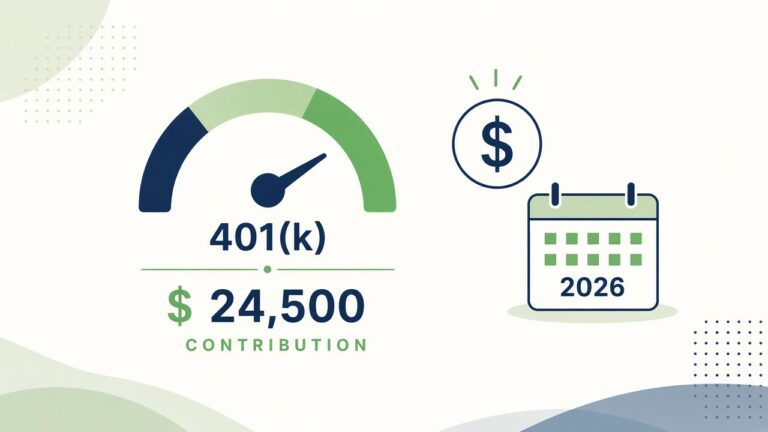
- Return to the 401(k) and keep contributing toward the employee elective deferral limit ($24,500 in 2026 for most plans).
Caveats change that stack: high-interest debt, no emergency fund, a high-fee / weak 401(k) menu after the match, income that phases out IRA options, or an excellent low-cost plan that makes extra 401(k) dollars more attractive than an IRA.
This guide compares a 401(k) vs an IRA for the “next dollar” decision — not a deep Roth-vs-Traditional IRA debate (see our Roth IRA vs Traditional IRA guide for that). Limits and phaseouts below are the IRS 2026 figures from IR-2025-111 / Notice 2025-67. For paycheck math inside a plan, use our 401(k) contribution limits 2026 article.
This is general education for a US audience — not tax, legal, or financial advice. Plan documents, payroll timing, and your tax situation control the real answer; confirm details with your plan administrator, IRS sources, or a qualified professional.
What a 401(k) is vs what an IRA is
401(k) (workplace plan)
- Offered by an employer (similar cousins include many 403(b), governmental 457(b), and TSP accounts).
- Funded mainly through payroll deferrals — often Traditional (pre-tax) and/or Roth (after-tax) employee contributions.
- May include an employer match or other employer contributions.
- Investment menu, fees, loans, and hardship rules are set by the plan.
- Annual employee elective deferrals have a high IRS ceiling (see 2026 limits below).
IRA (individual retirement arrangement)
- Opened by you at a brokerage, bank, or mutual fund company (Traditional IRA, Roth IRA, or both — subject to rules).
- Funded from your own money (not payroll-required), typically by transfer or contribution by the tax deadline rules that apply.
- No employer match.
- Usually a wide investment menu and transparent retail fees.
- Much lower annual contribution limit than a typical 401(k) elective deferral.
Think of the 401(k) as the workplace “channel” with match potential and payroll automation, and the IRA as the personal “channel” with more control — and tighter dollar room each year.
2026 contribution limits side by side (lists, not a table)
Figures below are the IRS 2026 cost-of-living amounts announced in IR-2025-111 and detailed in Notice 2025-67. Always confirm your own plan’s features (some plans do not offer every catch-up option).
401(k) / 403(b) / governmental 457 / TSP — employee elective deferral (2026)
- Base employee deferral limit: $24,500
- Age 50+ catch-up (most plans): $8,000 → employee total often illustrated as $32,500
- Ages 60–63 higher catch-up (if the plan allows): $11,250 instead of the standard $8,000 catch-up
- Annual additions limit (employee + employer contributions, IRC §415(c)): $72,000 for 2026 (catch-ups are generally treated as being on top of this limit under IRS framing — confirm with your plan)
- Pre-tax and Roth employee deferrals generally share one elective deferral limit
- High-earner note (SECURE 2.0): for some plans, catch-up contributions may be required as Roth when prior-year FICA wages exceed $150,000 — details and planning notes live in our 401(k) limits guide
IRA — Traditional and Roth combined (2026)
- Combined contribution limit across Traditional + Roth IRAs: $7,500
- Age 50+ IRA catch-up: $1,100 → total $8,600
- You generally cannot contribute more than your taxable compensation for the year
- Deductibility (Traditional) and contribution eligibility (Roth) can phase out with income — see the income section below
Quick contrast
- Workplace elective deferral room in 2026: up to $24,500 (plus catch-ups if eligible)
- IRA room in 2026: up to $7,500 (or $8,600 age 50+)
- You can often use both in the same year if you have compensation and meet the rules
Employer match and vesting: why the match usually wins the first dollar
An employer match is typically the strongest reason to put early retirement dollars into the 401(k).
Why match-first is the default
- A common formula is something like “100% of the first 3% of pay” or “50% of the first 6%.” Whatever the formula, unmatched free money left on the table is hard to beat with IRA returns alone.
- Match contributions are not the same as your elective deferral limit — they are employer money (subject to vesting and plan rules).
- Vesting schedules mean you may not keep 100% of the match if you leave early — but the match still usually dominates the next dollar decision while you are employed and accruing it.
Practical framing
- Contribute at least enough in the 401(k) to get the full match first.
- Then decide whether the next dollar goes to an IRA or more 401(k) based on fees, investments, tax treatment, and income limits.
If your plan has no match, the “match first” rule disappears — and the IRA-vs-more-401(k) comparison after basic emergency savings becomes more fee- and tax-driven.
Investments, fees, and loans: where 401(k) and IRA feel different
Investment choice
- Many 401(k)s offer a curated menu (target-date funds, a handful of index funds, maybe a brokerage window).
- IRAs typically let you buy a broad range of ETFs, mutual funds, and other investments at a retail brokerage.
Fees
- Compare expense ratios and any admin/recordkeeping fees in the 401(k) versus what you would pay in an IRA.
- A low-cost 401(k) with solid index options can be excellent after the match.
- A high-fee 401(k) with weak options may make “IRA next” more compelling once the match is captured.
Loans and access
- Some 401(k)s allow participant loans (plan-specific; unpaid loans can become taxable if you leave the job).
- IRAs generally do not offer the same loan feature; early distributions have their own tax and penalty rules.
- Neither account is a substitute for an emergency fund. Borrowing from retirement should be a last resort, not a strategy.
Payroll automation vs self-funding
- 401(k): easy “set it and forget it” through payroll.
- IRA: you must remember to contribute (or set up automatic transfers yourself).
Traditional vs Roth — at the 401(k) and at the IRA
Both account types can offer Traditional (pre-tax) and Roth (after-tax) flavors, but the decision trees differ.
Inside a 401(k)
- Traditional 401(k): deferrals can reduce taxable wages now; withdrawals later are generally taxed as ordinary income.
- Roth 401(k): deferrals are after-tax; qualified withdrawals can be tax-free.
- Your plan may offer one or both. Employer match is often contributed as pre-tax even when you elect Roth deferrals (plan-dependent).
Inside an IRA
- Traditional IRA: possible upfront deduction (subject to workplace-coverage phaseouts).
- Roth IRA: no upfront deduction; contribution eligibility phases out with income; qualified withdrawals can be tax-free; no lifetime required minimum distributions (RMDs) for the owner under current federal rules.
If your question is specifically Roth IRA vs Traditional IRA, use the dedicated BearSavings guide: Roth IRA vs Traditional IRA. This article focuses on 401(k) vs IRA as funding vehicles, then lightly notes tax flavor where it changes the next-dollar order.
Income rules when you already have a workplace plan
Having a 401(k) does not stop you from contributing to an IRA — but it can change whether a Traditional IRA contribution is deductible, and whether you can contribute directly to a Roth IRA.
2026 Traditional IRA deduction phaseouts if covered by a workplace plan (IR-2025-111)
- Single (covered): $81,000 – $91,000 MAGI phaseout range
- Married filing jointly, contributor covered: $129,000 – $149,000
- Married filing jointly, contributor not covered but spouse is covered: $242,000 – $252,000
- Married filing separately (covered): $0 – $10,000
If neither you nor your spouse is covered by a workplace plan, the workplace-coverage deduction phaseouts generally do not apply (other rules still can).
2026 Roth IRA contribution phaseouts (IR-2025-111)
- Single / head of household: $153,000 – $168,000
- Married filing jointly: $242,000 – $252,000
- Married filing separately: $0 – $10,000
Advanced note (high-level only): Higher earners sometimes use nondeductible Traditional IRA contributions and a conversion strategy often called a “backdoor Roth.” That path has Form 8606 tracking, pro-rata rules, and timing issues. This article does not walk through mechanics — our Roth IRA income limits 2026 guide covers the steps and the pro-rata math. Treat it as an advanced topic to review with a tax professional if your income blocks a direct Roth IRA contribution.
Priority order: a practical decision framework
Use this stack as a default, then adjust for your plan quality and cash-flow reality:
- High-interest debt and basic emergency cash — retirement tax shelters rarely beat crushing credit-card APR, and an empty emergency fund pushes people to raid accounts.
- 401(k) up to the full employer match
- HSA (if eligible) — optional adjacent bucket with strong tax treatment for medical costs; 2026 limits are $4,400 self-only / $8,750 family (+ $1,000 catch-up age 55+). See HSA contribution limits 2026.
- IRA (often Roth if eligible; otherwise Traditional if deductible, or a thoughtful mix)
- More 401(k) toward the $24,500 elective deferral (and catch-ups if eligible)
- Taxable brokerage / other goals after tax-advantaged room is used well
Social Security claiming age is a separate later-career decision — useful context lives in our Social Security full retirement age guide — but it does not change the “match → IRA → more 401(k)” cash-flow order for most workers earlier in their careers.
Scenario examples (illustrative only)
Scenario A — Match first, then Roth IRA
- Salary with a 401(k) that matches 100% of the first 4% of pay
- Next dollars after the 4% match: fund a Roth IRA toward the $7,500 (or $8,600 age 50+) limit if eligible
- Then increase 401(k) deferrals toward $24,500
Scenario B — High-fee 401(k) after the match
- Capture the match in the 401(k)
- Prefer IRA funding next because the plan’s non-match menu has high expense ratios and limited index options
- Return to the 401(k) only after the IRA is funded (or sooner if you value payroll automation highly)
Scenario C — Excellent low-cost 401(k); Roth IRA ineligible
- Capture the match
- Skip a direct Roth IRA contribution (income above the phaseout)
- Put more into the low-cost 401(k) (Traditional and/or Roth 401(k) as available) toward the elective deferral limit
- Consider professional advice before any advanced IRA conversion strategies
When more 401(k) beats an IRA after the match
Favor additional 401(k) dollars when:
- The plan has low-cost index funds or a strong target-date series
- You value automatic payroll contributions more than DIY IRA transfers
- You want access to a Roth 401(k) even if Roth IRA contributions are phased out
- You are chasing a high savings rate and the IRA’s $7,500 / $8,600 ceiling is too small alone
- You may want plan features (such as loans) that an IRA does not offer — remembering loans are still a double-edged tool
When an IRA wins the next dollar after the match
Favor an IRA next when:
- Plan fees are high or the investment menu is weak beyond the matched dollars
- You want broader investment choice or simpler consolidation at a brokerage you already use
- You specifically want Roth IRA features (for example, contribution/withdrawal nuance and no lifetime RMDs for the owner under current rules) and you are eligible
- You are self-employed or between jobs with no current 401(k) — then the IRA (and/or a solo 401(k) / other options outside this article’s scope) may be the main channel
Working both together (and the HSA as a third bucket)
A healthy pattern for many dual-income or mid-career households:
- Automate 401(k) to at least the match every paycheck
- Automate a monthly IRA contribution so the annual limit is hit by year-end (or by the contribution deadline rules)
- If you have an HDHP and HSA eligibility, treat the HSA as a medical + long-term tax shelter adjacent to retirement accounts (our HSA vs FSA guide explains how it compares with an employer FSA)
- Keep taxable investing for goals that do not fit retirement locks — capital gains planning context is in our 2026 capital gains tax brackets guide
You do not have to “pick a winner.” You have to sequence dollars so free match, tax rules, and fees line up.
FAQ: 401(k) vs IRA
Can I contribute to both a 401(k) and an IRA in the same year?
Yes, if you have eligible compensation and stay within each account’s limits and eligibility rules. Workplace coverage can affect Traditional IRA deductibility and Roth IRA contribution eligibility, but it does not automatically ban IRA contributions.
What if I do not have a 401(k)?
Prioritize an IRA (and other available plans such as a solo 401(k) if self-employed). Without a match, the IRA vs workplace-plan comparison is moot until you have a plan again.
What if my employer offers a 401(k) with no match?
Skip the “match first” step. Compare fees, investments, and tax treatment; many people still use the 401(k) for payroll convenience while funding an IRA heavily, but it depends on plan quality.
Traditional 401(k) vs Traditional IRA — which is better?
Different ceilings, different deductibility rules, different menus. Capture any match first; then compare deductibility phaseouts, fees, and automation.
Roth 401(k) vs Roth IRA — which is better?
Related but not identical. Roth IRA eligibility phases out with income; Roth 401(k) generally does not have the same contribution income cap (though wage-based Roth catch-up rules can apply for some high earners). See the Roth vs Traditional IRA article for IRA-specific tax timing, and the 401(k) limits article for plan deferral mechanics.
What happens to my 401(k) if I change jobs?
Common high-level paths include leaving it, rolling to a new employer plan, or rolling to an IRA. Each choice has fees, investment, creditor, and Roth/basis implications — get plan paperwork and consider professional advice before moving money.
Should I pause retirement contributions to pay debt?
Often yes for very high-interest consumer debt after (or sometimes instead of) a small match decision — but run the numbers. A large match can still be worth capturing while you attack debt aggressively.
Bottom line
For most people asking 401(k) vs IRA in 2026, the answer is a sequence, not a rivalry:
- Match first in the 401(k)
- IRA next (often Roth if eligible) up to $7,500 / $8,600 age 50+
- More 401(k) toward the $24,500 elective deferral (plus catch-ups if you qualify)
- Adjust for fees, income phaseouts, debt, and cash reserves
- Consider an HSA as a powerful adjacent bucket if you are eligible
Use the IRS figures above as planning anchors, then verify your plan’s summary description, match formula, vesting, and investment expenses before you lock in payroll percentages.
General education for US readers. Not tax, legal, or investment advice. Contribution limits, phaseouts, and plan features change; confirm with IRS IR-2025-111 / Notice 2025-67, your plan administrator, and a qualified professional.
Sources
- IRS Newsroom — IR-2025-111: 401(k) limit increases to $24,500 for 2026, IRA limit increases to $7,500
- IRS — Notice 2025-67 (PDF) — 2026 retirement plan COLA details
- IRS — Retirement topics — IRA contribution limits
- IRS — Retirement topics — 401(k) and profit-sharing plan contribution limits
Keep learning: courses on this topic
Self-paced courses to put this article into practice.
 Udemy
Complete Personal Finance Course: Earn, Save and Invest
A self-paced video course on budgeting, saving and investing, with practical lessons you can apply right away.
View course
 Udemy
Invest Like a Pro: Your First Steps in Wealth Creation
A self-paced video course on budgeting, saving and investing and investing basics, with practical lessons you can apply right away.
View course
 Udemy
Get Out of Debt, SAVE, Increase Wealth, Invest In The Future
Personal Finance, Investing, and Retirement: Get Out of Debt & Get Your Money to Work For You. Do you work hard for your money? Get your…
View course




Leave a Comment