

Quick answer: For 2026, you can make a full Roth IRA contribution if your modified adjusted gross income (MAGI) is under $153,000 as a single filer or head of household, or under $242,000 if you’re married filing jointly. Between $153,000 and $168,000 (single) or $242,000 and $252,000 (joint), your allowed contribution shrinks on a sliding scale. At $168,000 or more (single) or $252,000 or more (joint), you can’t contribute directly at all. Married filing separately is the harsh one: if you lived with your spouse at any time during the year, your phase-out runs from $0 to $10,000. These ranges come from IRS Notice 2025-67, released with news release IR-2025-111 on November 13, 2025.
The contribution limit itself is $7,500 for 2026, or $8,600 if you’re 50 or older (the catch-up rose to $1,100). If your income is too high, you still have legal routes into a Roth, including the backdoor Roth and a Roth 401(k), which has no income limit.
This guide walks through the exact phase-out math, what counts as MAGI, how to fix a contribution you shouldn’t have made, and when the backdoor route makes sense.
Educational only, not personalized tax or investment advice. IRA rules depend on your full return, so confirm your numbers with IRS Publication 590-A or a tax professional.
2026 Roth IRA income limits by filing status
These are the official 2026 MAGI ranges from IRS Notice 2025-67, with the 2025 ranges for comparison.
Single, head of household, or married filing separately (did not live with spouse at any time in the year)
- Full contribution: MAGI under $153,000 (2025: under $150,000)
- Partial contribution: MAGI from $153,000 up to $168,000 (2025: $150,000 to $165,000)
- No direct contribution: MAGI of $168,000 or more (2025: $165,000 or more)
Married filing jointly or qualifying surviving spouse
- Full contribution: MAGI under $242,000 (2025: under $236,000)
- Partial contribution: MAGI from $242,000 up to $252,000 (2025: $236,000 to $246,000)
- No direct contribution: MAGI of $252,000 or more (2025: $246,000 or more)
Married filing separately (lived with spouse at any time during the year)
- Full contribution: only if MAGI is $0
- Partial contribution: MAGI above $0 but under $10,000
- No direct contribution: MAGI of $10,000 or more
- This range is set by law and isn’t adjusted for inflation, so it’s the same every year.
Two details trip people up. First, the phase-out window is $15,000 wide for single filers but only $10,000 wide for joint filers, so couples lose eligibility faster per dollar of income. Second, head of household uses the single range, not the joint range.
2026 Roth IRA contribution limits
Income decides whether you can contribute. The contribution limit decides how much.
- Under 50: $7,500 for 2026 (up from $7,000 in 2025)
- Age 50 or older by December 31, 2026: $8,600 ($7,500 plus a $1,100 catch-up, up from $1,000)
- Shared limit: the $7,500 or $8,600 is the total across all your traditional and Roth IRAs combined, not per account
- Compensation cap: you can’t contribute more than your taxable compensation for the year (wages, salary, tips, bonuses, commissions and net self-employment income all count; investment income and Social Security don’t)
- No age limit: you can contribute to a Roth IRA at any age as long as you have compensation
- Deadline: contributions for tax year 2026 can be made until the due date of your 2026 return, not counting extensions, which for most people is April 15, 2027
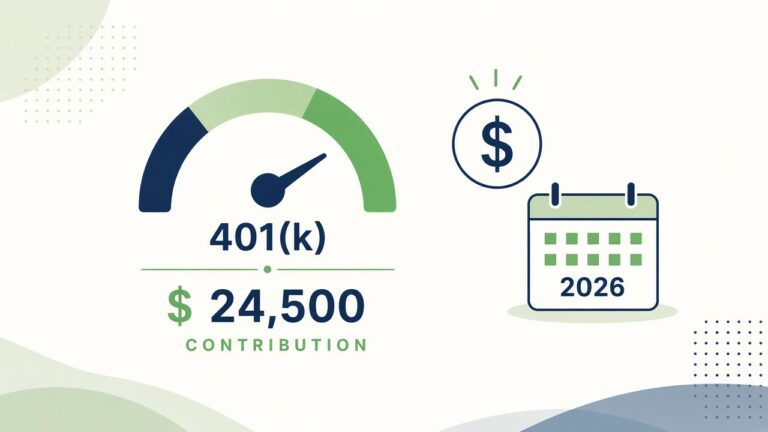
If you also have a workplace plan, the 401(k) limit is separate. For 2026 it’s $24,500 in employee deferrals. Our 401(k) contribution limits guide covers that side, and 401(k) vs IRA explains which account should get your next dollar.
What counts as MAGI for Roth IRA purposes
The income test doesn’t use your salary or your taxable income. It uses modified adjusted gross income for Roth IRA purposes, which the IRS walks through on Worksheet 2-1 in Publication 590-A. In plain terms:
- Start with your AGI from Form 1040. That already reflects pre-tax 401(k), 403(b) and 457(b) deferrals, HSA contributions, and some self-employment deductions.
- Subtract any income from converting a traditional IRA to a Roth IRA, and any rollover from a workplace plan into a Roth IRA. Conversion income doesn’t count against you here.
- Add back any deductible traditional IRA contribution you claimed.
- Add back the student loan interest deduction.
- Add back any foreign earned income exclusion, foreign housing exclusion, or foreign housing deduction (Form 2555). This matters a lot for Americans living abroad.
- Add back excludable savings bond interest (Form 8815) and excluded employer-provided adoption benefits (Form 8839).
The result is your Roth MAGI. If you want a rough starting point before running the worksheet, our AGI calculator gets you to step 1.
Legitimate ways to lower MAGI before year-end
- Increase pre-tax 401(k) or 403(b) deferrals. Every pre-tax dollar lowers AGI. Someone at $160,000 who adds $8,000 of pre-tax deferrals drops to $152,000, under the $153,000 line, and qualifies for the full Roth amount.
- Fund an HSA. HSA contributions reduce AGI if you have an HSA-eligible health plan. See the HSA contribution limits for 2026.
- Self-employed retirement contributions. SEP IRA or solo 401(k) deductions reduce AGI.
- Watch capital gains. Realized gains raise AGI. If you’re near a threshold, timing a sale into January can matter. Our capital gains tax brackets guide explains how gains stack on top of ordinary income.
- What doesn’t help: a deductible traditional IRA contribution, because it’s added back in step 3.

How the Roth IRA phase-out math works (with 2026 examples)
If your MAGI lands inside the phase-out range, the IRS reduces your limit in proportion to how far into the range you are. Using IRS Worksheet 2-2 with the 2026 thresholds:
- Subtract the start of your range from your MAGI ($153,000 single or head of household, $242,000 joint, $0 for married filing separately and lived together).
- Divide by the width of the range ($15,000 single, $10,000 joint or married filing separately). Round to at least three decimal places.
- Multiply that decimal by your full limit ($7,500, or $8,600 if 50+, or your compensation if it’s lower).
- Subtract the result from your full limit.
- Round up to the next $10. If the result is above $0 but less than $200, your limit is $200.
Example 1: single, age 35, MAGI $160,000
- $160,000 minus $153,000 = $7,000
- $7,000 divided by $15,000 = 0.467
- 0.467 times $7,500 = $3,502.50
- $7,500 minus $3,502.50 = $3,997.50, rounded up to $4,000
Example 2: single, age 52, MAGI $160,000
- Same 0.467 ratio
- 0.467 times $8,600 = $4,016.20
- $8,600 minus $4,016.20 = $4,583.80, rounded up to $4,590
Example 3: married filing jointly, both age 45, MAGI $246,500
- $246,500 minus $242,000 = $4,500
- $4,500 divided by $10,000 = 0.450
- 0.450 times $7,500 = $3,375
- $7,500 minus $3,375 = $4,125, rounded up to $4,130 each, so up to $8,260 for the couple
Example 4: single, MAGI $167,800 (just under the ceiling)
- $14,800 divided by $15,000 = 0.987
- 0.987 times $7,500 = $7,402.50
- $7,500 minus $7,402.50 = $97.50, which rounds up to $100. That is above $0 but under $200, so the limit is $200
Example 5: married filing separately, lived together, MAGI $6,000
- $6,000 divided by $10,000 = 0.600
- 0.600 times $7,500 = $4,500
- $7,500 minus $4,500 = $3,000
If you also put money into a traditional IRA for the same year, subtract that from your reduced Roth limit too, because the IRA limit is shared.

Special situations that change your answer
Married filing separately
- If you lived with your spouse at any point in the year, you get the $0 to $10,000 range, which rules out a direct Roth contribution for almost anyone with a job.
- If you didn’t live with your spouse at any time during the year, the IRS treats you as single for this test and you use the $153,000 to $168,000 range.
Spousal Roth IRA
- A spouse with little or no earned income can still contribute to their own Roth IRA, based on the working spouse’s compensation, if you file jointly.
- Each spouse can contribute up to the full limit as long as your combined compensation covers both contributions and your joint MAGI is under $242,000 (reduced between $242,000 and $252,000).
Roth 401(k), Roth 403(b) and Roth 457(b)
- Designated Roth accounts inside workplace plans have no income limit. A high earner who can’t touch a Roth IRA can usually still make Roth 401(k) deferrals up to the 2026 limit of $24,500.
- Starting in 2026, if your prior-year FICA wages from that employer exceeded $150,000, any catch-up contributions you make must go in as Roth (the threshold in IRS Notice 2025-67, up from $145,000).
529-to-Roth IRA rollovers
- Since 2024, a 529 beneficiary can move up to a $35,000 lifetime total from a 529 account open more than 15 years into their own Roth IRA, subject to the annual IRA limit and other rules in Publication 590-A.
Self-employed or variable income
- Your MAGI isn’t known until the year ends. Many people with bonuses, commissions or business income wait until after December 31, when the number is clearer, and contribute before April 15, 2027.
Saver’s Credit (the opposite end of the income range)
- Lower earners may also get a tax credit for Roth IRA contributions. For 2026, the AGI limits are $80,500 for joint filers, $60,375 for head of household and $40,250 for other filers (IRS Notice 2025-67).
What happens if you contribute too much
Contributing when you earn too much is common, especially after an unexpected bonus or capital gain. The IRS treats it as an excess contribution, and a 6% excise tax applies each year the excess stays in the account. You have several ways to fix it:
- Withdraw the excess plus its earnings by the due date of your return, including extensions. For a 2026 contribution that generally means October 15, 2027, if you extend or if you file on time (Publication 590-A allows a corrective withdrawal within six months of the original due date for timely filers). Done in time, the 6% tax doesn’t apply. The earnings are taxable, but the 10% early-withdrawal tax no longer applies to earnings withdrawn by that deadline.
- Recharacterize the contribution as a traditional IRA contribution by the due date, including extensions. The money and its earnings move to a traditional IRA and are treated as if they went there in the first place. This is often the first step of a backdoor Roth.
- Apply the excess to a later year if you’ll have unused room then. The 6% tax still applies for each year the excess sits there uncorrected.
- Report it on Form 5329 if you owe the 6% tax.
Tell your IRA provider which fix you want. They calculate the earnings on the excess and issue the correct tax forms.

The backdoor Roth IRA: how high earners still get in
If your MAGI is above $168,000 (single) or $252,000 (joint), the backdoor Roth IRA is the common workaround. It works because traditional IRA contributions have no income limit (only the deduction phases out) and Roth conversions have no income limit either.
How it works
- Make a nondeductible contribution to a traditional IRA, up to $7,500 (or $8,600 if 50+).
- Convert that traditional IRA balance to your Roth IRA. Many people convert soon after, so there’s little or no growth to tax.
- File Form 8606 with your tax return to record the nondeductible basis and the conversion. Skipping it can mean paying tax twice, and there’s a $50 penalty for a required Form 8606 you don’t file.
The pro-rata rule is the big catch
- When you convert, the IRS doesn’t let you pick only the after-tax dollars. Form 8606 figures the taxable share using the combined value of all your traditional, SEP and SIMPLE IRAs on December 31 of the conversion year.
- Example: you have $92,500 of old pre-tax rollover money in a traditional IRA and add $7,500 nondeductible. Only 7.5% of any conversion is tax-free, so converting $7,500 makes about $6,940 taxable.
- A common fix is rolling pre-tax IRA money into your current employer’s 401(k) before year-end, if the plan accepts roll-ins. Workplace plan balances don’t count in the pro-rata math.
- Your spouse’s IRAs don’t count toward your calculation. Each spouse runs their own Form 8606.
Other things to know
- Converted amounts have their own five-year clock for the 10% early-withdrawal penalty if you’re under 59½ (IRS Publication 590-B), separate from the five-year rule for tax-free earnings.
- Some 401(k) plans allow after-tax contributions with in-plan Roth conversions, sometimes called a “mega backdoor Roth.” It depends entirely on your plan document.
Roth IRA vs other options if you’re over the limit
If you can’t contribute directly, here’s a practical order many high earners think through:
- Capture any employer match in your 401(k) first. It’s an instant return.
- Use the Roth 401(k) if you want Roth money and your plan offers it, since there’s no income limit.
- Consider a backdoor Roth IRA if you have no (or very small) pre-tax IRA balances.
- Fund an HSA if you’re eligible. It’s often the most tax-efficient account available.
- Invest in a taxable brokerage account with tax-efficient index funds, for example a simple three-fund portfolio. See index fund vs ETF for which wrapper tends to be more tax-efficient.
For a deeper look at whether Roth or pre-tax money fits your situation, read Roth IRA vs Traditional IRA. Once you’ve picked the account, the next decision is what to hold inside it: our asset allocation by age guide and the S&P 500 investing guide are good next steps.
Why the Roth IRA is worth the effort
Income limits make the Roth IRA feel exclusive, but the payoff is why people work around them:
- Tax-free qualified withdrawals. After age 59½ and once the account has met the five-year rule, withdrawals of earnings are tax-free.
- No required minimum distributions for the original owner, unlike traditional IRAs and many workplace accounts.
- Flexible contributions. Regular contributions (not earnings) can come out at any time without tax or penalty, which is why some early retirees treat Roth contributions as a backstop. See our FIRE movement guide.
- Tax diversification. Having Roth, pre-tax and taxable money gives you more control over your taxable income in retirement, which matters if you’re planning a withdrawal strategy like the one in why the 4% rule may no longer be enough.
Time in the account matters most. Our compound interest calculator shows how much an extra $7,500 a year can grow over a few decades.
Year-end checklist for the 2026 Roth IRA
- Estimate your 2026 MAGI now, including bonuses, capital gains and any side income.
- If you’re near a threshold, consider raising pre-tax 401(k) deferrals or HSA contributions before your final paychecks.
- If you already contributed and may be over, wait for your final numbers, then withdraw or recharacterize before the deadline.
- If you’re clearly over, decide on the backdoor route and check your December 31 traditional IRA balances for pro-rata exposure.
- Remember the deadline: 2026 contributions are allowed until April 15, 2027.
- Watch for 2027 numbers. As of October 21, 2026, the IRS hasn’t announced the 2027 IRA limits or Roth income ranges. They usually arrive in the fall in the annual retirement-plan cost-of-living notice. The 2026 figures came out on November 13, 2025.
Frequently asked questions
What is the Roth IRA income limit for 2026?
For 2026, single filers and heads of household can make a full contribution with MAGI under $153,000, a reduced contribution between $153,000 and $168,000, and no direct contribution at $168,000 or more. Married couples filing jointly get the full amount under $242,000, a reduced amount between $242,000 and $252,000, and nothing directly at $252,000 or more.
What is the Roth IRA income limit for married filing jointly in 2026?
The 2026 phase-out for married filing jointly is $242,000 to $252,000 of MAGI. Below $242,000, each spouse can contribute up to $7,500 ($8,600 if 50+), provided combined compensation covers both contributions.
How much can I contribute to a Roth IRA in 2026?
Up to $7,500, or $8,600 if you’re 50 or older by the end of 2026. That limit is shared with any traditional IRA contributions, can’t exceed your taxable compensation, and is reduced if your MAGI falls inside the phase-out range.
Is the Roth IRA income limit based on gross income or AGI?
Neither exactly. It’s based on modified AGI for Roth IRA purposes, which starts with your AGI, removes Roth conversion income, and adds back items such as the traditional IRA deduction, the student loan interest deduction and the foreign earned income exclusion.
What happens if I contribute to a Roth IRA and my income is too high?
The amount over your limit is an excess contribution. It’s subject to a 6% excise tax for every year it stays in the account, unless you withdraw it with its earnings or recharacterize it to a traditional IRA by your tax-filing deadline, including extensions.
Is the backdoor Roth IRA legal?
Yes. A nondeductible traditional IRA contribution followed by a Roth conversion uses two features the law allows: traditional IRA contributions and Roth conversions have no income limit. You must report it on Form 8606, and the pro-rata rule can make part of the conversion taxable if you hold other pre-tax IRA money.
Does a Roth 401(k) have income limits?
No. Roth 401(k), Roth 403(b) and Roth 457(b) contributions have no income limit. For 2026, the employee deferral limit is $24,500, and workers whose prior-year FICA wages from the employer topped $150,000 must make any catch-up contributions as Roth.
When will the IRS announce the 2027 Roth IRA income limits?
The IRS hasn’t released 2027 figures as of October 21, 2026. It usually publishes them in the fall in its annual cost-of-living notice for retirement plans. The 2026 limits were announced on November 13, 2025, in Notice 2025-67 and news release IR-2025-111. We’ll update this guide when the official numbers are out.
Bottom line
For 2026, the Roth IRA is fully open to single filers under $153,000 of MAGI and joint filers under $242,000, partly open up to $168,000 and $252,000, and closed to direct contributions above that. If you’re in the phase-out, run the worksheet math rather than guessing. If you’re over, a Roth 401(k) or a properly reported backdoor Roth can still get money into Roth accounts. Either way, the deadline for 2026 contributions is April 15, 2027.
Sources: IRS Notice 2025-67; IRS news release IR-2025-111 (Nov. 13, 2025); IRS Publication 590-A (Contributions to IRAs), Worksheets 2-1 and 2-2; IRS Publication 590-B (Distributions from IRAs); Instructions for Form 8606. This article is for education only and isn’t tax, legal or investment advice.
Keep learning: courses on this topic
Self-paced courses to put this article into practice.
 Udemy
Complete Personal Finance Course: Earn, Save and Invest
A self-paced video course on budgeting, saving and investing, with practical lessons you can apply right away.
View course
 Udemy
Get Out of Debt, SAVE, Increase Wealth, Invest In The Future
Personal Finance, Investing, and Retirement: Get Out of Debt & Get Your Money to Work For You. Do you work hard for your money? Get your…
View course
 Udemy
Achieve Your Financial Goals By Learning To Invest
Designed for beginners, this course contains all you need to know about investing in stocks within 3 hours. Imagine exchanging $50 for the…
View course


Leave a Comment