
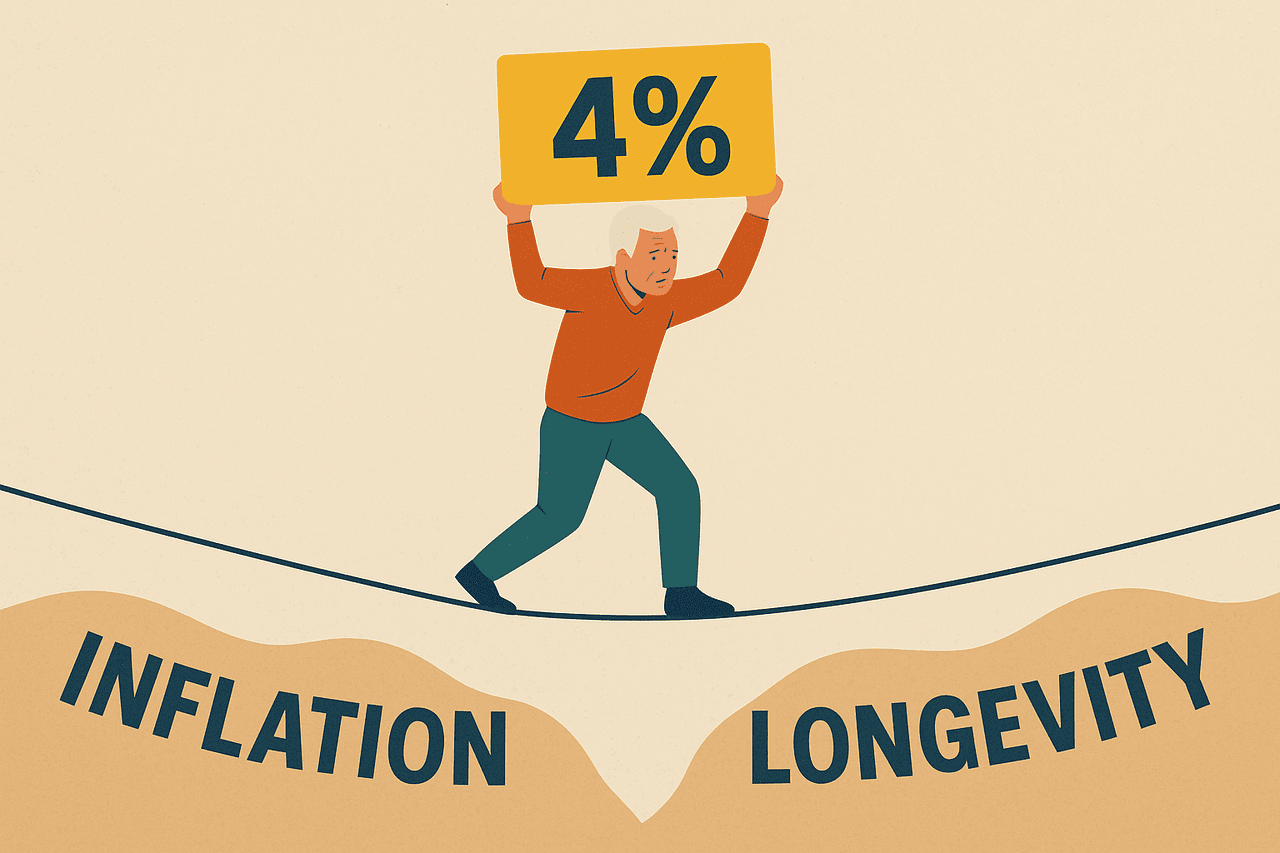
The “4% rule” is one of the most well-known rules in personal finance. It tells you that you should only withdraw 4% of your investment portfolio balance in your first year of retirement. Then, in each subsequent year, you should withdraw that same amount (adjusted for inflation).
If you follow this rule, you should never outlive your savings (according to the creators of the rule, anyway). For example, let’s say you have a million dollars in retirement savings when you retire. Your 4% withdrawal rate would be $40,000 per year. In the second year of retirement, if inflation was 3%, you would increase that withdrawal to $41,200. You would continue to increase your annual withdrawal by inflation each year.
The problem with that? It assumes that the “4%” number is the golden ticket to an immortal retirement portfolio.
The truth is, that number (and the old 4% rule in general) might not be sustainable in today’s environment of lower bond yields, longer lifespans, and different market/sequence of returns dynamics.
Here are some reasons the old 4% rule might fail and what to do instead…
Why the 4% Rule Probably Won’t Work Anymore
We’re Living Longer
First, life expectancy is going up every year. When the 4% rule was originally conceived by Bengen, the life expectancy for a 65-year-old in the US was around 83 years. Now, it’s closer to 86-88 for women and 83-85 for men.
The reason this matters is that it means retirement could easily last 30–40 years, not 25 like in Bengen’s era. If you are retiring early at age 55 or 60, you may even need your money to last for 50 years. A fixed withdrawal rate like 4% that is just adjusted for inflation each year could run out well before you’re ready to “retire from retirement”.
Interest Rates and Bond Yields Are Historically Low
In the 1990s, long-term US Treasury bonds were paying around 6-8% in annual yield. For retirees who wanted safe income, that made bonds and CDs an attractive foundation.
Today, with long-term yields around 4-5% even after the Fed’s recent rate hikes, that foundation is much weaker. Add in the fact that inflation is a major headwind to any return.
The problem with that? The original 4% rule was predicated on a balanced portfolio of 60% stocks/40% bonds. With bonds yielding so much less than they did 30 years ago, overall portfolio returns are projected to be lower in future decades. That means a 4% withdrawal rate is more dangerous because returns will be lower.
Sequence of Returns Risk Is Much More Prevalent
You can have two retirees that both earn the same average market return over 30 years of retirement. But if one of them gets bad market returns early on, they are very likely to run out of money much earlier—despite having the same 30-year average return as their peer.
This is called “sequence of returns risk” and it’s a major problem with a static rule that doesn’t account for bad market timing. If you’re very unlucky and retire right before a bear market (2008, 2022) that sequence of poor returns early on can permanently crater your portfolio.
Inflation Is Less Predictable
Historically, inflation was relatively stable and low. Bengen’s study accounted for that. In the 2020s, we’ve had periods where inflation spiked quickly and stayed high. Even moderate inflation of 3–4% per year compounds like gangbusters over 30 years.
If you increase your withdrawals by a fixed rate of inflation every year, you might drain your portfolio too soon, especially if returns don’t match up.
Spending Is Not Linear
In real life, most people don’t spend a perfectly smooth 4% of their portfolio every year. As people age, certain categories of spending go down (travel, big-ticket purchases) while others can go up (healthcare, adult care).
The old 4% rule doesn’t really account for this changing spending profile in retirement. It assumes a fixed, inflation-adjusted withdrawal each year.
How to Adapt the 4% Rule for 2026
OK, so if the old school 4% rule might not be safe anymore, what do you do? Here are a few modern adaptations to make your retirement savings last as long as you do…
Switch to a Dynamic Withdrawal Strategy
Instead of a fixed percentage inflation-adjusted withdrawal every year, use a dynamic or adaptive withdrawal strategy that adjusts based on portfolio performance.
Some popular strategies:
- Guardrails Method (aka Guyton-Klinger Rule): This method sets a target withdrawal rate (say 4%) but increases your spending only when your portfolio has grown above a certain threshold. If it falls, you slightly reduce spending instead. This helps smooth out bad years and extend portfolio life.
- Percentage-Based Rule: Instead of an inflation-adjusted withdrawal each year, you simply take a fixed percentage of your current portfolio value each year. For example, if your portfolio value drops in a down market, your withdrawal amount goes down too. This gives you flexibility but your income will fluctuate more.
These dynamic, portfolio-adjusted strategies help hedge against sequence risk and market downturns.
Lower Your Starting Withdrawal Rate
Many financial planners these days recommend a lower starting withdrawal rate of 3–3.5% instead of 4%. If you have a 3.5% rate and retire at age 60 with $1 million, that means $35,000 per year instead of $40,000.
It’s not as exciting, but that small change massively improves the odds your money will last 30-40 years, especially if you retire early or into a weaker market.
If markets surge and your portfolio grows more than expected, you can always increase the withdrawal rate later. It’s easier to start conservatively then loosen the purse strings later than the other way around.
Diversify Your Portfolio Beyond the Old 60/40
The 60/40 split of 60% US large-cap stocks and 40% bonds is still a good starting point for most investors. But it’s not bulletproof.
To get better risk-adjusted returns, consider diversifying your portfolio more:
- Real assets like REITs, infrastructure, commodities to hedge against inflation.
- Dividend growth stocks to provide income with rising payouts over time.
- International/global equities to diversify out of US markets.
Even a small allocation to alternative assets like private credit or even Bitcoin can act as a long-term hedge against dollar inflation.
The key is to create multiple sources of return so your portfolio isn’t dependent on US large caps and bonds alone.
Use a Bucket Strategy
Another approach is to divide your portfolio into “buckets” based on time horizon:
- Bucket 1: 1–3 years of living expenses in cash or short-term bonds
- Bucket 2: 3–10 years in income-focused investments like bond funds and dividend stocks
- Bucket 3: 10+ years in growth assets like equities
If the market falls, you tap into your cash bucket for expenses instead of selling investments at a loss. This lets the long-term portion of your portfolio recover while your spending is insulated from volatility.
Delay Social Security (if Possible)
Delaying Social Security for as long as possible (age 70 if you can afford it) effectively increases your “safe withdrawal rate” because you need less from your investment portfolio. Pair that with this year’s Social Security COLA when you update the guaranteed-income floor in your withdrawal plan.
For example, in the US, each year you delay past your full retirement age (66 or 67) increases your Social Security payment by 8% per year. By delaying benefits until age 70, you can boost monthly checks by 30-40% for life.
If you have part-time work income or are willing to spend down savings initially, delaying benefits as long as possible is one of the best things you can do to “raise” your sustainable withdrawal rate.
Build Flexibility Into Your Spending Plans
One of the most valuable financial independence hacks is not hitting a fixed target number. It’s flexibility.
Plan for a “core” budget that covers the essentials (housing, food, healthcare). Then, budget for a “discretionary” bucket for travel, hobbies, dining, etc.
In a down market, cut back on discretionary spending to protect core expenses. In a booming market, let that extra spending money flow freely.
Spending flexibility is one of the most powerful levers you have to extend portfolio longevity without sacrificing happiness.
Healthcare Costs Are Wildly Inflationary
If you’re retiring in the US, healthcare costs should be a major concern. Health care inflation is much higher than general inflation. Even a healthy US couple retiring today can expect to spend over $300,000 on medical expenses in retirement.
You should plan for this major uncertainty and consider:
- Health savings accounts (HSAs) if you’re eligible.
- Medigap/supplemental insurance.
- Long-term care insurance—or at least a self-insurance strategy (setting aside assets specifically for long-term care).
These rising healthcare costs should be planned for in detail on their own outside the 4% rule.
Tax Matters: Withdraw Smartly
Taxation matters as much as how much you withdraw. By sequencing tax-deferred accounts (401k, traditional IRA), taxable brokerage accounts, and Roth accounts, you can smooth your effective tax rate on withdrawals over time.
For example, in low-income years like early retirement, you might do Roth conversions from your traditional IRA to take advantage of a lower tax bracket and “smooth” out your tax burden.
Tax-efficient withdrawal sequencing is one of the most important levers to improve your after-tax income.
A 3.5% or 4% withdrawal rate can stretch a lot further when taxes are managed well.
Adjust Your Plan Annually, Not Once
Retirement planning is not a one-time decision. Revisit your plan each year to:
- Review your actual spending vs. targets.
- Monitor portfolio performance and asset allocations.
- Adjust your withdrawal rate if needed.
Even small course corrections (trimming spending by 5% during a bad year) can add years of portfolio longevity.
Partially Annuitize for Longevity Protection
If longevity risk (outliving your assets) is a concern, consider buying a small annuity.
This means using part of your portfolio to purchase a deferred income annuity that starts at a certain age (say age 80). You now have guaranteed lifetime income from the annuity, which means your other assets can be drawn down more aggressively in the early years.
It’s not for everyone, but buying a partial annuity can be an effective hedge against longevity risk.
Example: Let’s Run the Numbers
To see how these ideas play out in real life, let’s run through an example.Say you have two retirees—Sarah and James.
Sarah follows the traditional 4% rule:
- Starts with $1 million, withdraws $40,000 in year 1.
- Each year, Sarah increases that by inflation (say 3%).
James uses a flexible 3.5% rule with guardrails:
- Starts with $1 million, withdraws $35,000 in year 1.
- In bad years when the portfolio drops, James cuts spending by 10%.
- In good years, he increases spending only when the portfolio exceeds a certain threshold.
Over 30 years:
- Sarah’s portfolio is gone in year 29 if real returns are 5%.
- James has nearly $300,000 left in the bank even though he spent less in early years.
Power of flexibility
Let’s look at what the research says now…
Morningstar also took a look at the 4% rule and came to a similar conclusion in 2023. Based on lower future returns, their new research showed a sustainable withdrawal rate of around 3.3% for 30 years of retirement.
That’s assuming a 60% stock, 40% bond portfolio, like Bengen did. With a higher equity weighting and more flexible spending adjustments, you can push that closer to 3.8-4%.
Bengen himself has also adjusted his recommendation based on new data. He now thinks 4.7% is sustainable with a portfolio that includes small-cap stocks and tweaks the asset mix. The key takeaways?
It’s not one single number anymore. Your withdrawal rate depends on your portfolio allocation and how flexible you are willing to be in spending.
Summary: The 4% Rule Is a Framework, Not a Fixed Plan
The 4% rule was revolutionary when it was introduced. It’s still a great mental benchmark for estimating your retirement number. But it’s no longer a guarantee.
In a world of longer lifespans, more market volatility, and more unpredictable inflation, you need to be flexible and adjust as needed. The “new normal” may be:
- A 3–3.5% initial withdrawal rate,
- Coupled with dynamic spending adjustments,
- Invested in diversified, inflation-protected assets.
Retirement success is less about following a fixed formula and more about staying adaptable.
Plan conservatively, but be willing to spend flexibly. Review and adjust your plan every year, not just at the beginning.
Keep learning: courses on this topic
Self-paced courses to put this article into practice.
 Udemy
Invest Like a Pro: Your First Steps in Wealth Creation
A self-paced video course on budgeting, saving and investing and investing basics, with practical lessons you can apply right away.
View course
 Udemy
Get Out of Debt, SAVE, Increase Wealth, Invest In The Future
Personal Finance, Investing, and Retirement: Get Out of Debt & Get Your Money to Work For You. Do you work hard for your money? Get your…
View course
 Udemy
The Complete Personal Finance Course: Save, Budget & Invest
Take control of your money with a practical, step-by-step guide to personal finance, budgeting, saving, investing, debt management, and…
View course



Leave a Comment