

If you are planning retirement income in the United States, one of the first Social Security questions that comes up is deceptively simple: When do I get my full benefit? The answer is not “65 for everyone” anymore — and it is not the same as Medicare eligibility either.
Quick answer: Your Social Security full retirement age (FRA) — also called normal retirement age (NRA) — is the age at which you can claim retirement benefits equal to your full primary insurance amount, before any early-claim reduction or delayed-retirement increase. FRA depends on year of birth. For people born in 1960 or later, FRA is 67. You can still claim as early as age 62 (with a permanent reduction) or delay past FRA up to age 70 (with delayed retirement credits). Look up your birth year in the list below, then confirm your personal estimate in a my Social Security account.
This guide walks through the official birth-year FRA chart, why the age rose, how claiming at 62 vs FRA vs 70 changes benefits (using Social Security Administration examples), the January 1 birthday quirk, a light note on spouses and survivors, the important FRA vs Medicare age 65 distinction, and practical planning tips for US readers.
This is general education for a US audience — not Social Security, tax, legal, or financial advice. Benefit rules are complex; confirm your record, eligibility, and amounts with the Social Security Administration (SSA) or a qualified professional before you claim.
What full retirement age actually means
Full retirement age is the benchmark age SSA uses to pay your unreduced retired-worker benefit (before rounding). Claim earlier than FRA and SSA permanently reduces the monthly amount. Claim after FRA (up through age 70) and you can earn delayed retirement credits that raise the monthly amount.
A few framing points that save people confusion later:
- FRA is based on year of birth, not on when you “feel” ready to retire or when you leave a job.
- The earliest age for retirement benefits is still generally 62, even though FRA is higher than it used to be.
- Delaying past FRA can increase the benefit through age 70; waiting past 70 does not keep adding delayed retirement credits.
- FRA is not the same as Medicare eligibility at 65 (more on that below).
- Your exact monthly check also depends on your earnings history, work credits, and when you file — the FRA chart alone does not set the dollar amount.
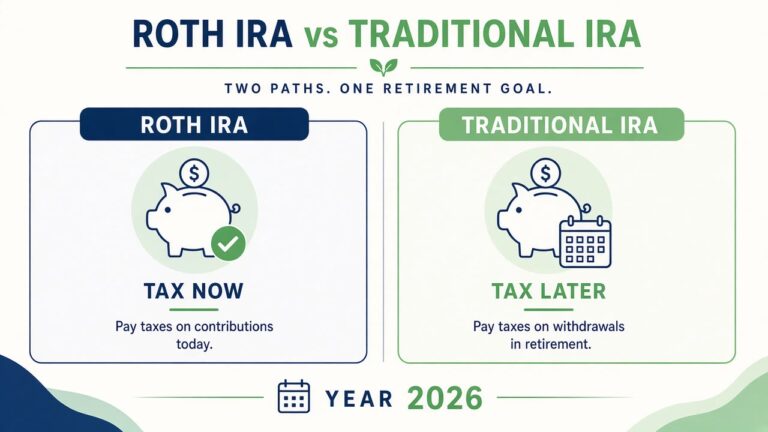
If you are building retirement income alongside tax-advantaged accounts, it can help to see Social Security as one pillar next to vehicles like a Roth or Traditional IRA and healthcare planning tools such as an HSA — but the claiming-age decision for Social Security is its own math problem.
Social Security retirement age chart by year of birth
SSA publishes the official schedule of normal / full retirement ages. Use your year of birth (with the January 1 note later in this article):
Born 1937 or earlier
- Full retirement age: 65
Born 1938
- Full retirement age: 65 and 2 months
Born 1939
- Full retirement age: 65 and 4 months
Born 1940
- Full retirement age: 65 and 6 months
Born 1941
- Full retirement age: 65 and 8 months
Born 1942
- Full retirement age: 65 and 10 months
Born 1943 through 1954
- Full retirement age: 66
Born 1955
- Full retirement age: 66 and 2 months
Born 1956
- Full retirement age: 66 and 4 months
Born 1957
- Full retirement age: 66 and 6 months
Born 1958
- Full retirement age: 66 and 8 months
Born 1959
- Full retirement age: 66 and 10 months
Born 1960 or later
- Full retirement age: 67
Source: SSA Office of the Chief Actuary, Normal Retirement Age; see also SSA’s retirement planner page on the age increase.
For most readers under about age 66 today, the practical takeaway is simple: your FRA is 66-and-some-months or 67, not the “classic” age 65 that older generations grew up hearing about.
Why full retirement age rose
Congress raised the normal retirement age in the 1983 Social Security Amendments as longevity increased and the program needed longer-run financing adjustments. The change phased FRA upward from 65 toward 67 by birth year — which is why the chart steps in two-month increments for certain years, then plateaus (for example at 66 for the 1943–1954 cohort), then steps again toward 67 for 1960 and later.
That history matters for planning because:
- Many workplace materials, older articles, and casual conversation still say “Social Security at 65.”
- Medicare still generally starts at 65, so people often assume Social Security full benefits start then too — they do not, for later birth years.
- The earliest claim age stayed at 62, so the gap between early claiming and FRA got wider for younger cohorts, which means a larger early-claim reduction if you start at 62 with FRA of 67.
In other words: the rules shifted gradually, but the marketing phrase “retire at 65” never fully caught up.
Claiming at 62 vs FRA vs delaying to 70
Think of three broad claiming windows. The right choice depends on cash-flow needs, health and longevity expectations, other income, spousal strategy, and whether you will keep working — not on a one-size slogan.
Claiming at age 62 (earliest retirement benefits)
- You can generally start retirement benefits as early as age 62.
- Starting before FRA permanently reduces the monthly benefit.
- For workers born 1960 or later (FRA 67), SSA’s illustrative chart shows that claiming at 62 reduces a $1,000 full-retirement-age benefit to about $700 — roughly a 30% reduction.
- For comparison, workers born 1943–1954 (FRA 66) see that same $1,000 example reduced to about $750 at age 62 (about 25%).
- Spouse benefits (up to 50% of the worker’s FRA benefit if claimed at the spouse’s own FRA) are reduced further if the spouse claims early; in SSA’s $1,000-worker example, a spouse benefit that would be $500 at FRA can fall to about $325 at age 62 for the 1960-and-later cohort.
Source: SSA Retirement Age and Benefit Reduction (illustrative $1,000 / $500 examples).
Early claiming can still be rational if you need the income, have shorter life expectancy, or are coordinating household cash flow — but treat the reduction as permanent, not a temporary bridge you later “catch up” by waiting.
Claiming at full retirement age
- At FRA, you generally receive your unreduced retired-worker benefit (subject to rounding and your actual earnings record).
- For many people this is the clean “full benefit” reference point on SSA statements and estimators.
- FRA is also a key switch for working while claiming: the retirement earnings test that can withhold benefits for some early claimers no longer applies in the same way once you reach FRA (rules are detailed on SSA’s site — check current earnings-test thresholds if you plan to work and claim before FRA).
Delaying past FRA up to age 70
- If you wait past FRA, you can earn delayed retirement credits.
- For people born in 1943 or later, the credit is 8% per year, or 2/3 of 1% for each month you delay after FRA, through age 70.
- Credits stop accumulating at 70 — waiting longer does not keep increasing the delayed-retirement percentage.
- For someone with FRA of 67 (born 1960 or later), delaying all the way to 70 is three years of credits: about 24% above the FRA benefit (SSA actuarial tables show age-70 benefits at 124% of the primary insurance amount for that cohort).
Source: SSA Delayed Retirement Credits; SSA Office of the Chief Actuary early/delayed retirement percentages.
Intuition checklist (worker benefit, FRA 67 cohort):
- Age 62: about 70% of the FRA benefit in SSA’s chart example ($1,000 → ~$700)
- Age 67 (FRA): 100% of the FRA benefit reference
- Age 70: about 124% of the FRA benefit if delayed retirement credits fully apply
Your real dollars will differ — use the $1,000 example only as a scale model, not as your predicted check.
January 1 birthdays and month-of-birth nuances
Two SSA administrative quirks catch people off guard:
- January 1 birthdays: Persons born on January 1 of any year should refer to the previous year’s FRA (and related early/delayed percentages). SSA notes this on the normal retirement age table.
- Born on the 1st of a month: For benefit and FRA figuring, SSA may treat a 1st-of-month birthday as if it fell in the previous month (and a January 1 birthday as if it fell in December of the previous year). You also generally must be at least 62 for the entire month to receive benefits for that month.
If your birthday sits on a month boundary, do not rely on a napkin calculation — verify in my Social Security or with SSA directly.
Spouses and survivors (high-level only)
Household claiming strategy can matter as much as the worker’s own FRA:
- A spouse may be eligible for a benefit based on the worker’s record — generally up to 50% of the worker’s FRA benefit if claimed at the spouse’s own full retirement age, and less if claimed early.
- Survivor (widow/widower) rules use related but not identical age schedules. SSA notes that for certain early-survivor entitlement calculations, widows and widowers may need to add two years to the birth year shown on the standard retiree NRA table when determining reductions — survivor FRA charts can differ from the retired-worker chart.
- Coordinating two claiming ages, survivor protection, and other income is one of the densest parts of Social Security planning. This article stays at the overview level on purpose.
If Social Security will be a large share of household income, get personalized estimates for both spouses before locking in an early claim.
FRA is not Medicare age 65
This distinction deserves its own headline because it trips up so many US retirees:
- Medicare eligibility for most people still begins at age 65 (with enrollment windows that can affect premiums if missed).
- Social Security full retirement age for people born in 1960 or later is 67.
- You can enroll in Medicare at 65 even if you are still working, still delaying Social Security, or not yet at FRA.
- Conversely, claiming Social Security at 62 does not move Medicare eligibility earlier to 62.
Plan the two systems on separate calendars. Healthcare coverage gaps, IRMAA surcharges, and HSA eligibility around Medicare enrollment are their own topics — which is one reason many savers track healthcare alongside retirement accounts and FIRE-style independence planning.
How to check your personal Social Security estimate
The birth-year chart tells you when full benefits start. Your my Social Security account tells you about how much under different claiming ages.
Practical steps:
- Create or sign in at ssa.gov/myaccount.
- Review your earnings record for missing or incorrect years (fix them early — they affect your benefit calculation).
- Look at estimated benefits at 62, at FRA, and at 70.
- If you expect to keep working while claiming before FRA, read SSA’s current guidance on the retirement earnings test so you are not surprised by withholdings.
- Remember estimates assume future earnings patterns; update the account as your career changes.
Do not invent a personal benefit amount from a blog chart. The $1,000 SSA example in reduction tables is illustrative only.
Planning tips for US readers
A few practical notes that fit next to the FRA decision without turning this into a full benefits manual:
- Work credits: You generally need enough Social Security work credits (often discussed as roughly 40 quarters of coverage for retirement benefits) to qualify on your own record. Check your status in my Social Security if your work history was uneven, part-time, or included years outside covered employment.
- Working while claiming early: If you claim before FRA and keep earning above SSA’s earnings-test limits, some benefits may be withheld and recalculated later. Once you reach FRA, the monthly earnings test no longer applies in the same way.
- Taxes on benefits: Depending on combined income, a portion of Social Security benefits may be taxable at the federal level (and some states tax benefits too). Claiming age changes the size of the check; tax treatment is a separate layer.
- Other income sources: Pensions, IRA/401(k) withdrawals, Roth conversions, and part-time work change the “need cash at 62” vs “delay for a larger check” tradeoff. Social Security claiming should sit inside the whole retirement-income plan, not in isolation.
- Health and longevity: Delayed credits help most if you expect a longer claiming period; early claiming may fit better if you need income now or have serious health concerns. There is no universal winner.
- Do not confuse COLAs with claiming strategy: Cost-of-living adjustments adjust benefits over time; they are not a substitute for understanding FRA reductions and delayed credits. See the 2027 Social Security COLA for this year’s percentage, the Medicare and tax side effects, and when the raise shows up.
FAQ: Social Security full retirement age
What is Social Security full retirement age? It is the age at which you can receive your full retired-worker benefit (your primary insurance amount, before early reduction or delayed credits). SSA also calls it normal retirement age.
What is my Social Security retirement age if I was born in 1960 or later? 67.
Can I still claim at 62? Yes, generally — but the benefit is permanently reduced. For FRA 67, SSA’s chart example shows about a 30% reduction versus the FRA amount.
Is full retirement age the same as Medicare age? No. Medicare eligibility is still generally 65 for most people. FRA can be 66, 66 and some months, or 67 depending on birth year.
Do delayed retirement credits keep growing after 70? No. For delayed retirement credits, the increase stops at age 70.
Where do I find my personal numbers? Use my Social Security for estimates based on your earnings record, and confirm rules on SSA.gov before you apply.
What if I was born on January 1? Refer to the previous year’s FRA on SSA’s chart.
Sources
- SSA Office of the Chief Actuary — Normal Retirement Age (NRA)
- SSA Benefits Planner — Retirement Age Increase
- SSA Benefits Planner — Retirement Age and Benefit Reduction (includes the illustrative $1,000 early-claim examples)
- SSA Benefits Planner — Delayed Retirement Credits
- SSA Benefits Planner — Born in 1960 or later
- SSA Office of the Chief Actuary — Early or delayed retirement percentages
- Create / manage your account — my Social Security
Verify figures on SSA.gov before making a claiming decision. Rules for spouses, survivors, disability conversions, windfall provisions, and earnings tests can change the outcome for individual situations.
Keep learning: courses on this topic
Self-paced courses to put this article into practice.
 Udemy
How to use your IRA or 401K to invest in real estate
If you are tired of trusting wall street with all of your retirement savings, come and learn about some alternative strategies to invest…
View course
 Udemy
Complete Personal Finance Course: Earn, Save and Invest
A self-paced video course on budgeting, saving and investing, with practical lessons you can apply right away.
View course
 Udemy
Get Out of Debt, SAVE, Increase Wealth, Invest In The Future
Personal Finance, Investing, and Retirement: Get Out of Debt & Get Your Money to Work For You. Do you work hard for your money? Get your…
View course



Leave a Comment