
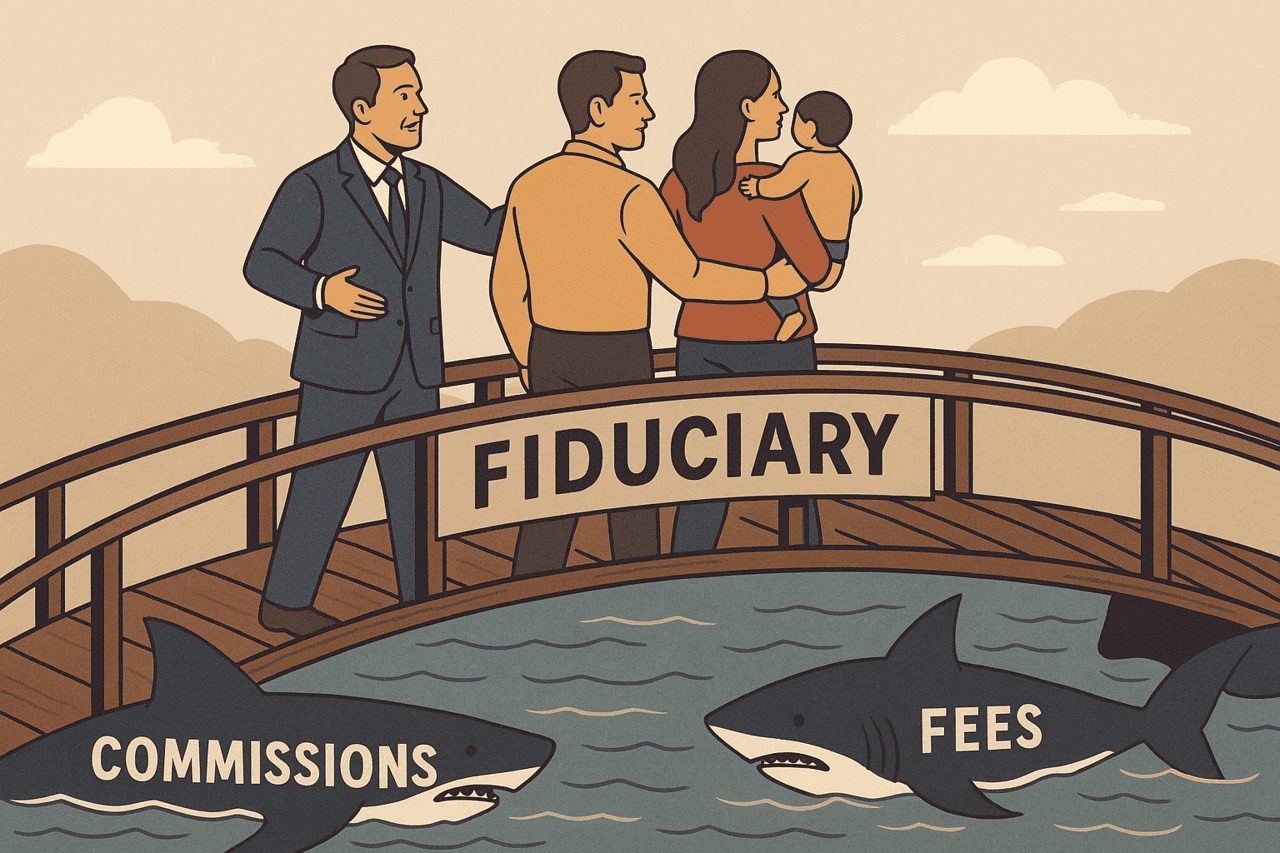
Do you get confused whenever you need to find a financial advisor? Should you trust the person at the local branch of the bank near you, the flashy Wall Street firm with a massive brand, or the independent guy operating out of his own office building? The answer is, of course, not easy for middle-class families and typical investors. Trusting the wrong person could cost you tens of thousands of dollars over the years in unnecessary fees, bad advice, and conflicts of interest.
If that doesn’t sound good to you, a fiduciary financial advisor is the place to start. The moment you step into their office, you are protected from misaligned incentives. There will be no hidden commissions when they sell you investment products. Instead, your relationship will be based on trust and transparency.
In this post, we will explain to you what a fiduciary financial advisor is. We will also show you what fiduciary duty means, how much you can expect to pay, and whether a fiduciary advisor is the right choice for you. Finally, we will take a look at real-world examples, the main pros and cons, and the fastest way to find a fiduciary financial advisor near you.
Let’s jump in.
What Is a Fiduciary Financial Advisor?
A fiduciary financial advisor is a person who is legally bound to act in the client’s best interests. That key fiduciary duty distinguishes them from other kinds of salespeople and financial advisors. Instead of a strong fiduciary duty, many other people out there will only recommend products that are “suitable” for you. That low standard allows advisors to point you toward more expensive and more complicated products that benefit them instead of you.
Most of the fiduciary advisors are fee-only financial planners, so they work only for you, not for any outside party. There will be no kickbacks or commissions and no hidden incentives. You pay your money, and they give you advice.
Example
A fiduciary advisor might recommend a low-cost index fund that matches your long-term goals and financial plan.
A non-fiduciary, commission-based advisor might sell you an expensive annuity that locks you in for a decade – not because it’s right for you, but because they earn a huge commission.
When you hire a fiduciary, you know that they will not have any other financial motivation than working for you. You know their interests are aligned with yours.
Fiduciary vs. Commission-Based
It’s important to understand how a fiduciary advisor can save you money. For example, let’s say that you walk into a couple of financial advisors’ offices with $100,000 to invest. Advisor A and Advisor B look at your money but recommend the following products:
Advisor A is a commission-based person who only works on commission. They sell you a “special” mutual fund with a 5% upfront sales charge. Before your money even hits the market, $5,000 evaporates. On top of that, the fund also charges annual expenses which may be twice as much as another no-load fund. Over the years, Advisor A is taking more of your money in hidden loads and higher expense ratios, while you get to pay for it and miss out on that money working for your retirement.
Advisor B is a fiduciary and charges a flat $2,000 for a full financial plan. They also help you get access to low-cost index funds with the lowest fees possible, advise you on the best ways to optimize your taxes, and help you understand the best ways to invest in your employer 401(k). As a result, all your money stays working for you, and you know that they are working for you.
Who would you rather choose? The advisor who sells you insurance products with higher commissions and costs? Or the advisor who is always trying to get you the best bang for your buck?
The answer should be obvious. You should hire a fiduciary financial advisor because the relationship is transparent and doesn’t include any inherent conflicts of interest. The advisor only wins when you win.
How Much a Fiduciary Advisor Charge
When you hire a fiduciary advisor, they are not going to work for free. On the other hand, there are no hidden commissions, and their way of charging is transparent. Here are the most common fee structures you will encounter:
Flat Fee
This is a set amount, usually between $1,000 to $3,000. The advisor will provide you with a detailed financial plan, which may include retirement projections, asset allocation, insurance reviews, and tax planning strategies.
Hourly Rate
Some fiduciary advisors charge by the hour, usually $150 to $400 per hour. This option works great if you need specific advice for a particular situation, such as whether to pay off your mortgage early, what to do with stock options, and so on.
Assets Under Management
Frequently, fiduciary advisors charge based on the assets they manage on your behalf. Usually, this is around 1% per year. So, if you have $250,000, then they will charge $2,500 per year.
Example
- Fiduciary with a flat fee: $2,000 per year.
- Fiduciary with an AUM fee of 1%: $2,500 per year.
- Commission-based model: $10,000 or more in upfront loads and ongoing high fees.
Even though the fiduciary advisors charge for their service, you will likely still come out on top because their model saves you money in commissions and bad products.
Who Should Hire a Fiduciary Financial Advisor?
There are plenty of people who do not need a fiduciary financial advisor just yet. However, if you belong to any of these groups, you are a good candidate to get started working with a fiduciary financial advisor.
Middle-Income Families Getting Ready for Retirement
After decades of work and saving for retirement, you want to retire and have a certain monthly income, just so you can live the life you want. Yet, there are plenty of bad financial advisors out there that will sell you expensive annuities and insurance products instead of planning for you.
Professionals with Stock Options or Equity Grants
Stock options and equity grants are a fantastic way to become wealthy, but they are also challenging to manage and are almost never included in employer-sponsored 401(k) plans. A fiduciary financial advisor will be able to help you figure out the best strategy, especially for saving on taxes.
Families Trying to Manage Debt and Investment Simultaneously
Should you pay off student loans? Should you refinance your mortgage? Or should you increase your contributions to the employer 401(k) plan? A fiduciary financial advisor will not be biased towards debt and will be able to help you figure out the math.
When it does not make sense
If you are just getting started and don’t have more than $10,000 in your savings account, you are better off using online tools such as BearSavings saving calculators and robo-advisors. When your finances become more complex, that will be a good time to start to look for a fiduciary.
Pros and Cons of Fiduciary Advisors
Pros
- Trust: They are legally obliged to act in your best interests.
- Transparency: Their fee structures are always transparent.
- No sales pressure: They are not motivated by commissions.
- Advice is personalized: The recommendations will always be based on your situation.
Cons
- Upfront fees: The costs can feel steep, especially if you are just getting started.
- Not all are equal: Fiduciary status is not a silver bullet and doesn’t mean the advisor is skilled. You need to vet them like any other financial advisor.
- Prefers wealthier clients: Some fiduciaries want to work only with wealthier people.
Real-World Examples
Case 1: Success Story in Retirement Planning
- Couple in their 40s with $300,000 in retirement accounts.
- Decision: Hired fiduciary advisor for $2,500.
- Outcome: Identified tax-loss harvesting opportunities and optimized 401(k) contributions. Projected to save the couple $40,000 over the next few years.
Case 2: Falling into the Commission Trap
- Recent college graduate with an account and their first full-time job.
- Decision: Sold a complex annuity by a commission-based advisor.
- Outcome: Locked into the product with early withdrawal penalties and high annual fees. Lost thousands and realized they were pushed into the wrong product.
The moral: fiduciary duty is not just a label on a certificate. It’s a promise that can save you from making bad financial decisions.
How to Find a Fiduciary Financial Advisor Near Me
As soon as you type fiduciary financial advisor near me into Google, you are likely to see dozens of options. While some of them may be worthy, other options are not. Instead, head to any of these sites and start your search from there:
- NAPFA (National Association of Personal Financial Advisors)
- Database of fee-only fiduciary financial advisors.
- Garrett Planning Network
- Focuses on hourly or project-based advice.
- XY Planning Network
- Focuses on younger professionals and ongoing planning.
- SmartAsset Marketplace
Tips for Choosing a Fiduciary Financial Advisor
Interview at least 2-3 candidates. Ask all of them to explain how exactly they get paid. Confirm that they are working as fiduciaries in writing. Ask about their experience and whether they like to work with clients just like you (retirees, young professionals, business owners).
Beyond Fiduciaries
We should mention that fiduciary advisors are not the only way to manage your money successfully. If you are at the beginning of your financial journey, there are more options:
- Free tools such as BearSavings, which provides daily saving tips, saving calculators, and a saving tracker
- Robo-advisors such as Betterment or Wealthfront are options that also tend to follow fiduciary duty. These are low-cost ways to invest your money. Yet, at the same time, most of them are not going to have your back for a long time.
- Combine your DIY learning with occasional fiduciary check-ins and advice. If a full-time relationship is too expensive for you.
Final Thoughts
We hope that the above examples and explanation have helped you realize what a fiduciary financial advisor is. A fiduciary is not just a money manager. Instead, when you hire a fiduciary advisor, you also hire a legal ally on your path to financial freedom.
Trust, in general, is hard to come by, let alone when it comes to managing your money. When you are on your own and make all the decisions, there are no issues, and there is no one who can really act against your interests.
When you hire a commission-based advisor, there is a significant risk that the recommendations won’t be in your best interests. When you hire a fiduciary financial advisor, all of this goes away.
If you are just getting started and don’t have more than $10,000 in savings, you don’t have to start with a fiduciary financial advisor. At the same time, once your finances become more complex, and there is a need to juggle different accounts, investment products, retirement plans, and tax-efficient ways to invest your money, then hiring a fiduciary financial advisor is one of the smartest investments you can make.
Keep learning: courses on this topic
Self-paced courses to put this article into practice.
 Udemy
Personal Finance from Zero: Budget, Save, Borrow & Invest
Money touches every day of your life, yet almost nobody is taught how it works. Where does your pay go between payday and the end of the…
View course
 Udemy
Invest Like a Pro: Your First Steps in Wealth Creation
A self-paced video course on budgeting, saving and investing and investing basics, with practical lessons you can apply right away.
View course
 Udemy
From Welfare to Wealth: Earn Online & Invest Wisely
If you're living on a low income, receiving benefits, or stuck in survival mode — this course is for you.“Financial Independence on a Low…
View course




Leave a Comment