
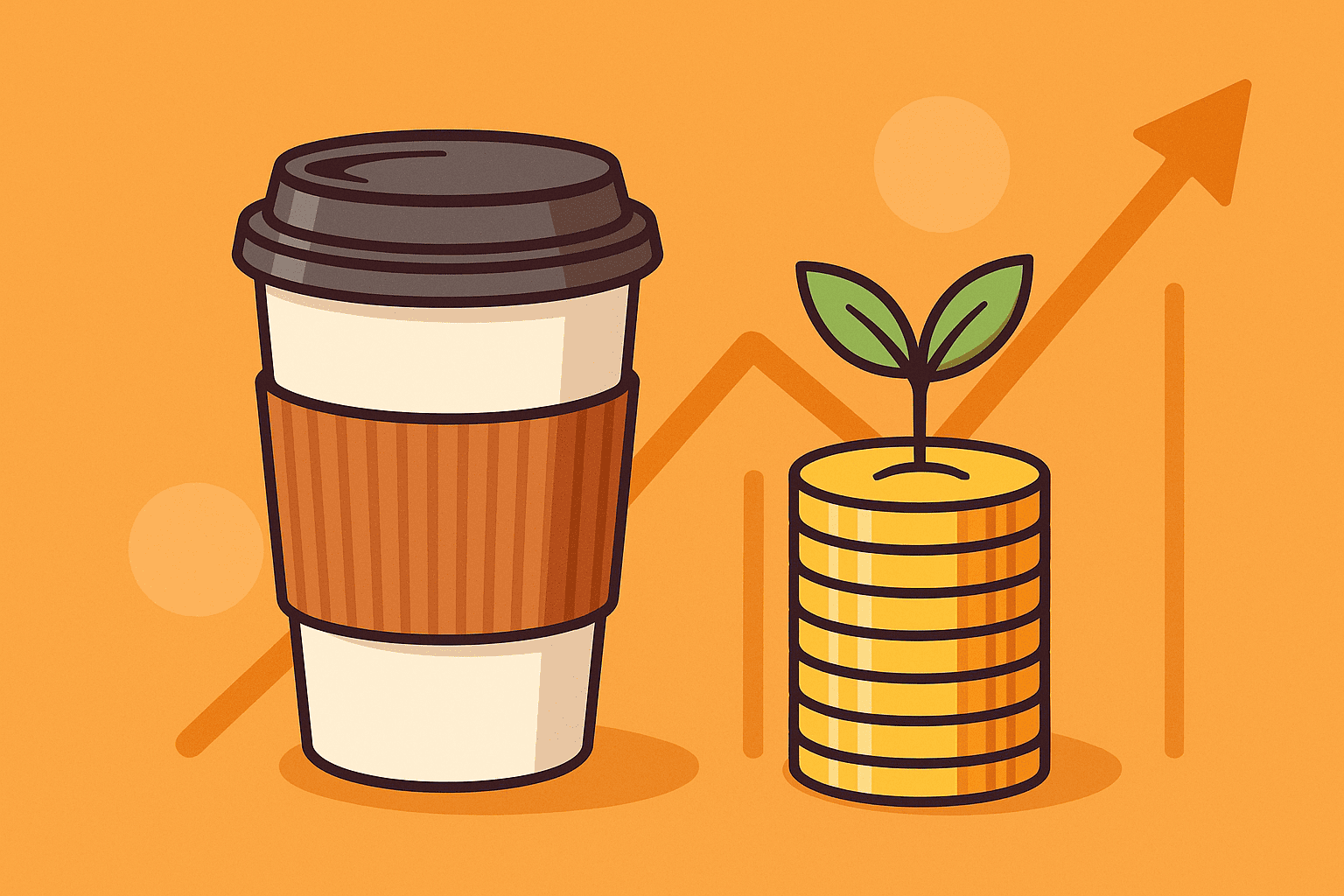
Imagine this: You love coffee. Your morning latte, after-dinner macchiato, and weekend flat white are all part of your daily routine.
These small purchases are part of your lifestyle and give you small moments of happiness.
There is nothing inherently bad about enjoying a drink.
Except… Your Latte Factor is holding you back from building wealth.
The Latte Factor is the theory that our everyday purchases can keep us from reaching our long-term financial goals. The name of the Latte Factor comes from the small indulgences that you buy on autopilot.
The daily $5 lattes that you buy during your work week. It is a fictional scenario, but many people see themselves in the daily caffeine run.
By themselves, these expenses do not seem like much. But over years and decades, they become substantial amounts of money that could be compounding in your 401(k) or brokerage account.
Instead, they are only building value for a large multinational coffee chain. But what if you chose a different path?
Instead of spending that money on your morning coffee, you could be building wealth.
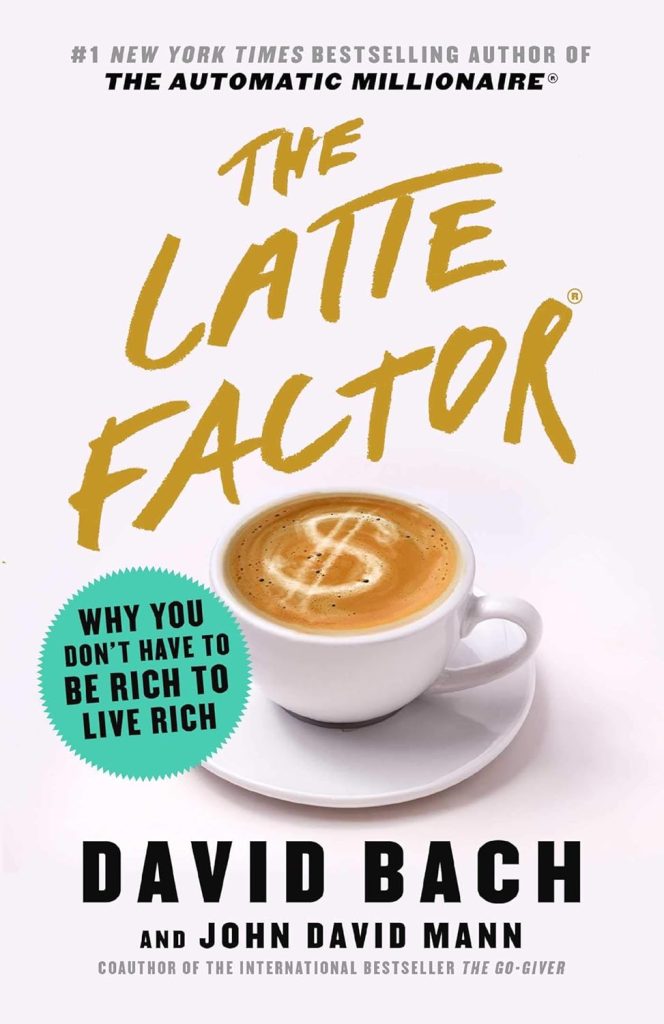
How the Latte Factor was Popularized
The concept of the Latte Factor was brought to the masses by author David Bach in his book The Automatic Millionaire.
He was on a mission to prove that you do not need to earn a high income to become wealthy. Becoming a millionaire is not about earning as much as possible but about redirecting unconscious spending habits.
To that end, he coined the Latte Factor concept, which became one of the most famous mantras in personal finance.
“The Latte Factor is a great concept that gets oversimplified. We use it in BearSavings to describe the powerful opportunity costs of recurring expenses.”
Bach’s key insight was that most people never truly question their daily, unconscious spending choices. This can lead to an unsustainable lifestyle that is not optimized for one’s financial goals.
The Latte Factor – Overview
David Bach is not the first person to popularize this simple but effective idea. In fact, the origins of the Latte Factor can be traced back to popular personal finance books of the 1990s.
It has its roots in the philosophy of 401(k) guru Joe Frankel’s classic book, 500 Years in Retirement. Frankel famously claimed you could retire with a 401(k) nest egg of $500,000 with just one small lifestyle change.
The concept of the Latte Factor since then has become another standard in the industry.
For better or for worse, the Latte Factor debate has been widely popularized in the personal finance industry. It has become so mainstream, with countless memes, articles, and t-shirts.
The humor and oversimplification have distracted some people from the fact that the Latte Factor’s basic premise still holds true.
The Latte Factor Math Example
Let’s run the numbers to see if the Latte Factor concept still holds true.
Suppose that you buy a $5 latte every day, five days a week, as an ordinary member of the working class.
That comes to $25 per week, $150 per month, and a little over $1,800 per year. Even with a relatively low and conservative estimate of a 7% average annual return, if you invested that amount instead of buying coffee every day for 30 years, you could amass over $170,000.
But let us be realistic here. The point is not that you need to give up coffee, as you will see from the real-world examples later. But what if you were spending $10/day combined on various habits like coffee, snacks, impulse purchases, or Uber rides? That would double the lost compounding opportunity to over $340,000.
Latte Factor: Invested Daily Habits Over Time (Extra $5/day)*
| Daily Savings | Return Rate | 10 Years | 30 Years |
|---|---|---|---|
| $5/day | 5% | $8,073 | $44,054 |
| $5/day | 7% | $12,485 | $81,778 |
| $10/day | 5% | $16,146 | $88,108 |
| $10/day | 7% | $24,970 | $163,557 |
It is not just hypothetical math. The long-term effects of compounding growth on small amounts are significant.
No one is arguing that you should stop drinking coffee or give up all of your favorite things. Instead, the point is to be aware of where your money is going.
Unintentional, unthinking leaks in your financial bucket can drain it quickly.
The Daily Latte Habit Replacement
One problem that many people will run into with the Latte Factor concept is, how do I replace it? Many of the financial habits you might look at to change are things you do out of pure habit.
How often have you picked up a drink you do not really want or pay for a food item out of habit?
The key is to find a replacement for this spending. For example, that could be a replacement, healthier drink choice.
Drink Less Coffee: The Reality Check
The counterargument against the Latte Factor is obvious: “Let people enjoy things.” The Latte Factor’s goal is not to shame people out of their daily indulgences.
In fact, critics of the Latte Factor (real or otherwise) are right. Not every expenditure is bad, especially if it is in the realm of joy, health, or general happiness.
The Latte Factor is about awareness. Most people do not realize that their little, automatic, daily expenditures have a purpose or a cost.
So the goal is not to deprive yourself of all of the little things you enjoy. The goal is to be mindful and intentional in your spending.
Financial advisors will often tout the concept of Zero-Based Budgeting.
The idea is that every dollar has a job in your budget. And if it is not working towards your overall life goals and values, then it is not a wise use of your hard-earned money.
Latte Factor Examples In the Real World
It is time for some real-world examples that will show that these opportunities are abundant in everyday life.
Let us start with three scenarios. They all represent real people and their real financial struggles.
Sarah – The Subscription User
Sarah is a 29-year-old teacher in Florida. She had signed up for multiple streaming services, premium music subscriptions, and a workout app a while ago.
Over time, she forgot about half of them. She was paying $85/month on unused or rarely used digital services.
She was not paying attention to those monthly charges and was simply clicking through, barely conscious of their presence.
After canceling those subscriptions and diverting those funds to her Roth IRA, she now makes an additional $100/month investment. That change alone could become $110,000 after 30 years of compounding.
Jake – The Lunch Combo King
Jake works long hours in the middle of nowhere and picks up lunch takeout every weekday. It is a $12 per meal average, and that adds up to $60/week or over $3,000 per year.
After he started meal-prepping twice a week on Sundays, he halved that recurring expense. He now contributes the remaining $1,500 per year and has more control over his nutrition.
Priya – Uber for Everything
Priya noticed she was spending $300/month on Uber taking her to work, shopping, the dry cleaners, and short errands. It felt much cheaper than a car or a transit pass, so she used it for everything.
But Priya realized that she could save 75% of that expense by using transit and walking when possible. She switched to a $80 monthly transit pass and redirected the savings into her student loan payoff.
The Latte Factor: Where to Find Yours?
Everyone has at least one. Your Latte Factor is out there, probably hiding in plain sight.
You may need to examine your financial life and spending habits with a fine-tooth comb to find it.
Start with the basics.
- Track all expenses for 30 days. Use our tracker tool to to help you.
- Divide into categories or even YNAB goals.
Watch for:
- Subscription you forgot you had
- Daily purchases you make unconsciously
- Things that you pay for frequently
Ask yourself:
- Do I value this product as much as it costs me?
- Am I buying this for reasons of joy or habit?
- Is this worth investing in or paying off debt?
- Try to quantify it and make that trade-off real in your mind.
- Replace lost purchases with healthier, happier, or lower-cost options. It could be:
- Learning to brew excellent coffee and drink it at home
- Cooking as a hobby and treat instead of chore
- Reading and listening to free library books on your phone
- Cancelling the second streaming service you never watch
- Trading down from dining out for fancy burgers or meals from home
- Switching transit, biking, or walking over short Uber trips
The Bottom Line: The Latte Factor
The Latte Factor is not about beating yourself up over little things. You do not need to abstain from all pleasures in life.
You just need to be aware of what you are spending your money on and how that aligns with your long-term financial plan.
The Latte Factor can be your financial wake-up call. In a world of one-click buying, it is easy to get away from consciously, intentionally making financial decisions.
No one is telling you to give up lattes or wine or dining out or other things that you love.
But when was the last time you questioned the cost of that decision? The Latte Factor does not ask you to make different choices. It just forces you to make a choice.
Keep learning: courses on this topic
Self-paced courses to put this article into practice.
 Udemy
Get Out of Debt, SAVE, Increase Wealth, Invest In The Future
Personal Finance, Investing, and Retirement: Get Out of Debt & Get Your Money to Work For You. Do you work hard for your money? Get your…
View course
 Udemy
Invest Like a Pro: Your First Steps in Wealth Creation
A self-paced video course on budgeting, saving and investing and investing basics, with practical lessons you can apply right away.
View course
 Udemy
2025 Personal Finance Blueprint: Budget, Save, Invest & Grow
Ready to take control of your financial future? This course is your all-in-one guide to building wealth with clarity and confidence—no…
View course





Leave a Comment