

Quick answer: A required minimum distribution (RMD) is the smallest amount the IRS makes you withdraw each year from tax-deferred retirement accounts such as traditional IRAs, SEP and SIMPLE IRAs, 401(k)s and 403(b)s. In 2026 you generally must start at age 73. If you were born in 1960 or later, your RMD age is 75. To figure each year’s amount, divide the account’s December 31 balance from the prior year by your factor in the IRS Uniform Lifetime Table. At 75, for example, that factor is 24.6, so a $100,000 IRA has a 2026 RMD of about $4,065. Your first RMD can wait until April 1 of the year after you reach your RMD age. Every later one is due by December 31. If you miss one, the excise tax is 25% of the shortfall, cut to 10% if you fix it within the correction window. Roth IRAs and Roth 401(k)s have no RMDs while the original owner is alive.
This guide covers who has to take RMDs and when, how to calculate yours step by step with real IRS factors, the 2026 deadlines, what to do if you miss one, and the legal ways to shrink the tax bill. Those include qualified charitable distributions (QCDs), which can send up to $111,000 to charity in 2026.
Educational only, not personalized tax or investment advice. RMD rules depend on your accounts, beneficiaries and plan terms, so confirm your numbers with IRS Publication 590-B, your plan administrator or a tax professional.
RMDs at a glance (2026)
- Who: owners of traditional, SEP and SIMPLE IRAs and of most workplace plans: 401(k), 403(b), 457(b), profit-sharing and other defined contribution plans. Beneficiaries of inherited accounts, including inherited Roth IRAs, have their own rules.
- Not required (owner alive): Roth IRAs and designated Roth accounts in 401(k) and 403(b) plans.
- Starting age: 73 if you were born 1951–1959. 75 if you were born in 1960 or later.
- First RMD deadline: April 1 of the year after the year you reach your RMD age.
- Every later RMD: by December 31 of each year.
- Formula: prior December 31 balance ÷ IRS distribution factor (usually the Uniform Lifetime Table).
- Missed RMD: 25% excise tax on the amount not taken, or 10% if corrected within the window, and it can be waived for reasonable error.
- Can’t roll over: an RMD can’t be rolled into another IRA or plan.
- Taxed as: ordinary income, apart from any after-tax basis or qualified Roth money.
- QCD limit for 2026: $111,000 per person, up from $108,000 in 2025 (IRS Notice 2025-67).
What is a required minimum distribution?
Traditional retirement accounts give you a deal: tax deferral now, tax later. RMDs are the “later.” Congress doesn’t let pre-tax money grow untaxed forever, so once you reach a set age you must pull out a minimum slice each year. That slice counts as taxable income.
A few points surprise people:
- The RMD is a floor, not a ceiling. You can always withdraw more. However, the IRS says withdrawing more this year doesn’t give you credit against next year’s RMD.
- You’re responsible for the number. Your IRA custodian or plan administrator may calculate it for you, but the IRS is clear that “the account owner is ultimately responsible for taking the correct RMD amount.”
- It’s calculated account by account, even if some account types let you take the combined total from one place (more on that below).
- You don’t have to spend it. You can reinvest the after-tax cash in a taxable brokerage account. You just can’t put it back into a tax-advantaged retirement account as a rollover.
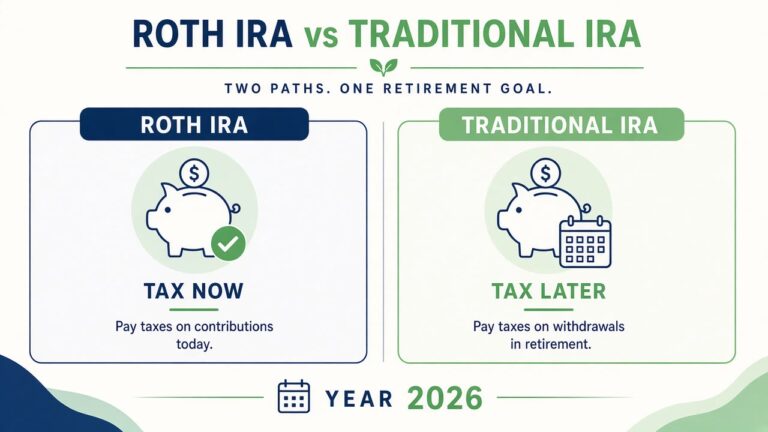
If you’re still choosing between account types, RMDs are one of the real differences. That’s covered in our Roth IRA vs Traditional IRA guide and our 401(k) vs IRA breakdown.
RMD age: when do you have to start?
The SECURE Act (2019) and SECURE 2.0 Act (2022) pushed the starting age back twice. The age that applies to you depends on your birth year:
- Born 1950 or earlier: you’re already taking RMDs under the older rules (age 70½ or 72, depending on when you reached them). Keep going every year.
- Born 1951 through 1959: age 73. IRS Publication 590-B says that if you reach age 72 after December 31, 2022, your RMDs begin based on age 73. (The statute’s wording overlaps for people born in 1959. Treasury’s July 2024 proposed regulations would settle that group at 73. Those rules were still not final as of October 2026.)
- Born 1960 or later: age 75. Under SECURE 2.0, anyone who reaches age 74 after December 31, 2032 has an applicable age of 75. The final RMD regulations published July 19, 2024 spell this out. For this group, the first RMD year is 2035 at the earliest.
Who reaches RMD age in 2026? People born in 1953 turn 73 this year. Their first RMD is for 2026, based on the December 31, 2025 balance, and it can be delayed until April 1, 2027.
Your first RMD: the April 1 option and the double-up trap
The first RMD has a grace period. You can take it any time during the year you reach RMD age, or wait until April 1 of the following year. The catch is that the second RMD is still due December 31 of that same following year.
Here’s how that plays out for someone born in 1953:
- 2026 RMD (first year): due by April 1, 2027, based on the December 31, 2025 balance.
- 2027 RMD: due by December 31, 2027, based on the December 31, 2026 balance.
- If you delay the first one, both withdrawals land in 2027 and both count as 2027 taxable income.
The IRS uses this exact pattern in its own example: “John” reached 73 in August 2024, took his 2024 RMD by April 1, 2025, and owed his 2025 RMD by December 31, 2025. Doubling up can push you into a higher bracket for one year, so many retirees take the first RMD in the year they actually turn 73.
Still working? The 401(k) exception
If you’re still employed at RMD age, your current employer’s 401(k), 403(b) or similar plan may let you delay RMDs from that plan until April 1 after the year you retire. Three limits apply:
- It’s plan-specific. The plan document decides, and some plans require RMDs at the applicable age regardless.
- 5% owners don’t qualify. If you own more than 5% of the business sponsoring the plan, you start at the normal age.
- It never applies to IRAs, including SEP and SIMPLE IRAs. An IRA owner starts at RMD age whether or not they’re working.
If you’re still contributing, our guide to how much to put into your 401(k) per paycheck in 2026 can help you keep saving efficiently right up to retirement.
One strategy some people use is rolling old 401(k)s into a current employer’s plan (if it accepts roll-ins) before RMD age, so more money falls under the still-working exception. Check with the plan first.
Which accounts have RMDs (and which don’t)
RMDs apply during the owner’s lifetime to:
- Traditional IRAs
- SEP IRAs and SARSEPs
- SIMPLE IRAs
- 401(k) plans (pre-tax balances)
- 403(b) plans
- Governmental and other 457(b) plans
- Profit-sharing and other defined contribution plans
- Defined benefit pensions, which meet the rules through their annuity payments rather than a balance-divided-by-factor formula
No RMDs while the original owner is alive:
- Roth IRAs. This has always been the case.
- Designated Roth accounts in 401(k) and 403(b) plans. Starting in 2024, SECURE 2.0 removed lifetime RMDs from Roth 401(k)s and Roth 403(b)s. The IRS RMD FAQs now say withdrawals from these accounts “are not required until after the death of the account owner.”
Watch out: beneficiaries who inherit a Roth IRA or Roth 401(k) are subject to RMD rules. The withdrawals are usually tax-free if the account met the five-year rule, but the timing rules still apply.
This is why converting some pre-tax money to Roth in your 60s can shrink future RMDs. We cover the trade-offs in Roth IRA vs Traditional IRA. Contribution eligibility, if you’re still working, is in our Roth IRA income limits 2026 guide.
How to calculate your RMD (step by step)
The formula on the IRS RMD page is simple:
RMD = account balance on December 31 of last year ÷ your distribution factor for this year
Step by step:
- Find last year’s December 31 balance for each account. For a 2026 RMD, use the balance at the close of business on December 31, 2025. It’s on your year-end statement, and many custodians also report it on Form 5498.
- Pick the right IRS table:
- Table III, Uniform Lifetime: most owners. Use it if you’re unmarried, if your spouse isn’t more than 10 years younger, or if your spouse isn’t your sole beneficiary.
- Table II, Joint and Last Survivor: if your spouse is your sole beneficiary and more than 10 years younger.
- Table I, Single Life: for beneficiaries of inherited accounts who use life-expectancy payments.
- Find your factor next to the age you’ll be on your birthday this year (2026).
- Divide. The result is your minimum for the year. Repeat for each account.
The Uniform Lifetime Table (IRS Table III)
These are the factors from Appendix B of IRS Publication 590-B, in effect since 2022. The percentage in brackets is roughly how much of the balance you must withdraw (1 ÷ factor).
- Age 72: 27.4 (3.65%)
- Age 73: 26.5 (3.77%)
- Age 74: 25.5 (3.92%)
- Age 75: 24.6 (4.07%)
- Age 76: 23.7 (4.22%)
- Age 77: 22.9 (4.37%)
- Age 78: 22.0 (4.55%)
- Age 79: 21.1 (4.74%)
- Age 80: 20.2 (4.95%)
- Age 81: 19.4 (5.15%)
- Age 82: 18.5 (5.41%)
- Age 83: 17.7 (5.65%)
- Age 84: 16.8 (5.95%)
- Age 85: 16.0 (6.25%)
- Age 86: 15.2 (6.58%)
- Age 87: 14.4 (6.94%)
- Age 88: 13.7 (7.30%)
- Age 89: 12.9 (7.75%)
- Age 90: 12.2 (8.20%)
- Age 91: 11.5 (8.70%)
- Age 92: 10.8 (9.26%)
- Age 93: 10.1 (9.90%)
- Age 94: 9.5 (10.53%)
- Age 95: 8.9 (11.24%)
- Age 96–100: 8.4, 7.8, 7.3, 6.8, 6.4
The table continues to age 120 and over (factor 2.0). The required percentage starts below 4% and climbs every year. That’s one reason RMDs can become a bigger tax issue in your 80s than in your 70s.
Worked RMD examples for 2026
All examples use the Uniform Lifetime Table and round to the nearest dollar.
- Example 1: first RMD at 73. Born in 1953, IRA worth $300,000 on December 31, 2025. 2026 RMD = $300,000 ÷ 26.5 = $11,321, due by April 1, 2027 (or by December 31, 2026 to avoid doubling up).
- Example 2: age 74. Born in 1952, IRA worth $500,000 on December 31, 2025. 2026 RMD = $500,000 ÷ 25.5 = $19,608, due by December 31, 2026.
- Example 3: the IRS’s own example. Turns 75 in 2026, $100,000 balance, spouse (the sole beneficiary) six years younger, so Table III applies. 2026 RMD = $100,000 ÷ 24.6 = $4,065.
- Example 4: age 80. $250,000 balance. 2026 RMD = $250,000 ÷ 20.2 = $12,376.
- Example 5: age 90. $250,000 balance. 2026 RMD = $250,000 ÷ 12.2 = $20,492. That’s the same balance as Example 4 but a much larger forced withdrawal.

If your spouse is more than 10 years younger
If your spouse is your sole beneficiary and more than 10 years younger, you use the Joint and Last Survivor Table instead. It gives a larger factor and so a smaller RMD. In the IRS example, a 75-year-old with a spouse who turns 64 in 2026 uses a factor of 25.3 instead of 24.6. On $100,000, that’s an RMD of $3,953 instead of $4,065. Marital status is set as of January 1 each year, so a divorce or death during the year generally doesn’t change the table until the next year.
Multiple accounts: what you can combine and what you can’t
You must calculate an RMD for each account separately. Whether you can withdraw the total from one place depends on the account type:
- IRAs (traditional, SEP, SIMPLE): you may add up the RMDs for all your IRAs and take the total from any one or more of them.
- 403(b)s: same idea. Add up the 403(b) RMDs and take the total from any of your 403(b) contracts.
- 401(k)s and 457(b)s: no combining. Each plan must pay out its own RMD.
- No crossing types: an IRA withdrawal can’t satisfy a 401(k) RMD, and a 401(k) withdrawal can’t satisfy an IRA RMD.
- Inherited IRAs: they’re tracked separately from your own IRAs. You can only combine inherited IRAs you received from the same person.
Example: at 75 you hold IRA A with $200,000 and IRA B with $100,000. The RMDs are $8,130 and $4,065, for a total of $12,195. You could take all $12,195 from IRA A and leave IRA B untouched. If you also have a $150,000 old 401(k), that plan needs its own $6,098 RMD.
That’s a practical case for consolidating scattered old 401(k)s into one IRA before RMD age: fewer accounts, one withdrawal. Our 401(k) vs IRA guide explains when rolling over makes sense, and when staying in a plan is better, for example for the still-working exception or creditor protection.
RMD deadlines for 2026
- April 1, 2026: deadline for the 2025 RMD of anyone who turned 73 in 2025 (born 1952) and chose to delay. That date has passed. If you missed it, see the next section.
- December 31, 2026: deadline for every regular 2026 RMD. That includes the second RMD for people born in 1952 and the yearly RMD for everyone already taking them.
- April 1, 2027: latest date for the first RMD of people born in 1953, who turn 73 in 2026.
- Inherited accounts: annual beneficiary RMDs are generally due by December 31 as well (see the inherited IRA section).
Don’t wait until late December. Custodians need time to process requests, especially in-kind transfers and QCDs, and the money has to actually come out of the account by December 31 to count for that year. Many retirees set up automatic monthly or quarterly withdrawals. The IRS allows installments as long as the year’s total meets the minimum.
Missed an RMD? The 25% excise tax and how to cut it to 10% (or zero)
The penalty used to be 50%. SECURE 2.0 lowered it. The current IRS rules are:
- 25% excise tax on the amount you should have withdrawn but didn’t.
- 10% if you correct it within the “correction window.” Publication 590-B says the window ends on the earliest of three dates: when the IRS mails a deficiency notice, when the tax is assessed, or the last day of the second tax year after the year the tax was imposed.
- Waiver possible. The IRS can waive part or all of the tax if the shortfall was due to “reasonable error” and you’re taking reasonable steps to fix it.
Example: you were supposed to take $10,000 and took nothing. That’s $2,500 at the 25% rate, or $1,000 at the 10% rate if you correct it in time. A successful waiver means $0.
What to do, in order:
- Take the missed amount as soon as you notice. It’s still taxable income in the year you receive it.
- File Form 5329 (instructions) for the year the RMD was missed.
- Ask for a waiver if it was an honest mistake. Following the Form 5329 instructions, enter “RC” and the shortfall amount you want waived (in parentheses) on the dotted line next to the shortfall line (line 54a or 54b on the 2025 form), and attach a short letter explaining what went wrong and how you fixed it. Common reasons include a custodian error, an illness, or a misunderstanding of the rules.
- Prevent a repeat. Set an automatic distribution or a calendar reminder for October.
How RMDs are taxed (and the ripple effects)
RMDs from pre-tax money are taxed as ordinary income at your regular federal rate. They don’t get the lower long-term capital gains rates, even if the money inside the IRA came from stock gains. (Compare our 2026 capital gains tax brackets guide for how taxable-account investments are taxed.) Exceptions:
- After-tax basis. Nondeductible IRA contributions tracked on Form 8606 come out tax-free in proportion.
- Qualified Roth money is tax-free.
The bigger issue is often the knock-on effect, because the RMD raises your adjusted gross income:
- Social Security taxation. IRS Tax Topic 423 says benefits aren’t taxable unless your modified AGI plus half your benefits is more than a base amount for your filing status. A large RMD can push you over it. Our Social Security full retirement age guide covers claiming timing, which works together with RMD timing.
- Medicare premiums. Higher income can trigger income-related surcharges on Medicare Part B and Part D premiums. If you saved in a health savings account before Medicare, see our HSA contribution limits guide. HSAs have no RMDs and can pay qualified medical costs tax-free.
- Bracket creep. Large pre-tax balances can force withdrawals bigger than you need, particularly in your late 80s when the percentage tops 7–8%.
You can see your AGI with our AGI calculator. Federal tax is withheld from traditional IRA distributions unless you choose not to have it withheld. For one-off withdrawals you set the rate on Form W-4R. Some retirees use a single December RMD with heavy withholding to cover the year’s estimated tax.
Smart, legal ways to manage RMDs
You can’t skip an RMD, but you can control how big it is, when you take it and how it’s taxed.
- Qualified charitable distributions (QCDs). From age 70½, you can have your IRA custodian send money directly to a qualifying charity. A QCD counts toward your RMD and stays out of your taxable income. The 2026 limit is $111,000 per person (IRS Notice 2025-67), and a married couple can each give up to that from their own IRAs. Rules:
- The check must go directly from the IRA to the charity.
- QCDs can’t come from an ongoing SEP or SIMPLE IRA.
- You can’t also deduct the gift.
- You need the same written acknowledgment as for a deductible donation.
- Donor-advised funds and supporting organizations aren’t eligible recipients, and most private foundations aren’t either. Confirm the charity qualifies before you send the money.
- There’s also a one-time election of up to $55,000 for 2026 to fund a charitable remainder trust or charitable gift annuity.
- Roth conversions before RMD age. Converting pre-tax money to Roth in lower-income years, such as between retirement and Social Security or RMD age, shrinks the balance that RMDs are calculated on. You pay tax on the conversion now, so it works best when today’s bracket is lower than the one you expect later. Note that an RMD itself can’t be converted, so take the year’s RMD first.
- Take your first RMD in the year you turn 73 (or 75) to avoid two taxable withdrawals in one year.
- Take it in kind. Many custodians can move shares from your IRA to a taxable account to satisfy the RMD without selling. The shares’ value on the transfer date counts as the distribution and is taxed as income.
- Choose what to sell. If you combine IRA RMDs, take the withdrawal from the account or holding that best rebalances your overall mix. Our asset allocation by age guide and the three-fund portfolio make that easy to plan. Holding funds rather than individual stocks also makes in-kind transfers simple, as explained in index fund vs ETF.
- Use the still-working exception for your current employer’s plan if it applies and you aren’t a 5% owner.
- Coordinate with your withdrawal plan. RMDs are a minimum. If your spending plan already draws more than the RMD, it covers the requirement automatically. See why the 4% rule may no longer be enough for how withdrawal rates and RMD percentages compare.

Inherited IRA RMDs: the 10-year rule in plain English
Inheriting a retirement account brings a different set of rules. For owners who died in 2020 or later, the SECURE Act (see IRS Retirement Topics – Beneficiary) sorts beneficiaries into groups:
- Eligible designated beneficiaries: the surviving spouse, the owner’s minor child (until age 21, the age of majority under the final regulations), a disabled or chronically ill person, or someone not more than 10 years younger than the owner. They can generally stretch withdrawals over their own life expectancy using IRS Table I. A spouse can also treat the IRA as their own.
- Other individual beneficiaries, such as most adult children and grandchildren: the 10-year rule. The account must be emptied by December 31 of the year that contains the 10th anniversary of the owner’s death. If the owner died in 2025, that means by December 31, 2035.
- Non-individuals (such as an estate, or a trust that doesn’t qualify for look-through treatment): the 5-year rule may apply if the owner died before their required beginning date.
The detail that trips people up is whether the original owner had already started RMDs. If the owner died on or after their required beginning date, a non-eligible beneficiary under the 10-year rule must generally take annual RMDs in years 1–9 and empty the account by year 10. If the owner died before that date, no withdrawals are required until the 10th year, though spreading them out is often smarter for taxes.
The IRS waived the penalty for missed annual “specified RMDs” in 2021 through 2024 while it finalized the rules (most recently in Notice 2024-35, following Notice 2023-54). The final regulations apply from 2025, so 2026 annual RMDs on inherited accounts are enforced. If you inherited an IRA from someone already taking RMDs, check that your custodian has a 2026 amount set up.
Your RMD checklist for the rest of 2026
- Confirm your RMD age from your birth year: 73 if born 1951–1959, 75 if born 1960 or later.
- List every pre-tax account: IRAs, old 401(k)s, 403(b)s, 457(b)s and inherited accounts.
- Pull each December 31, 2025 balance and calculate each 2026 RMD with the factor for your 2026 birthday age.
- Decide where to withdraw. Combine IRAs if useful, and take each 401(k) RMD separately.
- Decide on a QCD if you give to charity and are 70½ or older. Ask your custodian about its year-end processing cutoff.
- Set withholding so the RMD doesn’t create an April tax surprise.
- Withdraw before December 31, leaving a few weeks of buffer.
- Check any inherited accounts for annual RMDs.
- Look ahead to 2027. If you turn 73 in 2026, decide whether to take the first RMD now or by April 1, 2027.
Want a sense of how your savings stack up as RMDs begin? Compare with typical balances in our net worth at 70 and net worth at 75 benchmarks for the United States. Planning further back? How to retire at 60 and how much emergency cash an early retiree should keep cover the years before RMDs begin. Model long-run growth with our compound interest calculator.
Frequently asked questions
What is the RMD age in 2026?
It’s 73 for anyone born from 1951 through 1959, so people born in 1953 reach RMD age in 2026. If you were born in 1960 or later, your RMD age is 75 under SECURE 2.0, so your first RMD year will be 2035 at the earliest.
How do I calculate my required minimum distribution?
Divide each account’s balance on December 31 of the previous year by your factor from the IRS Uniform Lifetime Table, based on the age you’ll be on your birthday this year. For 2026, a 75-year-old with $100,000 divides by 24.6, which gives about $4,065. Use the Joint and Last Survivor Table instead if your sole beneficiary is a spouse more than 10 years younger.
When is the RMD deadline for 2026?
December 31, 2026 for regular RMDs. The exception is your very first RMD, which can wait until April 1 of the year after you reach RMD age. For people who turn 73 in 2026, that’s April 1, 2027. Waiting means you’ll take two RMDs in 2027.
What happens if I miss an RMD?
You may owe a 25% excise tax on the amount you didn’t withdraw. It drops to 10% if you take the missed amount and file within the correction window. The IRS can waive it entirely if the miss was a reasonable error you’re fixing. Report it on Form 5329 and attach an explanation if you’re asking for a waiver.
Do Roth IRAs have required minimum distributions?
Not for the original owner. Roth IRAs have never had lifetime RMDs, and since 2024 designated Roth accounts in 401(k) and 403(b) plans don’t either. Beneficiaries who inherit a Roth account do have to follow RMD rules, although qualified withdrawals are usually tax-free.
Can I take my RMD from just one account?
For IRAs, yes. Calculate each IRA’s RMD, add them up and take the total from any of your IRAs. The same goes for 403(b)s. 401(k) and 457(b) plans must each pay out their own RMD, and IRA and 401(k) RMDs can’t cover each other.
Do I have to take an RMD if I’m still working?
From your current employer’s 401(k) or 403(b), often not until you retire, if the plan allows it and you don’t own more than 5% of the company. IRAs have no still-working exception. You must start IRA RMDs at your RMD age either way.
Can I avoid taxes on my RMD?
You can’t avoid the withdrawal, but a qualified charitable distribution lets you send all or part of it directly from your IRA to charity, tax-free, up to $111,000 per person in 2026 if you’re 70½ or older. Converting pre-tax money to Roth before RMD age can also reduce future RMDs, though you pay tax on the conversion.
Bottom line
RMDs are predictable once you know your three inputs: your birth year (which sets age 73 or 75), last year’s December 31 balance, and your factor from the IRS table. The costly mistakes are avoidable: missing the December 31 deadline, doubling up in your first year without meaning to, mixing up IRA and 401(k) aggregation, and forgetting annual RMDs on an inherited IRA. Start planning in your 60s. Roth conversions, QCDs and smart withdrawal ordering can make the required part of retirement much less taxing.
Sources: IRS Retirement Topics – Required Minimum Distributions (reviewed April 8, 2026); IRS Retirement Plan and IRA RMD FAQs (reviewed January 29, 2026); IRS Publication 590-B (2025), including Appendix B Tables I–III; IRS Notice 2025-67 (2026 limits, including QCD $111,000 and $55,000); IRS Notice 2023-54 and Notice 2024-35; Treasury/IRS final RMD regulations, Federal Register, July 19, 2024; Instructions for Form 5329; IRS Retirement Topics – Beneficiary; IRS Tax Topic 423. Educational only, not tax advice.
Keep learning: courses on this topic
Self-paced courses to put this article into practice.
 Udemy
Get Out of Debt, SAVE, Increase Wealth, Invest In The Future
Personal Finance, Investing, and Retirement: Get Out of Debt & Get Your Money to Work For You. Do you work hard for your money? Get your…
View course
 Udemy
Invest Like a Pro: Your First Steps in Wealth Creation
A self-paced video course on budgeting, saving and investing and investing basics, with practical lessons you can apply right away.
View course
 Udemy
2025 Personal Finance Blueprint: Budget, Save, Invest & Grow
Ready to take control of your financial future? This course is your all-in-one guide to building wealth with clarity and confidence—no…
View course



Leave a Comment