
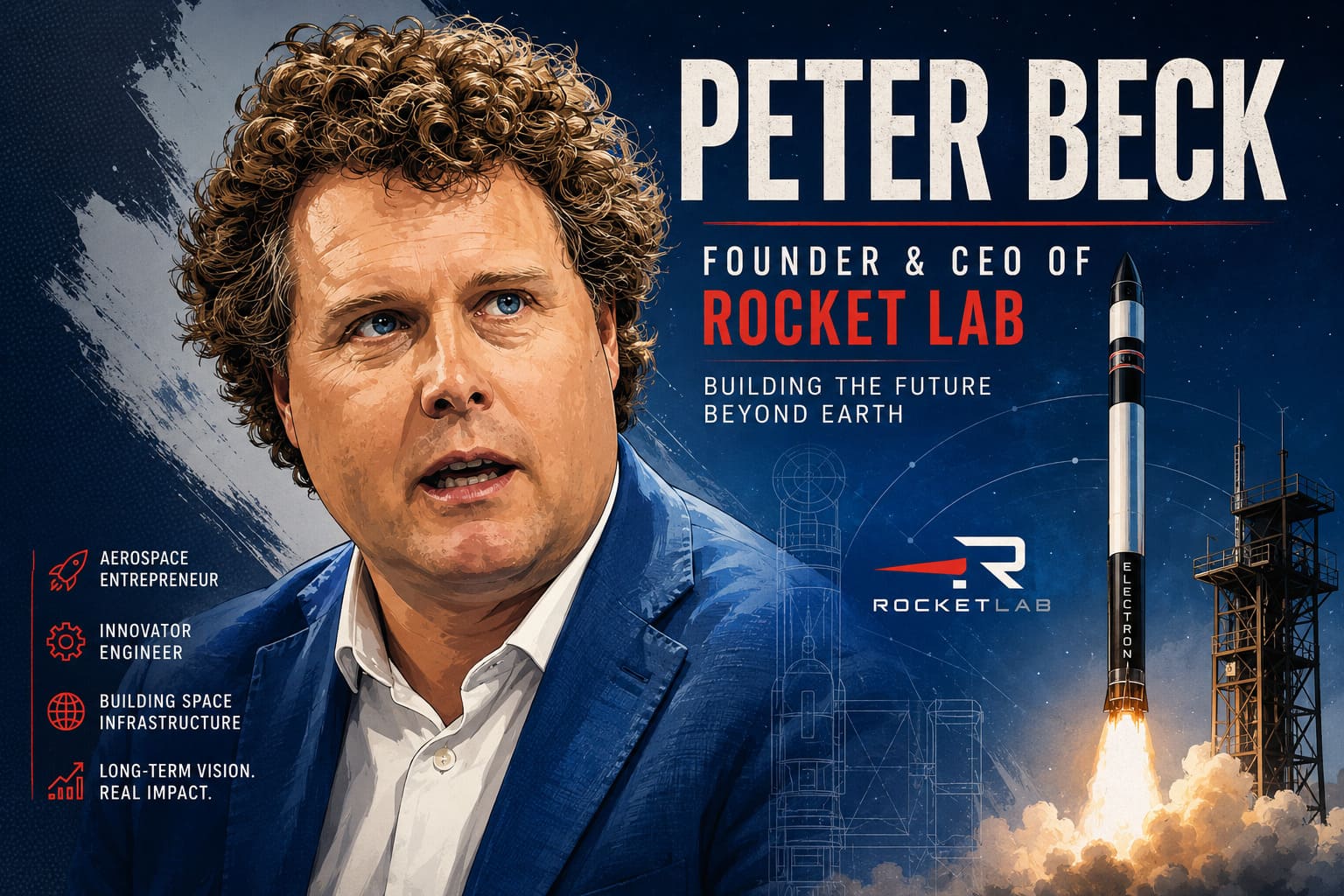
The space industry of today isn’t just governments and huge aerospace contractors. Enter entrepreneurs. Space startups have existed for almost as long as the space industry itself, but the last 20 years have birthed some of the most intriguing characters in the new space era. Peter Beck is certainly one of them.
If you aren’t already familiar with Elon Musk, Jeff Bezos, or Richard Branson, you’ve likely heard about Peter Beck. The founder and CEO of Rocket Lab has quietly created one of the most significant companies in the commercial space economy. From humble beginnings as a small aerospace startup out of New Zealand, Rocket Lab has turned into a legitimate satellite launch company, spacecraft manufacturer, and player in the space infrastructure industry.
Investors love stories of visionary founders building immense companies from the ground up. Peter Beck’s story is unique because he exemplifies the trifecta of obsession with engineering, future-thinking, and disciplined execution. Peter isn’t your typical flashy founder. He took his time building Rocket Lab, translating high-tech aerospace innovations into a public company with actual revenue, actual customers, and a very tangible path to becoming a space industry heavyweight.
In this post, we’ll dive into who Peter Beck is, how he built Rocket Lab, why investors are watching him, and what his endgame means for the future of space.
- Early Life and Background
- The Founding of Rocket Lab
- The Electron Rocket Changed Rocket Lab’s Future
- Peter Beck’s Leadership Style
- Rocket Lab’s Relationship With SpaceX
- The Neutron Rocket and Bigger Ambitions
- Why Investors Are Interested in Peter Beck
- Peter Beck’s Vision for the Space Economy
- Risks Investors Should Understand
- Final Thoughts
Early Life and Background
Peter Beck grew up in New Zealand with an interest in engineering, machinery, and aviation. He wasn’t necessarily a typical aerospace executive. Many of his peers had attended prestigious universities or studied aerospace engineering through military programs.
Contrary to other leaders in the space industry, Beck didn’t follow that path. Reports say he didn’t actually earn a formal engineering degree from a university. He picked up his technical knowledge from experimenting, working in hands-on engineering, and teaching himself. He is the rocket scientist who never went to college.
Beck held jobs in manufacturing and industrial engineering in New Zealand before Rocket Lab. When he was working, Beck privately experimented with rockets and developed an interest in small launch vehicles.

Commercial space industry was focused on huge rockets and billion-dollar contracts. Beck recognized small satellites were going to become highly significant in the future. He knew cheap and adaptable launch vehicles made for sending up small satellites would be necessary.
Rocket Lab was built on that premise.
The Founding of Rocket Lab
Rocket Lab launched its first company in 2006 in New Zealand.
It sounded crazy at first. Rocket launches are some of the hardest engineering feats on the planet. Here was a little-known New Zealand startup thinking it could crack the market.
Space is unforgiving. Missions fail. Rockets crash and burn. Funds are required. It has to work near-flawlessly every time.
Beck started picking up traction early by zeroing in on a market that no large aerospace company was paying much attention to at the time: Dedicated launches for small satellites.
The satellite landscape was rapidly evolving through the 2000s and early 2010s. Satellites were getting smaller, cheaper, more capable, and more commercially oriented. Universities, startups, defense organizations, and commercial operators were increasingly launching small satellites.
The drawback was they didn’t have the schedule flexibility or orbit customization riding on larger rockets.
Beck smelled opportunity.
Rocket Lab wasn’t going to immediately build massive rockets. Instead, it would build one optimized for getting small payloads to space as efficiently as possible.
That rocket would be Electron.
The Electron Rocket Changed Rocket Lab’s Future
Electron was Rocket Lab’s first orbital rocket, and would become its signature launch vehicle.
Built around small payload launches, Electron gave customers the ability to put satellites into orbit more frequently with more flexibility than ever before.
Rocket Lab’s advances in 3D printing rocket engines was one of the more impressive elements of Electron. Rocket Lab’s Rutherford engines were known for using additive manufacturing to greatly simplify production.
Having rocket engines that could be manufactured at greatly reduced complexity and cost was no small feat.
Rocket manufacturing had traditionally been extremely slow and expensive. Beck wanted Rocket Lab to think more like a software company where iteration velocity and production scalability were crucial.
It also allowed Rocket Lab to become one of the first private companies in history that could regularly launch rockets into space.
This mattered to investors because Rocket Lab had gone from being a concept, to an operating space company that flew missions on recurring basis, secured government contracts, built a customer base, and gained credibility within the industry.
Peter Beck’s Leadership Style
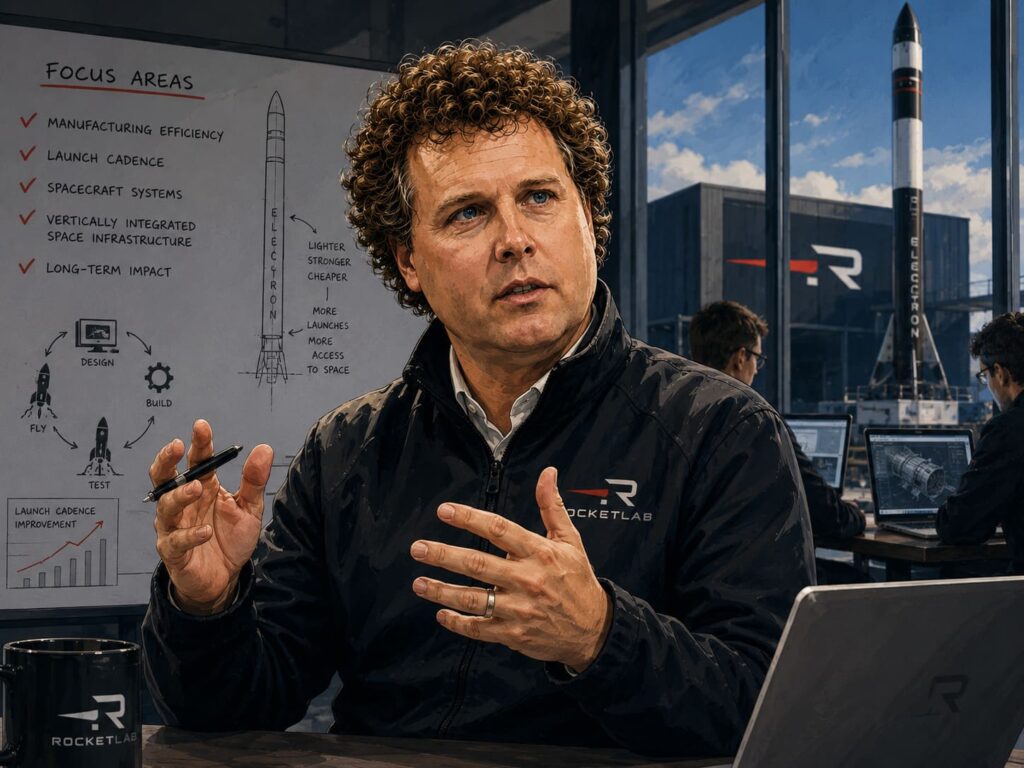
The leadership style is one reason Peter Beck has impressed investors.
Instead of always being in the headlines like some founders, Beck focuses intensely on execution and engineering.
He almost always seems cool-headed, pragmatic, and technical. Interviews with Beck are about manufacturing efficiency, launch cadence, spacecraft systems, or building out space infrastructure long-term instead of buzzword infused hype.
This mentality has allowed Rocket Lab to earn the respect of the aerospace industry.
Peter Beck also seems very grounded. He’s not trying to outdo SpaceX at everything right now. Rocket Lab is building realistic competitive advantages.
Rocket Lab has gone beyond launches to provide:
- Satellite components
- Space systems
- Spacecraft manufacturing
- Mission management
- GovCon (Government contracting, especially in defense)
- Deep space
Beyond providing launches, Rocket Lab is building out other sectors of the space industry. Launch services will become very competitive and margin sensitive over time. By vertically integrating into space infrastructure, Beck is turning Rocket Lab into a space economy platform instead of just a rocket company.
Rocket Lab’s Relationship With SpaceX
Many Rocket Lab investors naturally compare the company to SpaceX.
The problem is that the two companies are vastly different in size today.
SpaceX leads all companies in heavy launch capability and runs massive programs like Starlink. Rocket Lab is tiny by comparison.
But Rocket Lab does fill an important niche in the market.
“The second most important pure-play space company” is how some Rocket Lab investors describe the company’s value to public market investors.
The reasoning here relates to SpaceX being a private company.
If SpaceX ever decides to go public, expect the entire space sector to garner much more investor attention from that point forward. Rocket Lab investors believe that a SpaceX IPO would drive significant inflows of institutional capital into the broader space economy ecosystem.
Rocket Lab would likely benefit from such a development as well, since it will be one of the few companies with an “orbital track record” that trades on public markets.
The Neutron Rocket and Bigger Ambitions
Electron built Rocket Lab a name for themselves, but Beck’s bigger plans were revealed with Neutron.
Rocket Lab’s next generation medium-lift reusable rocket.
Neutron will open Rocket Lab up to a much bigger slice of the launch market.
Think about that.
Rocket Lab going from small launch vehicles all the way up to medium-lift rockets.
That leap is hard, and very costly. However the size of their potential market increases exponentially.
Neutron will enable Rocket Lab to:
- Launch larger satellite constellations
- Go after defense missions
- Deploy human spaceflight infrastructure
- Launch larger constellations
- Land National security contracts
- Launch larger cargo payloads
For Rocket Lab investors, Neutron might be the project that decides if Rocket Lab becomes a household name in aerospace or continues operating on the smaller end of the industry.
Peter Beck will play a big role in this.
A lot of investors are sticking with Rocket Lab because “yeah but Peter Beck got Electron flying.” Beck has proven that he can build and scale orbital launch vehicles despite huge doubters.
Why Investors Are Interested in Peter Beck
Founder quality is extremely important for growth investors.
Lots of growth investors care about investing in founders that are “visionaries” and not just financial statements/products.
Peter Beck checks a lot of boxes that other investors care about:
Technical Expertise
Peter Beck really knows rocketry/engineering/manufacturing. You don’t often find investors that care about founders leading technical companies where they lack deep knowledge of the product.
Long Term Vision
Building space infrastructure isn’t a get rich quick scheme. Peter Beck seems to have ambition that goes beyond quarterly returns. Looks like he is thinking on a 10-30 year time horizon.
Long term holders might like this type of mentality.
Capital Efficient
Rocket Lab is nothing like SpaceShipOne or Stratolaunch. Rocket Lab has been relatively capital efficient for its stage.
They’ve actually made it past the “unicorns that burn millions but don’t launch anything” phase.
Operating Track Record
Rocket Lab isn’t just talking about concepts of the future. They’ve already:
- Launched to orbit multiple times
- Supported government launches
- Produced satellites
- Generated revenue
- Scaled their factory
- Built reusable rockets
A long operating track record matters when there are so many rocket startups that are vaporware.
Peter Beck’s Vision for the Space Economy
An intriguing part of Beck’s investment thesis is that he seems to view space as a long-duration infrastructure play.
Celestial rockets are typically viewed as transportation vehicles by laypeople.
But Beck thinks bigger.
Rocket Lab’s plans have started to sound an awful lot like a vertically integrated space infrastructure company in many interviews. Spacecraft bus systems, launch vehicles, satellites components, and mission ops.
Why does this matter? The moonshots of tomorrow will need all of the above to reach their profit potential.
Infrastructure markets of the future could include:
- Satellite Earth observation
- Space-based internet
- Military, intelligence, and defense
- Climate
- Deep space
- Moon
- In-space manufacturing
- Satellite swarms
If you build a moat in one of those businesses, you could own it for decades.
That’s why growth investors have been keen on Rocket Lab despite gyrations in the space sector.
Risks Investors Should Understand
Rocket Lab is hot right now, but remember Peter Beck is not SpaceX.
Space is hard.
Launches are expensive to build out and come with little technical margin for error. Production delays, technical failures, regulation, and competition among many other factors can derail long-term results.
Rocket Lab also isn’t immune to competition from larger rivals like SpaceX.
Neutron also needs billions in capital and perfect execution.
Remember space is still speculative compared to other industries.
Highflyers can see wild swings in their stock price.
Final Thoughts
Peter Beck has a chance to go down in history as one of the most significant space entrepreneurs of his era.
His journey has been impressive, not just for Rocket Lab’s accomplishments but because it began so implausibly. A brash entrepreneur from New Zealand with unorthodox experience started one of the few companies in the world capable of orbital launches, and turned it into a public space infrastructure company.
In Beck, investors are seeing something different than other noisy tech founders of the last decade.
He comes across as laser focused on the engineering, execution, manufacturing excellence, and crafting something that will last.
We don’t yet know if Rocket Lab will become one of the go-to space infrastructure platforms. The industry is nascent, highly competitive, and brutally capital intensive.
We do know that Peter Beck has transcended being a small sub-sector aerospace entrepreneur. He is now playing a key role in defining what the commercial space economy will look like going forward.
That certainly makes Beck, and Rocket Lab stocks, ones to watch over the next decade for investors thinking beyond traditional technology.


Leave a Comment