
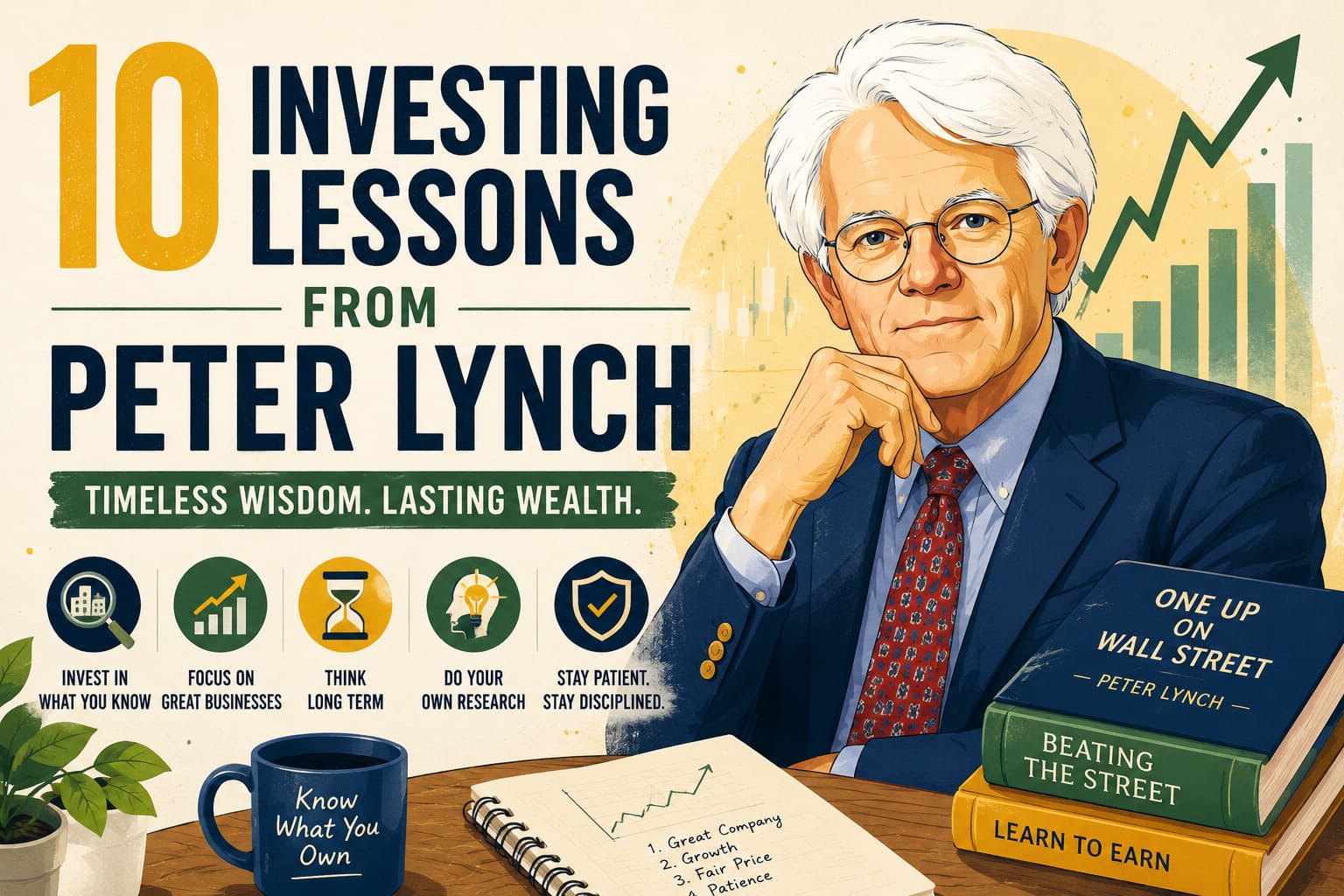
Peter Lynch is one of the rare investors whose advice remains utterly timeless.
Markets change. AI disrupts industries. Crypto bubbles burst. But one thing remains true: Invest with common sense.
Peter Lynch was the manager of the Fidelity Magellan Fund from 1977–1990. During this period, he achieved average annual returns of approximately 29%. His Magellan fund is considered one of the best mutual funds of all time.
What set him apart wasn’t some flashy Wall Street secret.
Peter Lynch realized that retail investors could beat the pros by simply observing the world around them.
Instead of getting caught up in day-to-day price fluctuations or guessing about macro events, Lynch looked at business. He bought great companies at fair prices and held on for years as his thesis unfolded.
Peter Lynch’s lessons are still useful today. Here are 10 timeless investing lessons from Peter Lynch to become a better investor.
- Invest In What You Know
- Great Companies Can Be Hidden In Boring Industries
- The Stock Market Rewards Patience
- Avoid Overcomplicating Investing
- Earnings Matter More Than Stories
- Volatility Is Normal
- Do Your Own Research (DYOR)
- Not Every Stock Needs To Be A Home Run
- Understand Why You Own A Stock
- The Biggest Winners Often Surprise Everyone
- Final Thoughts

Invest In What You Know
Peter Lynch is known for many things, but perhaps his most quoted line is:
Buy what you know.
This doesn’t mean buy stocks in companies that make products you like to use.
It means observe companies that you have first-hand knowledge of before they become popular on Wall Street.
Lynch thought the average consumer sees new trends before analysts do. If your kids’ favorite toy brand is taking over your house, other parents probably feel the same way. When you can’t get a table at that new restaurant chain, that’s a good sign people want to eat there. If a new software program is making life easier at your job, the company may have sustainable growth behind it.
Some of the greatest investments begin with observation.
The challenge is transitioning from observation to doing your homework.
Just because you love a company’s product doesn’t mean the stock will perform well. Peter Lynch was a big proponent of looking at sales growth, balance sheet strength, profitability, competitive advantages, and valuation.
This lesson is even more important today as news travels faster with the internet. Many people get caught up in the excitement on social media and invest in businesses they know little about.
Investing within your circle of competence decreases the likelihood that you’ll make emotional investments.
Great Companies Can Be Hidden In Boring Industries
Peter Lynch was a big fan of “boring” companies.
He avoided glamorous industries filled with speculation and unrealistic expectations. He preferred dull industries that were consistently throwing off cashflow.
- Garbage companies.
- Commercial printers.
- Local banks.
- Wrapping paper.
- Funeral homes.
Things you don’t typically discuss at dinner parties.
Yet boring industries share a few characteristics:
- Less competition
- Predictable demand
- Steady revenue
- Fewer speculative investors
- Better long-term visibility
When industries become sexy, too much investor money flows into them. Everyone has high expectations and what should be good news is treated as disappointment.
Remember: stock price performance != company performance
Many of the greatest wealth generators of all time were in businesses no one cared about.
Look around. Everyone wants AI stocks. Everyone wants meme stocks. Everyone wants hyped-up tech companies betting on the future.
The more exciting your stock is, the more people care what happens to it.
But there are a lot of profitable companies out there quietly compounding cash for their shareholders.
The Stock Market Rewards Patience
Peter Lynch drilled one point into investors again and again: Investing is a long-term endeavor.
A lot of investors have short-term expectations.
They buy a stock and want to see instant results. If the stock dips 10% a few weeks later, they panic and sell.
Peter Lynch saw volatility differently.
He realized that short-term price movements are emotional. Stocks go up and down based on fear, greed, headlines and macro noise.
But the longer you give it, the more a company’s stock price will reflect its business fundamentals.
If a company continually grows earnings, margins and competitive advantages, eventually the market will notice.
That’s why patience is one of the most undervalued skills in investing.
So many investors kill their returns by selling too soon, not because they invested in bad companies.
Great businesses compound for decades if you’re willing to let them.
- Amazon
- Apple
- Costco
- Nvidia
- Visa
Long-term investors with the patience to ride the volatility saw life-changing returns.
Peter Lynch knew that time in the market beats timing the market.
Avoid Overcomplicating Investing
Peter Lynch was strongest at reducing investing to its simplest form.
Predicting interest rates. Oil prices. Elections. GDP growth.
Doesn’t matter.
Invest in great businesses.
Too many people waste time guessing on macroeconomic events that no one can predict.
PhD level economists often miss calls on recessions, inflation, and market cycles.
Peter Lynch said investors should instead be asking:
- Is the business profitable?
- Is sales growing?
- Does management have a strong track record?
- Is debt under control?
- Is the stock fairly priced?
- Does the business have a moat?
Asking simple questions can lead to better investment decisions than complex financial models.
Today’s investing environment is full of noise.
- Daily market forecasts
- Finance influencers
- AI stock pickers
- Breaking news alerts every 5 minutes.
Remember Peter Lynch kept it simple.
Buy quality businesses at fair prices and hold for the long term.
Earnings Matter More Than Stories
Peter Lynch didn’t invest in businesses that were just built on hype.
He only wanted companies that had earnings growth.
Every market cycle has these buzzwords:
- “This sector is going to transform the world”
- “This company is going to disrupt everything”
- “Don’t worry about profits, just look at growth!”
Oftentimes these stories do come true.
But a lot of times they don’t because the business fundamentals never develop.
Lynch cared a lot about
- Earnings growth
- Cash flow
- Margins
- Balance sheet
He knew that no matter how sexy the story is, stock prices don’t go up forever on promises.
Eventually a company needs to earn actual dollars.
This lesson is insanely valuable today in 2026. Especially when there’s so much hype around specific themes.
There will definitely be a handful of AI companies that become billion or trillion dollar businesses.
But the majority will fail.
It all depends if the business can translate that hype into earnings power.
Don’t let a good story trick you into a bad investment.
Volatility Is Normal
Peter Lynch once said:
If I were asked to reduce investing to one sentence, I would say that ‘The key organ for investing is the stomach, not the brain.
Meaning emotional stability is EXTREMELY important.
Even great businesses will have steep declines.
- Stock markets can plummet overnight.
- Economies can fall into recession.
- Fear can become contagious.
And during times of pain and panic, emotional investors panic sell quality businesses at the absolute bottom.
Peter Lynch realized that volatility isn’t the problem.
Permanent loss of capital is.
When you own a great company with a durable competitive advantage, short-term market drops are actually opportunities to buy more shares at a discount.
And history has proven that the investors who experience the greatest compounding are the ones who don’t panic.
The problem is it’s human nature to panic.
When the market is correcting -50% or more, media is pure negativity. Facebook & Twitter is freaking people out. Every day it feels like the economy is going to fall off a cliff.
But over-and-over we’ve seen that investors who stay disciplined and stay invested will beat the market over the long-run.
Do Your Own Research (DYOR)
Peter Lynch was a big fan of thinking for yourself.
He cautioned investors about following the advice of:
- Stock Analysts
- TV Commentors
- Market experts
- Family and friends
- Reddit and Discord
Part of the reason is simple:
You should care about your investments more than anyone else.
Peter Lynch once said that investors should know precisely why they own a stock.
- Do you understand the business?
- Can you clearly explain how the company makes money?
- Are you aware of what can go wrong?
- What will make you sell?
If you’re struggling to answer these questions. You may be investing by proxy too much.
Do your own research. Have conviction in your ideas.
Because when the markets challenge you with uncertainty. Most people sell out of fear.
Investors with a strong understanding of the business know when fear is overshadowing a temporary setback versus a long-term issue.
With AI news updates and meme stocks, thinking for yourself has never been more important.
Not Every Stock Needs To Be A Home Run
An underrated Peter Lynch lesson is that you do not have to pick perfectly.
You do not need every stock to turn into Nvidia or Amazon.
Peter Lynch realized that:
- Some investments will fail
- Some will just do okay
- A few home runs can produce portfolio returns
This philosophy allows you to take pressure off yourself.
Investors often become laser-focused on trying to find “the next 100x stock.” When they do this, they tend to chase high-risk investments.
Peter Lynch realized he could buy great businesses at fair prices and look at the stock market in terms of probabilities.
As long as you repeatedly buy quality companies at fair prices, you have a good chance that over time your winners will exceed your losers.
Allow your winners to keep compounding, and you exponentially increase your odds of success.
ONE OR TWO winners can catapult your wealth into another league LONG TERM.
That’s the key… you must remain invested long-term.
Understand Why You Own A Stock
Peter Lynch said investors need a thesis.
When thinking about investing in a stock consider:
- Why should this company grow?
- What is its competitive advantage?
- What could cause EPS to rise?
- What could shatter the thesis?
Too many people buy stocks because they think they’ll continue to go up.
This might work for a while when the markets are rising but it ends badly when momentum shifts.
A thesis helps keep emotion out of investing.
It can also help differentiate:
- Temporary market moves
- Permanent value destruction
If a company with a great business falls 20% due to macro panic but the business is performing well then the thesis may be intact.
However if top-line growth slows, margins are permanently eroded, or management no longer has a leg up on competition then the thesis may no longer apply.
Knowing the difference requires a clear thesis.
The Biggest Winners Often Surprise Everyone
Peter Lynch knew that great companies can compound well beyond what investors expect.
Investors often sell winning stocks too early out of the belief they need to experience a period of slowing growth.
Growth does slow down.
But the best businesses compound longer than you think.
They find new innovations, markets, and ways to build competitive advantage year after year.
That’s why Lynch told investors to keep an open mind with these long-term compounders.
One error investors make is over analyzing short-term valuation without appreciating the impact of compounding earnings growth.
A high-quality business that will compound earnings at high rates for 10, 20 years can trade at lofty valuations.
Final Thoughts
Peter Lynch was brilliant at boiling down investing to fundamental principles that will never change.
Because they are based on human psychology and the true nature of business, not market forecasts.
Here are some of his timeless tips:
- Know what you own
- Buy quality businesses
- Don’t listen to the noise
- Be patient
- Keep emotions in check
- Think for yourself
In a world of algo-trading, meme stocks, AI bubbles and 24/7 financial media coverage – they’ve never been more important.
So many investors try to find hidden formulas or the “perfect” strategy to predict market timing.
Peter Lynch proved that most of the battle is winning by doing simple things… over and over again.
Making money in the markets is not usually the result of being super-smart.
Most of the battle is discipline, patience, rational thinking and letting compound interest do its thing.
Allowing it to work takes time.



Leave a Comment