
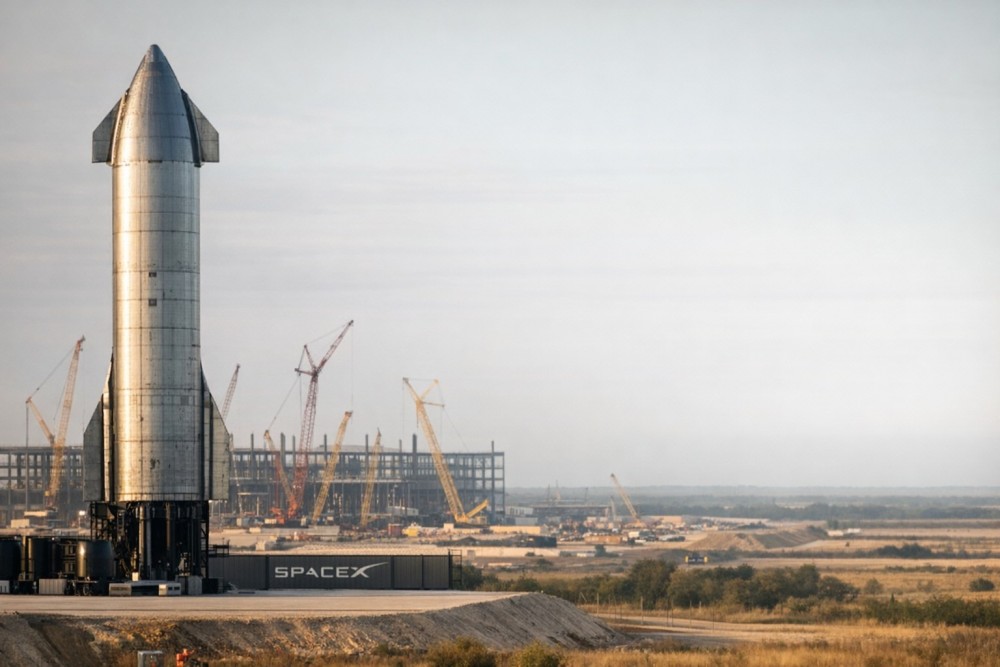
Investors have long been spectators in SpaceX’s journey.
While Tesla made electric vehicles a Wall Street theme, SpaceX has quietly become private space’s most significant company. Musk’s rocket manufacturer mastered reusable rockets, slashed launch costs, built the largest satellite internet company in the world with Starlink, and commercialized space travel.
But now imagine if…
SpaceX filed to go public at a valuation of nearly $1.75 trillion.
Such a valuation would make SpaceX one of the most significant IPOs in history.
The offering would be larger than Saudi Aramco. Meta. Alibaba.
Assuming SpaceX could achieve that billion-dollar valuation, it could become one of the most valuable companies in the world overnight.
However, if that occurs, investors could witness an even more significant event than the IPO itself:
The reset of space valuations.
Imagine SpaceX achieves a $1.75 trillion valuation. Wall Street would suddenly have a reference point to value a profitable, fully scaled space company.
It would open the door for other space companies to be repriced higher.
Just as Nvidia helped lead an AI infrastructure boom across the broader tech ecosystem, a SpaceX IPO could supercharge the entire space economy. Expect a significant halo effect to cross over into other launch companies, satellite companies, defense contractors, earth monitoring companies, space mining startups, and other verticals within the space industry.
And in my opinion, there is one name that could benefit longer term more than most:
Rocket Lab ($RKLB) — Biggest Secondary Gainer
RKLB is one of the most underrated names in all of retail’s favorite nano-cap rally section: space.
Rocket Lab is frequently written off by investors as “just a small rocket launching company.”
That is far from reality today.
Rocket Lab has quietly expanded its business into a vertically integrated space systems company. The business operates similarly to SpaceX years before Wall Street realized what SpaceX was building.
Rocket Lab today is:
- A launch provider
- Satellite manufacturer
- Spacecraft component supplier
- Mission software firm
- Government defense contractor
That is just what Rocket Lab does today.
But the company is increasingly looking like a full-stack space infrastructure company.
This is significant.
If SpaceX publicly trades at a valuation near $1.75 trillion one day, every institution will be searching for “the next best public space company.”
Rocket Lab is arguably the most straightforward solution to that problem.
4 Reasons Why a SpaceX IPO Changes Everything
The space economy remains relatively small in today’s public markets.
Space companies are largely viewed as highly speculative capital intensive businesses without a clear path to monetization for at least another decade.
However, if SpaceX became public at a $1.75 trillion valuation, it would immediately change the narrative on space.
Here’s why:
SpaceX has already validated:
- Reusable rockets
- Satellite internet
- Heavy government spending in space
- Defense / National security applications
- Launch cost competitiveness
- Space as a strategic asset
If these realities become even slightly ingrained into investor consciousness through corporate earnings, institutional investors, analyst coverage, ETFs, and indexes; you could see a massive spike into space infrastructure.
This has already happened once before with AI.
Investors drastically underestimated the size of the AI infrastructure market before Nvidia went public. However, once Nvidia started releasing earnings that demonstrated the massive size of AI growth, the entire semiconductor industry and infrastructure ecosystem started to skyrocket.
Wall Street will find “the next big thing” in space.
Billions of dollars could pour into space infrastructure companies if SpaceX validates even half of what it plans to do publicly.
Space Economy Could Reach $1+ Trillion Annual Revenue Run Rate
Experts are already saying the space economy could surpass $1 trillion in annual revenue by the end of the next decade.
Honestly, I believe $1 trillion will eventually be conservative.
Why?
Because nearly everyone analyzing the space economy today is looking at it through the lens of aerospace.
Space will increasingly impact:
- Telecommunications
- Defense
- AI
- Climate technology
- Logistics
- Earth monitoring
- Navigation
- Autonomous technology
- National security
- Energy
The list goes on.
Space is quickly becoming a foundational industry.
Think about what that means for valuations.
Investors aren’t just buying “rocket companies.”
They are buying space infrastructure companies that could very well own their market for the next several decades.
1. Rocket Lab (RKLB) — Clear Winner
RKLB is my biggest play for a SpaceX IPO.
Let me explain why:
A. Rocket Lab Is Quickly Turning Into A Full Space Company
When thinking about Rocket Lab, most investors immediately think of Electron rocket launches.
While launches are crucial to Rocket Lab’s business, the company is building much more than that.
Rocket Lab generates substantial revenue from space components, spacecraft parts, and satellite technology. Over the years, Rocket Lab has been buying companies that allow it to vertically integrate its space technology stack.
Rocket Lab currently provides:
- Solar panels
- Reaction wheels
- Spacecraft software
- Satellite buses
- Guidance technology
- Defense tech
And that is just the beginning.
Rocket Lab is proving to be a repeatable revenue stream creator.
Wall Street has not fully priced in the possibility of SpaceX being a high-margin, low-cost leader in launch. If SpaceX pushes launch costs even lower, we will see an acceleration of space infrastructure investments.
Rocket companies can be cyclical, low-margin businesses. But hardware providers to a future space economy could be tremendous long-term businesses.
B. Neutron Will Change The Narrative On Rocket Lab
Investors often sleep on just how game-changing Rocket Lab’s Neutron rocket could be.
If Neutron is successful, Rocket Lab has the chance to graduate from a small launch company into a meaningful player in medium-lift rockets. That will open the door for Rocket Lab to win national security contracts that were once only reserved for SpaceX and United Launch Alliance.
Think about how perception around Rocket Lab would shift if it began to compete with SpaceX.
Combined with a SpaceX IPO opening the space spigots, Rocket Lab could become the easiest way for institutions to gain public space exposure.
I’m being conservative here.
2. Intuitive Machines (LUNR)
Intuitive Machines is another name I like as a SpaceX IPO play.
The company specializes in lunar missions and moon infrastructure. While Moon missions remain speculative, investors love a narrative.
The more excitement there is around space, the more investors will price in future trends. The company could benefit if LUNR trades like a moon-play.
3. Redwire Corporation (RDW)
RDW is another strategically positioned company that may not get much love from retail investors.
The company provides:
- Space manufacturing equipment
- Solar arrays
- Mission infrastructure
- In-space servicing
A lot of these companies don’t get much love because investors fail to see how massive space manufacturing could become.
Think about how important cloud computing infrastructure is to the world today. Now imagine space manufacturing was just as cheap and accessible as cloud servers.
Suddenly, manufacturing parts in space doesn’t seem so crazy.
RDW is a pure play on reducing launch costs. Other companies like RKLB provide exposure to the government defense contracts that will come as infrastructure companies partner with the US government.
4. Iridium Communications (IRDM)
IRDM gets forgotten about because it’s already a known-established satellite company.
But here’s the thing about mature space companies:
They also tend to have recurring cash flow.
Iridium provides:
- Existing satellite infrastructure
- Government contracts
- Aviation and maritime customers
- Covered cash flows
As the space spigots open, I believe investors will start looking for quality space infrastructure businesses with proven profitability. Investors could turn to IRDM to gain exposure to satellite connectivity if SpaceX trades like Elon does every quarter.
5. AST SpaceMobile (ASTS)
This is easily the riskiest name on the list.
AST SpaceMobile is a direct-to-cell satellite company hoping to blanket the world with satellite coverage that will allow cellphones to access satellites directly.
Execution risk is high with ASTS.
But if they can execute, AST SpaceMobile could change the face of mobile infrastructure forever.
ASTS is a risk-on play that could significantly benefit from a SpaceX IPO.
Why Because SpaceX Matters
SpaceX going public is a narrative event.
Narratives drive markets. Once investors understand what SpaceX is trying to build, it will be challenging to trade against space infrastructure as a long-term megatrend.
Watch what happens to Bitcoin after Tesla announced it was a holder. Expect something similar to happen to space if SpaceX IPOs.
Wall Street Likes To Follow The Leader
Analysts will line up to initiate coverage on space companies. ETFs will have to add space allocations. Institutions will see buying opportunities. Pension funds will want exposure. Sovereign wealth funds will demand allocations.
Space will go from a zero to a hundred-type allocation overnight.
Remember how fast cloud computing went from a niche idea to a mega sector within tech?
It can happen in other industries too.
The space industry is getting a multiplier ETF, AI chip stock, and cloud computing all at once.
For Aerospace and Satellite Stocks, SpaceX IPO = Nvidia
Why SpaceX is significant to so many companies
Just imagine what happens when:
- Everyone realizes satellite internet is going to be a real thing
- SpaceX starts launching satellites monthly instead of quarterly
- SpaceX shares how low launch costs can go
- Enterprises begin to price in space as a real long-term investment case
- Countries begin to nationalize space around infrastructure, security, and telecommunications
SpaceX doesn’t even need to go public for most of this to happen. However, a SpaceX IPO would bring overnight visibility to space investing.
Risks To Your Investment Strategy
Not every space company is going to succeed.
Expect boat loads of space companies to:
- Run out of cash
- Dilute shareholders
- Go bankrupt
- Fail to achieve SpaceX-like scale
- Get bought out
- Go public to raise capital
Space is hard.
Due diligence has never been more critical. Here at Moonshot Trades, we try to weed out companies with no path to profitability, extreme dilution, or unrealistic use cases.
Ultimately, when evaluating space companies, investors should always ask themselves:
Is this company building real infrastructure?
Or is this company hoping to hop on board a space bubble?
Only time will tell how massive the space industry will become. But if history is any indication, space infrastructure companies like RKLB are going to own their respective markets for the long-term.
RKLB = Nvidia Of Space?
This may sound crazy now. But if investors realize what Rocket Lab is building today, it could look insane not to have RKLB on your portfolio.
Remember, there were people calling Nvidia overvalued in the beginning. The smart money was buying.
While we can’t predict the future, we can position ourselves for outcomes that are heavily weighted in our favor.
Building a future space infrastructure play like Rocket Lab fits that bill.
What are your thoughts on how a SpaceX IPO would impact the aerospace and satellite sectors? Let me know below!
Keep learning: courses on this topic
Self-paced courses to put this article into practice.
 Udemy
How to Invest in Stocks, Mutual Funds & ETFs for Beginners
Are you ready to take charge of your own investment accounts? Make informed decisions about how to manage your money and let it work for…
View course
 Udemy
Investing For Beginners: How To Invest With Confidence
This Course is for you if ...1. You know nothing about investing.2. You are new to stock market investing and looking for a place to…
View course
 Udemy
Personal Finance 101: Budget, Save & Invest
Do you ever feel like you’re working hard but not getting ahead? Do you get to the end of the month and wonder where all your money went?…
View course





Leave a Comment