
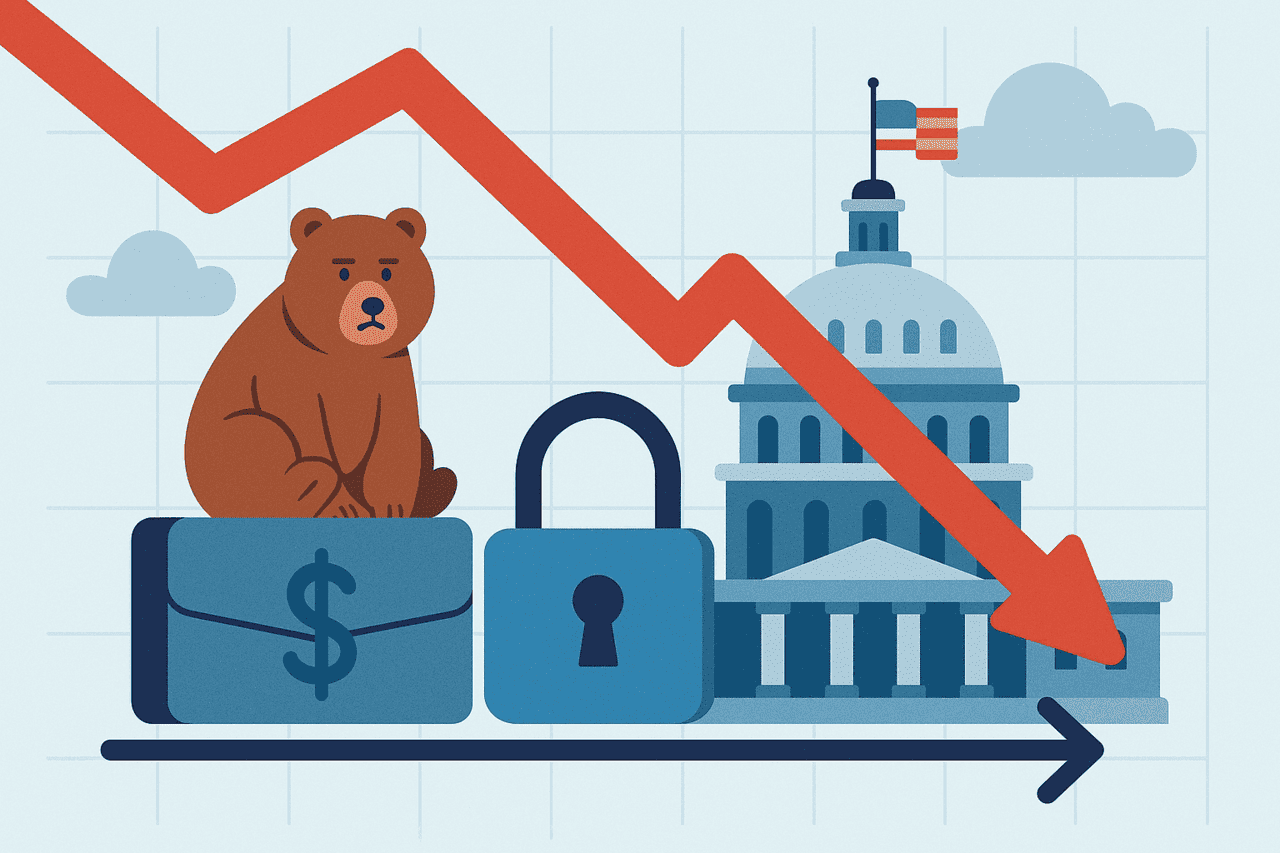
A U.S. government shutdown occurs when Congress can’t pass or the President won’t sign appropriations bills needed to fund the government. The last one occurred from December 2018 to January 2019, and one is looming in late 2021.
The shutdowns are always major news events, with countdown clocks on the news, finger-pointing between Democrats and Republicans, and concerns about the impact on public services and employees.
As an investor, you may be wondering what a shutdown means for your portfolio. The answer is, it depends.
On one hand, shutdowns do create headlines and a certain amount of short-term market volatility. They reflect a dysfunctional political climate in Washington, which is not great for market sentiment.
But if you look at the long-term performance of the stock market during shutdowns, you’ll see a very different story. In fact, history suggests there is usually no impact—or even a positive impact—on the stock market.
Shutdowns Are a Regular Occurrence
It may surprise you to learn just how often U.S. government shutdowns have occurred over the past few decades. In fact, since 1976, the U.S. has experienced nearly two dozen government shutdowns of various lengths.
That’s because the appropriations process in Congress can be quite contentious, and sometimes lawmakers can’t agree on a budget before the deadline.
Shutdowns also happen when there are divided government, with different parties controlling Congress and the White House. This has been the case for much of the past two decades.
Shutdown Lengths Vary Greatly
Shutdowns can last anywhere from one day to several weeks.
The longest shutdown in U.S. history occurred from December 2018 to January 2019, and lasted 34 days. Other recent long shutdowns include the 21-day shutdown in 2013 and the 16-day shutdown in 2018.
However, most shutdowns are much shorter, often lasting just a few days or even less.
Shutdowns: Little or No Impact on the Stock Market
Despite the drama of a shutdown, when you look at the data it’s striking just how little impact they appear to have on the stock market.
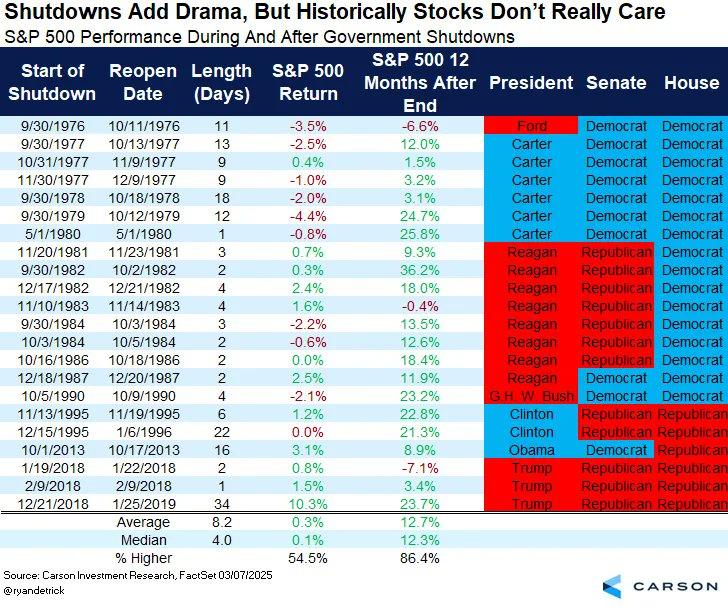
One study by Carson Investment Research (source: FactSet) examined S&P 500 returns during and after government shutdowns from 1976 to 2019.
The results? The market actually finished higher 86% of the time in the year after a shutdown.
You can also look at stock market performance before, during, and after individual shutdowns in history. Here are a few examples:
The 1976 shutdown was followed by a +15% increase in the S&P 500.
The 1980 shutdown saw a +29% gain in the market the following year.
The 2013 shutdown was followed by a +32% increase in the S&P 500 over the next year.
The point is, if you zoom out and look at the big picture, you won’t see much of a shutdown’s impact on the market.
The media often makes a big deal about the shutdown and its potential economic consequences. But investors are focused on the long-term trends in earnings and economic growth, and these bigger forces drive stock prices much more than a temporary funding lapse.
Remember: Investors Are Long-Term Investors
Most investors are long-term investors, meaning they buy and hold stocks for years or decades. Shutdowns, by contrast, are short-term events that last a few days to a few weeks.
For long-term investors, a government shutdown is just a blip on the radar. It may cause some short-term volatility, but it won’t derail the overall trend of the market.
Investors don’t need to worry about a shutdown derailing the economy, either. Most government functions continue during a shutdown, and essential services like Social Security and Medicare are still funded.
Shutdowns Affect Different Sectors Differently
Of course, a shutdown can have a negative impact on certain sectors of the economy. For example, government contractors and other businesses that rely on government spending may see reduced revenues.
Similarly, federal employees who are furloughed or working without pay during a shutdown will have less income to spend, which can hurt local businesses.
Federal agencies may also experience backlogs and other operational challenges when they reopen, which can have an impact on the services they provide.
But these sector-specific impacts are not the same thing as a broad-based stock market downturn.
The Bottom Line on Shutdowns
Shutdowns are noisy and political, but they usually don’t matter for investors. Here’s the data:
- Shutdowns have little to no impact on the stock market.
- Shutdowns rarely last long (average length of 7 days since 1976).
- Shutdowns don’t hurt economic growth.
- Shutdowns are just a distraction from the long-term fundamentals of the market and the economy.
The 2021 Shutdown Update: Don’t Let Politics Keep You Up At Night
Shutdowns have a number of negative economic and social consequences. They can hurt economic growth, increase the national debt, and cause harm to small businesses and federal employees.
Shutdowns also create uncertainty in financial markets, which can lead to volatility. But in general, this volatility is short-term and does not affect the long-term performance of the stock market.
If you’re an investor, there are a few things you can do during a shutdown:
- Don’t panic. Shutdowns are temporary and have historically had little to no impact on the stock market.
- Stay focused on the long term. The best way to ride out any market volatility is to maintain a well-diversified portfolio that is aligned with your long-term financial goals.
- Look for opportunity. If the market does react negatively to a shutdown, it may present buying opportunities for certain stocks or sectors.
- Pay attention to fundamentals. As always, focus on the fundamentals of the companies you own, and don’t let short-term political noise sway your investment decisions.
Conclusion: Keep a Long-Term Perspective
U.S. government shutdowns are an all-too-familiar feature of our political landscape. The next one may be around the corner if a deal isn’t reached by October 1st.
But as an investor, it’s important to keep things in perspective and not get too worked up about shutdowns. History has shown they rarely have a long-term impact on the stock market.
Investors are best served by focusing on the fundamentals of the economy and the companies they own, rather than getting distracted by political drama in Washington.
Shutdowns are just noise in the long-term investment journey. As the data above shows, the S&P 500 has historically gained in the year following a shutdown.
The best advice during a shutdown? Stick to your long-term investment strategy and stay disciplined. Over time, the market will forget about shutdowns just as it has in the past.
The moral of the story: Don’t sweat it. Stay invested, stay focused on the long term, and let history work in your favor.
Keep learning: courses on this topic
Self-paced courses to put this article into practice.
 Udemy
Investing For Beginners: How To Invest With Confidence
This Course is for you if ...1. You know nothing about investing.2. You are new to stock market investing and looking for a place to…
View course
 Udemy
Stock Investing Masterclass - Invest like the professionals
In this class we will teach you how to successfully invest in the stock market with the same knowledge that hedge funds and smart money…
View course
 Udemy
How To Invest In Stocks In 15 Minutes?
This is for anyone who wants a quick lesson on stocks and want to start trading stocks today—Within 15 minutes. This beginner guide will…
View course



Leave a Comment