
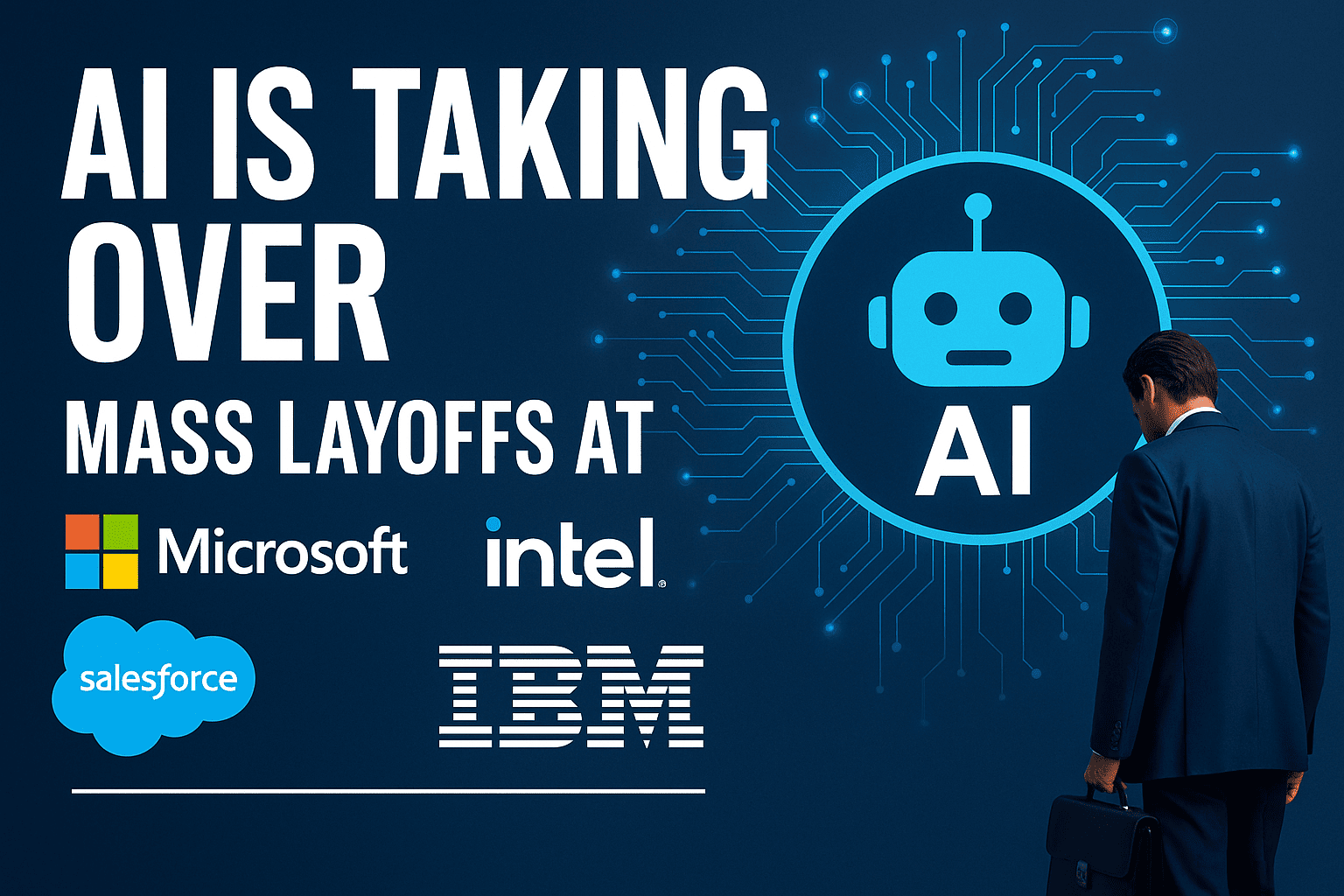
Over the last few months we’ve been inundated with a series of breathless headlines. At first it felt like one was rolling off the next. Taken together they signal a shift in tone about AI. No longer are we reading about “promising AI experiments” or “intriguing AI research”. AI is real now and it is changing the global workforce, in full view:
- Microsoft is laying off 9,000 workers
- Intel is outsourcing its marketing to Accenture and AI, slashing its headcount
- Salesforce says “AI is doing 50% of the work”
- IBM has replaced 8,000 workers with AI tools
Industry leaders are sounding the alarm: entire job categories may soon be gone
If that sounds like a dystopian nightmare, it should. But it should also sound like an inevitability. To those who have been following the rise of AI closely over the last few years, these aren’t sudden or surprising developments—they’re mile markers in a longer-term transformation that has only accelerated since ChatGPT and other tools were released in late 2022.
In this post we unpack what these big-name corporate layoffs really mean, why AI is behind it all, and what individuals and investors can do to prepare for the future.
The AI Tsunami Has Hit: Layoffs Signal Extreme AI Efficiency
Let’s break this down.
Microsoft’s Layoffs: Streamlining for a Smarter Workforce
Microsoft shocked the world by announcing 9,000 layoffs. But given the company’s deep AI investments and partnerships with OpenAI—and the Copilot AI already integrated into Office and Azure—it’s not surprising.
Documentation, code testing, content summarization, customer support—all functions that previously required legions of workers now can be at least partially or fully handled by AI agents. These are not simply cost cutting measures. These are productivity multipliers. Microsoft is wagering that the company can do more with fewer people, thanks to smarter tools.
Intel’s AI Shift: AI Outsourcing Human Functions
Intel is also reorganizing by outsourcing a significant chunk of its global marketing division to Accenture. Accenture in turn is using generative AI to perform ad targeting, campaign creation, and even analytics. As a result, Intel has cut back full-time marketing staff as well as contract and temporary roles. The stated goal is efficiency, but the end result is clearly AI replacing human decision makers and operational workers.
Salesforce: “AI Is Doing Half the Work”
Marc Benioff, the Salesforce co-CEO, has gone on the record as saying that AI is already doing up to 50% of the work internally. He means data processing, sales forecasting, marketing automation, and even parts of the software development process.
Tasks that used to require whole teams can now be cranked out by AI-powered dashboards and assistants. This is no longer sci-fi or some promise for the future. This is the present day.
IBM’s AI Replacements: 8,000 Jobs Lost
IBM announced it has replaced more than 8,000 jobs with AI, in particular HR and finance positions. Routine administrative functions like scheduling, payroll, report writing are all automated. The company has been reorganized around AI development, cloud infrastructure, and a hybrid workforce model.
This is no longer some start-up play or Silicon Valley hype. IBM, after all, is a legacy firm with over a century of history. And it too is getting swept up in the AI transition.
In short, we are living through that shift. AI is not just about productivity. It is also about replacing entire categories of work.
And we are only in the early innings.
The Four Waves of AI Disruption
A helpful way to think about this is that the impact of AI is playing out in four overlapping waves:
Automation of Routine Tasks: Scheduling, data entry, service scripts, report generation, etc. This is already well underway.
Augmentation of Expertise: AI is now serving as a “copilot” to help doctors diagnose, lawyers draft, and developers code more quickly and with greater accuracy.
Agent-Based Autonomous Systems: AI agents are now stringing together tasks on their own to do research, make purchases, manage investment portfolios, and even book trips without human intervention.
Physical Robotics: Tesla’s Optimus and other robotics companies are now making progress at AI-powered machines that can do physical labor. These may replace warehouse workers, factory line jobs, and home assistants.
These trends suggest both the depth and the future direction of the AI disruption.
What This Means for Jobs and Society
Layoffs are a symptom. AI is the cause.
AI’s impact on the labor market is going to be much more extreme than what we are seeing now. Entire professions and job categories are going to be made redundant. Economies and societies will be put under pressure and governments are going to need to step in with a social safety net that has never existed before.
One important difference in this cycle of automation is that white-collar work is now at risk. Not just blue-collar roles. This transformation is penetrating the professions: law, journalism, accounting, marketing, education, medicine, etc.
The skill that is most needed now more than ever is the ability to learn, adapt and work alongside AI.
What This Means for Investors
If this cycle of disruption is AI’s coming of age then it is also a once-in-a-generation opportunity for smart investors. This moment is not unlike the internet boom of the 1990s, the smartphone revolution of the 2010s, or the new internet in the 2020s. We are living through the rise of a new tech platform and AI is spawning entire new industries and businesses.
Industries to Watch:
- Semiconductors (Nvidia, AMD, etc.)
- Cloud infrastructure (Microsoft Azure, AWS, Google Cloud, etc.)
- AI software platforms (Palantir, OpenAI partnerships, etc.)
- Data and cybersecurity
- AI robotics (Tesla, Boston Dynamics spinoffs, etc.)
AI is going to add trillions to global GDP by the 2030s. Savvy investors are already positioning.
AI Is Here to Stay
Look, AI is real. Despite the skeptics, doomsayers, and naysayers. It is here. It is now. The revolution is not coming. It is here.
One day the people who say AI is a fad are going to look like the people who called the internet a bubble. Or the people who mocked smartphones.
People who were early to Amazon, Google, or Apple made fortunes. We may be seeing the same new wave of wealth creation in the next few years and those that understand AI and get on board are going to benefit.
Final Thoughts: Act or Get Replaced
If this post sounds like a wake-up call, it is meant to be. If you are a business leader, a mid-career employee, a recent graduate, or an investor, the takeaway is the same:
AI is not a threat you can afford to ignore.
This is not a reason to panic. This is a reason to act.
For workers:
- Get up to speed on AI tools that can be used to help do your daily job better.
- Build a portfolio of AI-aligned stocks and investments.
- Double down on uniquely human skills: Creativity. Emotional intelligence. Communication and writing. Decision making. Judgment.
- It is not about fearing AI. It is about learning how to leverage AI in your work and life.
For investors:
- Find the smartest, earliest players in the AI economy.
- Think software platforms, data, cloud infrastructure, semiconductors, and A-I robotics.
- Do your research.
- Stay up to date.
- Position early.
AI is not the end of work. It is not even the end of white-collar work. But it is the end of work as we know it.
The next decade will be marked by the people and companies that ride the wave and the ones that are wiped out by it.



Leave a Comment