
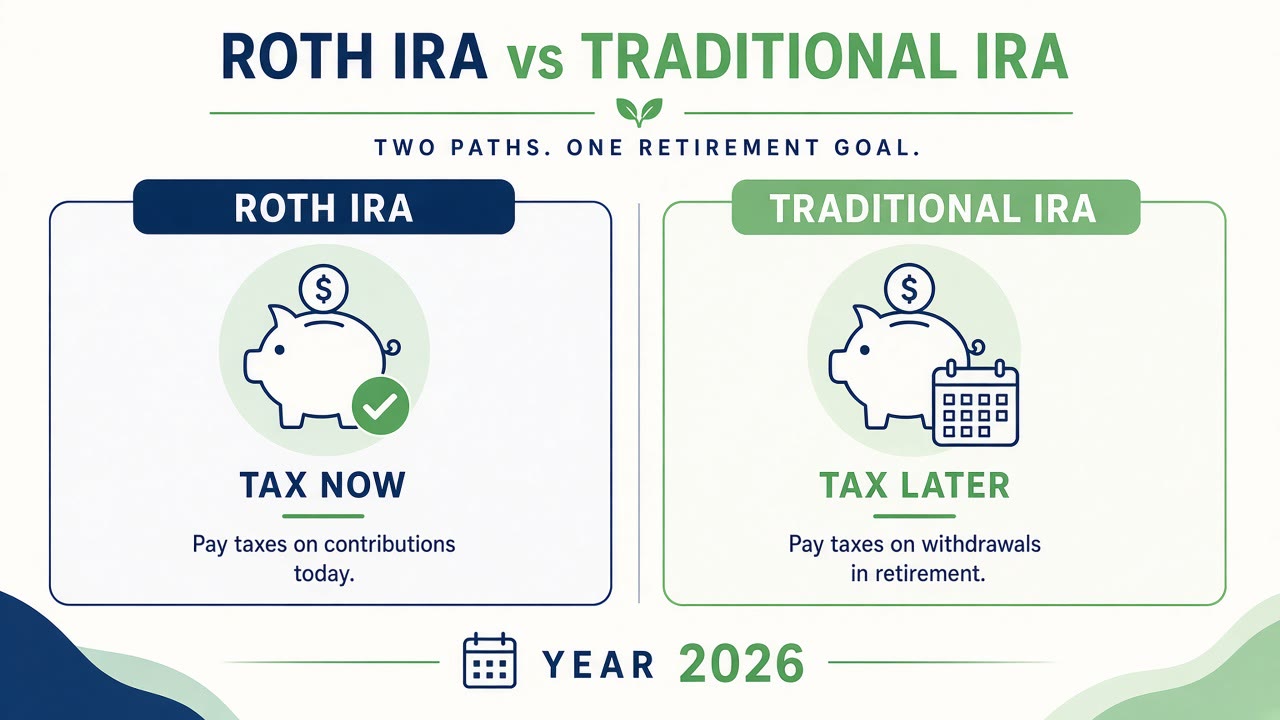
If you are choosing between a Roth IRA and a Traditional IRA in 2026, you are really choosing when you want to pay federal income tax on that savings — now, or later.
Both accounts can help you invest for retirement with tax advantages. Both share the same 2026 contribution ceiling. The differences that usually decide the winner are deductibility, income eligibility, withdrawal rules, and required minimum distributions (RMDs).
Quick answer: For 2026 you can contribute up to $7,500 across all your Traditional and Roth IRAs combined ($8,600 if age 50+), limited by taxable compensation. A Traditional IRA may give you a deduction now (subject to workplace-plan and income phaseouts). A Roth IRA uses after-tax contributions, can grow for potentially tax-free qualified withdrawals, and has no lifetime RMDs for the original owner. Prefer Traditional when you strongly expect a lower tax rate in retirement and can use the deduction. Prefer Roth when you expect a similar or higher future tax rate, want tax-free withdrawal flexibility, or want to avoid RMDs.
This is general education for US readers — not tax advice. Confirm your MAGI, plan coverage, and filing status with IRS Publication 590-A / 590-B or a tax professional.
Roth vs Traditional IRA at a glance (2026)
- Shared contribution limit: $7,500 under age 50; $8,600 age 50+ (combined across all Traditional + Roth IRAs), or taxable compensation if lower
- Traditional — tax on the way in: Contributions may be deductible now; withdrawals of deductible amounts and earnings are generally taxed as ordinary income later
- Roth — tax on the way in: Contributions are after-tax (not deductible); qualified withdrawals of contributions and earnings can be federal-income-tax-free
- Traditional — income limits: No income limit to *contribute*; income can limit the *deduction* if you or your spouse is covered by a workplace plan
- Roth — income limits: Direct contributions phase out at higher MAGI (see 2026 ranges below)
- Traditional — RMDs: Generally required starting at age 73 for people born 1951–1959, or age 75 if born in 1960 or later (SECURE 2.0)
- Roth IRA — RMDs: Not required during the original owner’s lifetime
- Early access: Roth contributions (not earnings) can generally be withdrawn anytime without tax or penalty; Traditional early withdrawals are often taxable and may face a 10% additional tax unless an exception applies
2026 IRA contribution limits
For tax year 2026, the IRS combined limit for Traditional and Roth IRAs is:
- $7,500 if you are under age 50
- $8,600 if you are age 50 or older (includes a $1,100 catch-up)
That limit is shared. You cannot put $7,500 into a Traditional IRA and another $7,500 into a Roth IRA in the same year. You can split the total any way you like (all Traditional, all Roth, or a mix), as long as you stay within the combined ceiling and your taxable compensation.
Rollover contributions do not count against this annual limit.
Deadline note: IRA contributions for a tax year can generally be made until the tax filing deadline for that year (not including extensions) — often mid-April of the following year. Confirm the exact deadline for the year you are funding.
How a Traditional IRA works
A Traditional IRA is designed around tax deferral.
- You may deduct contributions on your federal return if you qualify
- Investments can grow tax-deferred inside the account
- Withdrawals of pre-tax contributions and earnings are generally taxed as ordinary income
- If you made nondeductible contributions, part of later withdrawals may be a nontaxable return of basis (track with Form 8606)
When Traditional IRA deductions phase out in 2026
If neither you nor your spouse is covered by a workplace retirement plan, Traditional IRA contributions are generally fully deductible regardless of income (subject to the contribution limit and compensation rules).
If you are covered by a workplace plan, the 2026 deduction phaseout ranges (modified AGI) are:
- Single / head of household: $81,000 to $91,000
- Married filing jointly (contributor covered): $129,000 to $149,000
- Married filing jointly (contributor not covered, spouse is): $242,000 to $252,000
- Married filing separately (covered): $0 to $10,000 (not inflation-adjusted)
Inside the phaseout range you may get a partial deduction. Above the top of the range, a covered worker generally cannot deduct the contribution — though a nondeductible Traditional IRA contribution may still be allowed.
How a Roth IRA works
A Roth IRA is designed around tax-free qualified withdrawals.
- Contributions are made with after-tax dollars (no upfront deduction)
- Qualified distributions of earnings can be federal-income-tax-free
- You can generally withdraw your direct contributions anytime without federal income tax or the 10% early-withdrawal additional tax
- Earnings generally need to meet the 5-year rule plus a qualifying event (often age 59½, disability, death, or a limited first-time home purchase) to come out tax-free
2026 Roth IRA income phaseouts (direct contributions)
Your ability to contribute directly to a Roth IRA depends on filing status and MAGI:
- Single / head of household: full contribution below $153,000; phaseout $153,000–$168,000; no direct contribution at $168,000+
- Married filing jointly: full contribution below $242,000; phaseout $242,000–$252,000; no direct contribution at $252,000+
- Married filing separately (lived with spouse): phaseout $0–$10,000
If your income is too high for a direct Roth contribution, some people use a backdoor Roth strategy (nondeductible Traditional contribution + conversion). That approach has pro-rata and reporting rules; it is covered in depth in our Roth IRA income limits 2026 guide and needs careful tax handling.
The real decision: tax rate now vs later
The textbook rule of thumb:
- Traditional tends to win if your marginal tax rate today is higher than you expect in retirement (deduction is more valuable now).
- Roth tends to win if your marginal tax rate today is similar or lower than you expect later (paying tax now locks in tax-free qualified growth).
- If you are unsure, a split (some Traditional, some Roth over time) is a reasonable hedge — still under one combined IRA contribution limit each year.
Other reasons Roth can win even when rates look similar:
- No lifetime RMDs for the original owner, which helps tax-bracket management and heirs planning
- Contribution withdrawals can add emergency flexibility (still not a substitute for a cash emergency fund)
- Tax-free qualified withdrawals do not increase taxable income the way Traditional withdrawals / RMDs can (which can also matter for Medicare IRMAA and taxation of Social Security benefits)
Other reasons Traditional can win:
- The upfront deduction frees cash flow today
- If you expect to be in a much lower bracket later, deferral can reduce lifetime tax
- If you are below Roth income limits but want maximum current-year tax reduction, deductible Traditional may fit better
Worked scenarios (illustrative, not predictions)
These examples use 2026 federal IRA limits. They are scenarios, not forecasts of investment returns or future tax law.
Scenario A — Early-career worker, lower current bracket
Jordan is 28, single, MAGI $70,000, no huge itemized deductions, expects higher earnings later.
- Likely lean: Roth IRA (pay tax now at a relatively modest rate; buy tax-free qualified growth)
- 2026 contribution room: up to $7,500
- Also contribute enough in a workplace 401(k) to capture any match first
Scenario B — Peak earner covered by a 401(k)
Sam is 45, married filing jointly, MAGI $180,000, covered by a workplace plan.
- Traditional IRA deduction likely phased out (joint phaseout for covered contributor ends at $149,000 in 2026)
- Direct Roth still available (joint full Roth below $242,000)
- Likely lean: Roth IRA for the IRA dollars (Traditional deduction not available); still max the 401(k) separately
- See BearSavings’ 401(k) limits guide for workplace deferral math
Scenario C — Near-retiree who wants a deduction now
Riley is 58, MAGI $95,000 single, covered by a workplace plan, plans to retire in a few years with mostly taxable retirement income still uncertain.
- Traditional deduction phaseout for single covered workers is $81,000–$91,000 — at $95,000, deductible Traditional may be unavailable
- Roth phaseout for single starts at $153,000 — Roth contribution still allowed
- Likely lean: Roth for IRA contributions; review whether Roth 401(k) vs pre-tax 401(k) is the bigger lever at work
- Catch-up: age 50+ IRA limit is $8,600 for 2026
Scenario D — Expecting a sharp income drop in retirement
Casey is 50, high earner today, expects mostly paid-off housing and a much lower taxable income after stopping work.
- If a Traditional deduction is available, Traditional may reduce tax in high-earning years
- Still consider some Roth space over time so future RMDs and Social Security taxation are easier to manage
Withdrawals, early access, and RMDs
Traditional IRA withdrawals
- Earnings and deductible contributions are generally taxable when withdrawn
- Before age 59½, a 10% additional tax often applies unless an IRS exception qualifies
- RMDs generally begin at age 73 (born 1951–1959) or age 75 (born 1960 or later), even if you are still working (IRA rule differs from many workplace plans)
Roth IRA withdrawals
- Direct contributions: generally withdrawable anytime, tax- and penalty-free
- Earnings: need qualified distribution rules (5-year clock + qualifying event) for tax-free treatment
- No RMDs for the original owner during life; beneficiaries have their own distribution rules
Missing a Traditional IRA RMD can trigger an excise tax (generally 25%, potentially reduced if corrected timely). The account owner is responsible for taking the correct amount. Our required minimum distributions (RMDs) 2026 guide covers the IRS table, the deadlines and the step-by-step math.
How IRA choice fits next to a 401(k)
For many households the order of operations looks like this:
- Contribute enough to the workplace plan to get the full match
- Fund a Roth or Traditional IRA (whichever fits your tax picture) up to the annual limit
- Return to the 401(k) toward the much higher elective deferral limit
- Consider taxable brokerage savings after tax-advantaged room is used
IRAs and 401(k)s have separate contribution limits. Using one does not reduce the other’s dollar cap, though your cash flow still has one budget.
Related BearSavings reading:
- How Much Should I Contribute to My 401(k) Per Paycheck in 2026?
- The Ultimate FIRE Guide
- Why the 4% Rule May No Longer Be Enough for Retirement
- How to Invest in the S&P 500
- FIRE Score Calculator
Common mistakes when choosing
- Assuming you can fully fund both a Traditional and a Roth IRA at $7,500 each
- Focusing only on “Roth is always better” without checking whether a Traditional deduction is available and valuable
- Ignoring workplace-plan coverage when estimating Traditional deductibility
- Mixing up Roth *contribution* income limits with Traditional *deduction* income limits
- Forgetting state income tax rules can differ from federal treatment
- Treating IRA choice as a substitute for capturing a 401(k) match
- Skipping Form 8606 tracking when making nondeductible Traditional contributions
Bottom line
For 2026, Roth vs Traditional is mostly a tax-timing decision under one shared contribution limit of $7,500 ($8,600 age 50+). Choose Traditional when a deduction is available and you expect a meaningfully lower tax rate later. Choose Roth when you want tax-free qualified withdrawals, no lifetime RMDs, or your current bracket already looks modest relative to your future. If you are unsure, splitting contributions over time is a practical hedge — then invest the account consistently.
General education for US readers. Not tax, legal, or investment advice. Rules and phaseouts change; verify with IRS sources and your tax advisor.
Keep learning: courses on this topic
Self-paced courses to put this article into practice.
 Udemy
How to use your IRA or 401K to invest in real estate
If you are tired of trusting wall street with all of your retirement savings, come and learn about some alternative strategies to invest…
View course
 Udemy
Complete Personal Finance Course: Earn, Save and Invest
A self-paced video course on budgeting, saving and investing, with practical lessons you can apply right away.
View course
 Udemy
Invest Like a Pro: Your First Steps in Wealth Creation
A self-paced video course on budgeting, saving and investing and investing basics, with practical lessons you can apply right away.
View course




Leave a Comment