
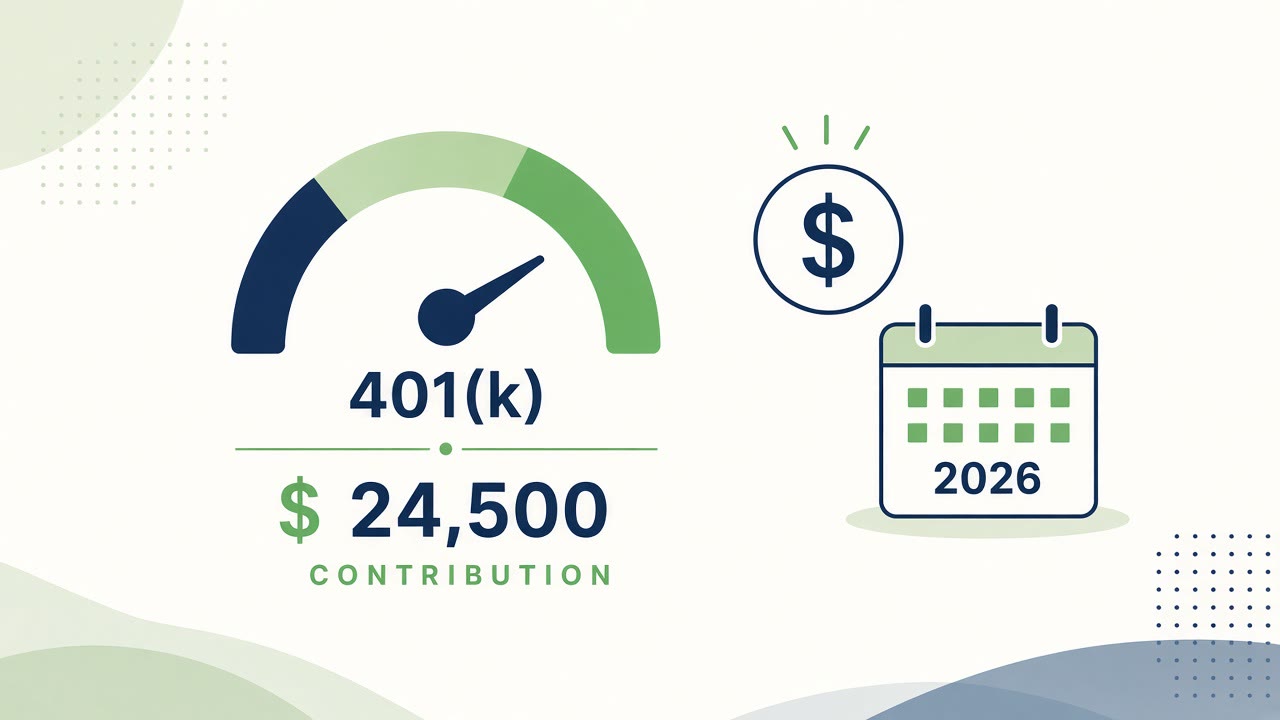
If you are asking how much to put in your 401(k) each paycheck in 2026, start with the new IRS annual limits — then divide by your pay schedule. The IRS raised several contribution caps for tax year 2026, and SECURE 2.0 also changed how many high earners must treat catch-up contributions.
This guide gives you the official 2026 dollar limits, a simple per-paycheck translation, how traditional and Roth 401(k) deferrals share the same employee ceiling, what changed for ages 60–63, and the new Roth catch-up rule.
Quick answer: For 2026, most employees can defer up to $24,500 per year (~$942 biweekly). Ages 50+ can generally add an $8,000 catch-up ($32,500 total, ~$1,250 biweekly). Ages 60–63 can use a higher $11,250 catch-up if the plan allows ($35,750 total, ~$1,375 biweekly). Combined employee + employer contributions are generally capped at $72,000 (catch-ups are extra). High earners over a $150,000 prior-year FICA wage threshold must make catch-ups as Roth.
2026 401(k) limits at a glance
- Employee elective deferrals (pre-tax + Roth combined): $24,500 — Under age 50 (and anyone not using catch-ups)
- Standard catch-up (age 50+): $8,000 — Ages 50–59 and 64+ (if the plan allows)
- Higher “super” catch-up (ages 60–63): $11,250 — Ages 60, 61, 62, or 63 (if the plan allows)
- Max employee deferrals with standard catch-up: $32,500 — Age 50+ using the $8,000 catch-up
- Max employee deferrals with super catch-up: $35,750 — Ages 60–63 using the $11,250 catch-up
- Annual additions (employee + employer + forfeitures): $72,000 — Per employer plan family; catch-ups generally sit on top
- Compensation limit used for plan calculations: $360,000 — Cap on pay that can be counted for contribution formulas
- Roth catch-up wage threshold (lookback): $150,000 FICA wages in 2025 — Determines if 2026 catch-ups must be Roth
Sources: IRS news release IR-2025-111, IRS Notice 2025-67 / COLA tables, and the IRS “Retirement topics – 401(k) and profit-sharing plan contribution limits” page.
Employee elective deferral limit: $24,500 in 2026
For 2026, the IRS employee elective deferral limit under Internal Revenue Code section 402(g) is $24,500, up from $23,500 in 2025.
That $24,500 is a personal limit across plans that share the same elective-deferral rules. Pre-tax 401(k) deferrals and designated Roth 401(k) deferrals count toward the same $24,500. You can split the limit any way your plan allows (all pre-tax, all Roth, or a mix), but you cannot put $24,500 into each.
The same $24,500 figure generally also applies to elective deferrals to 403(b) plans, most governmental 457(b) plans, and the federal Thrift Savings Plan (TSP), though each plan type has its own nuances. SIMPLE 401(k) plans use a lower elective deferral limit ($17,000 in 2026).
Your plan can set a lower internal cap. Highly compensated employees may also be limited by nondiscrimination testing.
Catch-up contributions for ages 50 and older
If your plan permits catch-up contributions and you are age 50 or older by December 31, 2026, you may contribute above the $24,500 deferral limit.
Standard catch-up: $8,000
For 2026, the standard catch-up for most 401(k), 403(b), governmental 457(b), and TSP participants is $8,000 (up from $7,500 in 2025). Combined with the base deferral limit, that is $32,500.
Higher catch-up for ages 60–63: $11,250
SECURE 2.0 created a higher catch-up for participants who turn 60, 61, 62, or 63 during the calendar year. For 2026, that higher catch-up is $11,250 instead of $8,000, for a combined employee deferral total of $35,750, if the plan allows it.
This higher amount replaces the standard catch-up for those ages; it is not stacked on top of the $8,000.
Plan permission matters. Catch-ups are optional plan features. Confirm with your plan administrator whether standard and/or age 60–63 catch-ups are offered.
Traditional vs Roth 401(k): same dollar limit, different tax timing
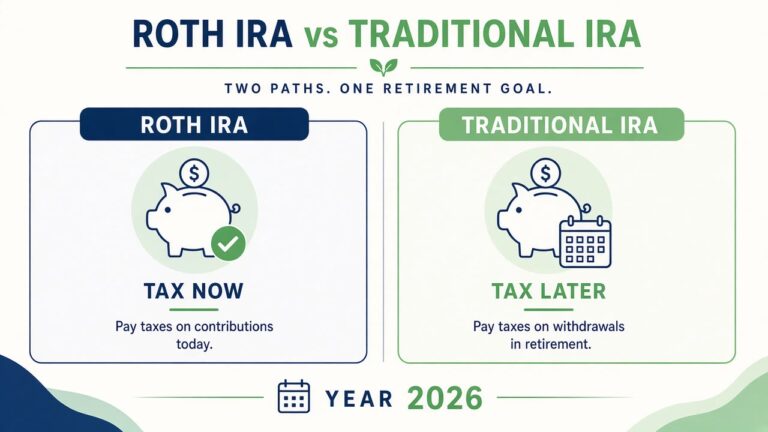
A traditional (pre-tax) 401(k) deferral usually reduces taxable wages in the contribution year. Withdrawals of pre-tax amounts and earnings are generally taxed as ordinary income later.
A Roth 401(k) deferral is made with after-tax dollars. Qualified withdrawals of contributions and earnings can be federal-income-tax-free if the account meets the Roth 5-year rule and a qualifying event (typically age 59½, disability, or death).
For the 2026 elective deferral limit, traditional and Roth deferrals are interchangeable dollars under the same $24,500 (plus catch-up) ceiling. Choosing Roth vs pre-tax is a tax-timing decision, not a way to raise the limit.
The overall annual additions limit: $72,000 in 2026
Separate from the employee deferral cap, IRC section 415(c) limits total “annual additions” to a participant’s accounts in plans of one employer (and related employers) to the lesser of:
- 100% of compensation, or
- $72,000 for 2026 (up from $70,000 in 2025)
Annual additions generally include:
- employee elective deferrals (not including catch-up contributions)
- employer matching contributions
- employer nonelective / profit-sharing contributions
- allocations of forfeitures
Catch-up contributions are generally in addition to the $72,000 annual additions limit. The IRS 401(k) contribution-limits page illustrates 2026 combined figures of about $80,000 including the standard $8,000 catch-up, or up to about $83,250 including the $11,250 age 60–63 catch-up.
There is also a $360,000 annual compensation limit for 2026 used when applying many plan contribution formulas.
New for 2026: mandatory Roth catch-ups for many high earners
Starting January 1, 2026, SECURE 2.0’s Roth catch-up rule takes effect for many higher-paid workers.
In plain English: If you are age 50+ and your 2025 FICA wages from the employer that sponsors the plan exceeded $150,000, any 2026 catch-up contributions to that plan generally must be designated Roth (after-tax), not pre-tax.
Key details:
- The wage test uses prior-calendar-year FICA wages (often Form W-2 Box 3), not AGI.
- The $150,000 threshold for the 2026 determination is the inflation-adjusted amount tied to IRC section 414(v)(7) (see IRS Notice 2025-67).
- The rule applies to catch-up amounts only. You can still choose pre-tax and/or Roth for deferrals within the regular $24,500 limit, subject to plan rules.
- It applies to standard catch-ups and to age 60–63 “super” catch-ups.
- If a plan allows catch-ups but has no Roth feature, high earners subject to the mandate generally cannot make catch-up contributions until the plan adds Roth.
- New hires with little or no prior-year FICA wages from that employer may not meet the threshold even if current pay is high.
This is a federal payroll/plan rule. State income tax treatment of Roth contributions and distributions can differ by state; confirm with a tax professional if your state taxes retirement contributions or withdrawals differently.
Worked examples (illustrative)
These scenarios use 2026 federal limits. They are examples, not tax advice, and assume the plan allows the stated features.
Example A — Age 42, maximizes employee deferrals
Alex is 42 and wants the maximum employee contribution.
- Elective deferrals: $24,500
- Catch-up: $0 (under 50)
- Total employee deferrals: $24,500
If Alex’s employer also contributes a $6,000 match, annual additions are $24,500 + $6,000 = $30,500, well under the $72,000 cap.
Example B — Age 55, uses standard catch-up
Blair is 55.
- Base deferrals: $24,500
- Catch-up: $8,000
- Total employee deferrals: $32,500
If Blair’s 2025 FICA wages from this employer were $160,000, the $8,000 catch-up must be Roth. The $24,500 base can still be pre-tax, Roth, or split (plan permitting).
Example C — Age 62, uses super catch-up
Casey turns 62 in 2026 and the plan offers the higher catch-up.
- Base deferrals: $24,500
- Super catch-up: $11,250
- Total employee deferrals: $35,750
If Casey is over the Roth catch-up wage threshold, the $11,250 must be Roth.
Example D — Large employer profit-sharing
Dana is 47, defers $24,500, receives a $10,000 match, and a $30,000 profit-sharing contribution.
- Annual additions: $24,500 + $10,000 + $30,000 = $64,500
- Still under the $72,000 annual additions limit
- No catch-up available (under 50)
How much should you contribute per paycheck?
Annual IRS limits are the ceiling. Your per-paycheck number is just that ceiling (or your chosen savings target) divided by how often you get paid — then adjusted for employer match and cash-flow needs.
Simple formula:
Per-paycheck deferral ≈ annual employee contribution goal ÷ number of paychecks per year
- Weekly (52 paychecks/year): under 50 ~~$471; with $8,000 catch-up ~~$625; with $11,250 super catch-up ~~$688
- Biweekly (26 paychecks/year): under 50 ~~$942; with $8,000 catch-up ~~$1,250; with $11,250 super catch-up ~~$1,375
- Semimonthly (24) (24 paychecks/year): under 50 ~~$1,021; with $8,000 catch-up ~~$1,354; with $11,250 super catch-up ~~$1,490
- Monthly (12 paychecks/year): under 50 ~~$2,042; with $8,000 catch-up ~~$2,708; with $11,250 super catch-up ~~$2,979
Figures are rounded. Payroll systems may truncate pennies; if you aim for the exact annual maximum, check a mid-year YTD total and nudge the last few elections.
A practical “should” framework (not a promise)
There is no single correct percentage for every household. A workable order of operations for many US workers:
- Contribute enough to capture the full employer match — skipping free match is usually the costliest miss.
- Build a basic emergency buffer outside the 401(k) if you do not have one.
- Increase toward the IRS maximum if cash flow allows, especially in peak earning years.
- Use catch-ups at 50+ (and the higher ages 60–63 amount if your plan offers it) when you are playing catch-up on retirement savings.
- Watch the Roth catch-up rule if your prior-year FICA wages from this employer exceeded $150,000 — catch-ups may have to be Roth even if your base deferrals stay pre-tax.
“Should” depends on debt interest rates, expected tax bracket now vs later, job stability, and other goals. The IRS limit tells you the maximum allowed, not the amount your budget can support.
How to actually use the higher 2026 limits
- Log into your plan / payroll portal and raise your deferral percentage or flat-dollar election early enough for payroll to catch up before year-end.
- Confirm Roth availability if you are near or above the catch-up wage threshold, or if you prefer Roth for the base deferral.
- Ask HR / the plan administrator whether age 60–63 catch-ups are enabled.
- Watch the combined limit if you change jobs mid-year or contribute to more than one 401(k)/403(b). The $24,500 elective deferral limit is aggregated across those plans; excess deferrals generally need correction by the following April 15 to avoid double taxation.
- Coordinate employer money. A generous match or profit-sharing contribution can approach the $72,000 annual additions limit even if your own deferral is not at the maximum.
Common mistakes to avoid
- Treating Roth and traditional 401(k) as separate $24,500 buckets
- Assuming every plan offers catch-ups or the age 60–63 higher catch-up
- Ignoring the new Roth catch-up mandate and expecting a pre-tax catch-up if you are over the wage threshold
- Forgetting that multiple unrelated employers’ plans still share one personal elective deferral limit
- Confusing the employee deferral limit with the higher annual additions limit that includes employer contributions
- Using 2025 dollar amounts when setting late-2026 elections
How this fits a broader retirement plan
Maxing a 401(k) is one building block, not a complete plan. Contribution room works best alongside an investing approach you can stick with, a clear savings rate, and a retirement income framework.
Related BearSavings reading:
- The Ultimate FIRE Guide — early-retirement strategy types
- Why the 4% Rule May No Longer Be Enough for Retirement — withdrawal-rate caution
- How to Invest in the S&P 500 — simple equity-market building block many 401(k) menus include
- How to Retire at 60 — timeline planning around traditional retirement ages
- FIRE Score Calculator — progress check toward financial independence
Bottom line
For 2026, plan around $24,500 in employee elective deferrals, $8,000 in standard catch-ups (or $11,250 at ages 60–63 if allowed), and a $72,000 annual additions ceiling before catch-ups. If your prior-year FICA wages from the plan sponsor exceeded $150,000, treat catch-ups as Roth. Verify the final setup in your own plan documents and payroll elections before year-end.
This article is for general education for US readers. It is not tax, legal, or investment advice. Contribution limits and plan features change; confirm figures with IRS publications and your plan administrator.
Keep learning: courses on this topic
Self-paced courses to put this article into practice.
 Udemy
Complete Personal Finance Course: Earn, Save and Invest
A self-paced video course on budgeting, saving and investing, with practical lessons you can apply right away.
View course
 Udemy
Get Out of Debt, SAVE, Increase Wealth, Invest In The Future
Personal Finance, Investing, and Retirement: Get Out of Debt & Get Your Money to Work For You. Do you work hard for your money? Get your…
View course
 Udemy
Invest Like a Pro: Your First Steps in Wealth Creation
A self-paced video course on budgeting, saving and investing and investing basics, with practical lessons you can apply right away.
View course




Leave a Comment