
Rocket Lab (NASDAQ: RKLB) fell approximately 7% in after-hours trading on Aug. 10 following its Q2 20LY earnings report.
I get it. The easy takeaway from tonight is pretty clear:
Neutron might be delayed until after 2026.
Margins will take a hit next quarter.
Rocket Lab remains unprofitable.
Sell the stock.
I stared at the numbers for a while, however, and walked away with something almost diametrically opposed to that takeaway.
Rocket Lab’s Q2 earnings were primarily about how fast the rest of Rocket Lab is evolving into a much larger space company ahead of any material Neutron revenues.
And it’s that number — or, should I say, group of numbers — that I think investors should be focused on.
- Why Did Rocket Lab Stock Fall After Earnings?
- Rocket Lab Just Reported Record Revenue — Again
- The Number I Think Investors Should Be Talking About: $2.36 Billion
- The Biggest Earnings Beat Was Hidden Further Down the Report
- Rocket Lab Is Quietly Becoming Much More Than a Rocket Company
- Ironically, a Neutron Delay Could Matter Less Than Investors Think
- There Are Still Risks RKLB Investors Shouldn’t Ignore
- My Take: The 7% Drop Was About Expectations, Not Business Deterioration
Why Did Rocket Lab Stock Fall After Earnings?
But before we get to the good news, let’s address the negativity heading this headline because there was good reason for markets to react this way.
Rocket Lab had been discussing launching Neutron for the first time in the fourth quarter of 2026.
At earnings, however, the company changed its tune, only saying it expects to have the first stage tank ready for delivery to the launch site for Neutron in Q4 2026.
CEO Peter Beck would go on to say during the call that the opportunity for a year-end launch “is starting to slip away.” Reuters would later write that’s amounted to “reportedly slipping Neutron timeline.”
This matters because Neutron is not just another rocket launch.
Neutron is probably Rocket Lab’s single most important product roadmap item.
Electron made Rocket Lab one of the only companies in the world that could reliably launch payloads into orbit. Neutron is what opens the door for Rocket Lab to compete on bigger constellation launches, national security missions and commercial contracts.
Investors are right to pay attention to every month that passes in Neutron’s development timeline.
Rocket Lab also surprised on margins.
For the third quarter, Rocket Lab is guiding for GAAP gross margins of just 29% to 31%. Non-GAAP gross margins are expected to be 35% to 37%. Reuters noted the Street was looking for GAAP gross margins of approximately 37.6%. Management said part of the miss is due to lower margin satellite-platform sales making up a larger percentage of revenue.
When you combine those two bullets, you see why traders pushed sell buttons.
But here’s where things get juicy.
Rocket Lab Just Reported Record Revenue — Again
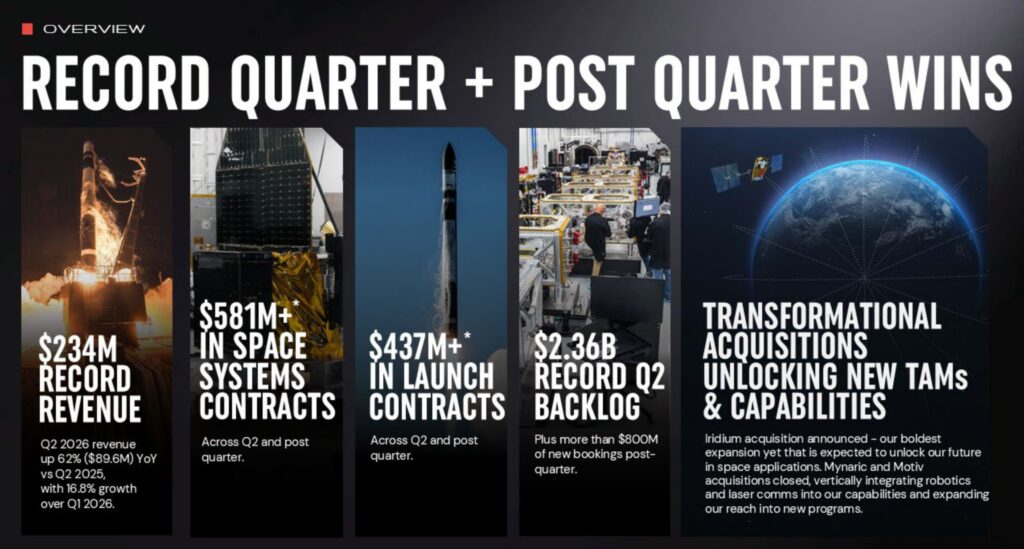
Rocket Lab had $234 million in revenue for Q2 2026.
That was another all-time quarterly revenue record.
More impressively, revenue grew 62% annually and was ~$34 million higher than Q1’s prior record.
The growth pace here is important to think about.
Rocket Lab is not passively waiting on Neutron to bail them out.
Their core business is booming.
Management is guiding to revenue of $250-$265 million for Q3. Rocket Lab will have the opportunity to immediately establish another quarterly revenue record.
At the midpoint, this implies $257.5 million in revenue.
Rocket Lab is now approaching a quarterly run rate of over $1 billion on an annualized basis before Neutron has even flown once.
To me, this shifts how the company needs to be evaluated.
Rocket Lab is quickly transitioning from just an Electron launch company looking to build a bigger rocket.
Rocket Lab is evolving into a true space infrastructure company.
The Number I Think Investors Should Be Talking About: $2.36 Billion
Revenue was strong.
But I actually think Rocket Lab’s backlog could be even more significant.
The rocket company finished Q2 with a record $2.36 billion backlog, up 137% from a year ago.
That already large figure is getting even bigger.
Beck said Rocket Lab has already seen more than $1 billion of new contracts for launch and space systems when combining Q2 backlog with deals signed after the quarter. That includes contracts signed during Q3.
$1 billion. In one quarter. For a company that only posted $234 million in revenue for the entire quarter.
Rocket Lab also announced more than $437 million of new launch contracts for Electron, HASTE, and Neutron during Q2 and after. With that addition, Rocket Lab’s contracted launch manifest topped 90 missions.
For that reason, I’m not sure focusing only on if Neutron launches in December 2026 or sometime after is particularly productive thinking.
I do want Neutron launching ASAP. No question there.
But what matters even more to me is if customers are willing to commit and sign contracts for Rocket Lab’s offerings. And today, it appears they are.
The Biggest Earnings Beat Was Hidden Further Down the Report
Here’s probably my favorite number from the quarter:
Rocket Lab had been guiding investors to an adjusted EBITDA loss of $20 million to $26 million for the second quarter.
Guess how much adjusted EBITDA loss the company actually reported?
$8.8 million.
Rocket Lab reported an adjusted EBITDA loss of approximately $27.6 million in Q2 2020.
Rocket Lab is crushing its own expectations.
There’s more:
Rocket Lab guided investors to expect Q2 non- GAAP gross margin in the range of 38% to 40%.
Non- GAAP gross margin actually came in at 41.5%.
The market is rightfully concerned about margin compression next quarter as Rocket Lab moves to its next-gen LauncherOne Rutherford.
But the quarter just completed was actually much stronger than expected from an operational standpoint.
Of course, Rocket Lab is still losing money.
The company reported a net loss for Q2 of approximately $49.3 million, or $0.08 per share.
That’s an improvement from a loss of $66.4 million, or $0.13 per share, in Q2 2020.
I get it, investors.
Rocket Lab Is Quietly Becoming Much More Than a Rocket Company
We’ll probably never see full funding for Neutron. This, I think, is the single biggest reason why my long-term thesis on Rocket Lab holds true.
Consider what Rocket Lab is building. Launch is just one layer of the stack.
Satellite manufacturing is another layer. Satellite components are another layer. Optical communications is another layer. National- security spacecraft are another layer. Rocket Lab is now even taking steps to operate space infrastructure itself.
The company announced its intention to acquire Iridium Communications this week as part of its efforts to become a vertically integrated company that can design, manufacture, launch and ultimately operate constellations.
“We’re excited to announce plans to acquire Iridium Communications,” said Peter Beck, CEO and founder of Rocket Lab. “This is a significant step in Rocket Lab’s evolution towards vertically integrating satellite manufacturing, launch services, and satellite operation.”
This is Rocket Lab talking about acquiring another company with a market capitalization of more than $3 billion. That is a very different business than the Rocket Lab many investors first bought into years ago.
Rocket Lab was also awarded a contract worth up to $397 million to provide multiple Flatellite spacecraft to help power the U. S. Space Force’s Space-Based Airborne Moving Target Indicator (SAMTI) program.
Importantly, Rocket Lab is one of only two vendors chosen to both provide the spacecraft and the launch services to get those spacecraft into orbit.
That, right there, is the vertical integration thesis playing out in the real world.
Rocket Lab is increasingly looking to own more of the stack instead of simply selling one piece of a space mission. If Rocket Lab continues to execute effectively on that strategy, Neutron becomes far more valuable than just another rocket in the skies for hire.
Ironically, a Neutron Delay Could Matter Less Than Investors Think
I don’t mean that delays aren’t important.
They are. Of course they are.
Each additional quarter means billions in more development spending, increased execution risk and another year before Neutron can begin generating revenue.
But there is a difference between saying:
“Neutron is failing.”
and
“Neutron may launch several months later than investors wanted.”
Those are very different conversations about investment thesis.
Rocket Lab has stated the first-flight hardware is continuing to make it’s way through assembly, integration and testing and that the Stage 1 tank is currently on track to fly on the first mission that gets the vehicle to the pad in Q4. Beck himself has noted that getting Neutron into a predictable and sustainable launch cadence is more important after the vehicle’s initial flight than being hyper-focused on one specific first-launch date.
While I am obviously invested in Neutron launching as soon as possible, for Rocket Lab’s flagship reusable medium-lift launch vehicle that’s going to be a centerpiece of their business for years to come I’d much rather them take an extra couple of months to get it right than trying to hit some arbitrary December deadline just to appease Wall Street.
The first flight of Neutron will no doubt be exciting.
But the second flight, the fifth flight, the tenth flight and twentieth flight will determine whether or not Neutron actually turns into a sustainable business.
There Are Still Risks RKLB Investors Shouldn’t Ignore
I’m bullish on Rocket Lab. However, this is not an earnings report where you spin all the numbers bullish.
The Q3 margin guidance is worth highlighting.
Another slip on Neutron moving further into 2027 will likely disappoint investors again.
Rocket Lab is also still spending billions while growing via acquisitions and organically.
Plus, after RKLB has massively appreciated over the past few years, the expectations baked into the valuation are obviously a lot higher than they used to be.
When your stock is trading at a premium valuation bad news can get amplified. But good doesn’t always equal good enough when a stock is trading at a premium.
Investors want great.
That’s why a slight shift in wording around Neutron can zap billions of dollars of market cap overnight.
Valuation risk and execution risk are one thing. Deterioration in the business is another.
I’m not seeing much of that thus far.
My Take: The 7% Drop Was About Expectations, Not Business Deterioration
Yesterday’s earnings report reinforced several pillars of my Rocket Lab thesis.
Revenue:
Record.
Backlog:
Record.
Q3 revenue guidance:
Potential record.
Adjusted EBITDA:
Well ahead of Rocket Lab guidance.
Q2 non- GAAP gross margin:
Above guidance.
New contracts:
Over $1 billion in new contracts signed during Q3 when factoring in the activity announced after the quarter ended.
At the same time, the biggest concern that apparently caused investors to hit sell yesterday was whether Neutron’s first launch will take place prior to December 31, 2026.
I get it. If you’re a trader trading around this date, of course it matters.
But if you’re thinking about Rocket Lab as a long-term investment, like I am over multiple years, I care much more about what Rocket Lab is capable of doing several years from now:
Can Rocket Lab build spacecraft?
Yep. Already doing that.
Can Rocket Lab win major U. S. government spacecraft contracts?
Yep. Already doing that.
Can Rocket Lab sell dozens of launches?
Yep. Already doing that.
Can Space Systems become a meaningful business?
Already has.
Can Rocket Lab one day offer launch, satellites, components and space-based services together as one vertically integrated platform?
That is today’s big question.
Neutron will play a big role in Rocket Lab answering that question “yes.”
But I think Rocket Lab’s Q2 earnings report highlighted something investors may be losing amid the frenzy around that one launch date:
Neutron is just one piece of Rocket Lab’s long-term potential…
…and Rocket Lab’s underlying business is building just as strong as we wait for Neutron.
That’s why, while I don’t ever cheer earnings-driven stock moves in either direction, I’m not walking away from this quarter feeling disappointed. Far from it.
While investors obsess over one date on Neutron’s calendar, Rocket Lab is quietly building a moat across multiple parts of the space industry.
Disclosure: This article represents personal opinion and is not financial advice. Investors should conduct their own research before buying or selling any security.
Keep learning: courses on this topic
Self-paced courses to put this article into practice.
 Udemy
Investing For Beginners: How To Invest With Confidence
This Course is for you if ...1. You know nothing about investing.2. You are new to stock market investing and looking for a place to…
View course
 Udemy
Stocks & Bitcoin + Cryptocurrency: Trade, learn & Invest
Stocks & Bitcoin + Cryptocurrency: Trade and Invest Learn Proven Strategies for Stock Market Success and Crypto Mastery Are you ready to…
View course
 Udemy
Stock Investing Masterclass - Invest like the professionals
In this class we will teach you how to successfully invest in the stock market with the same knowledge that hedge funds and smart money…
View course





Leave a Comment