
Every investor dreams of finding the next Amazon, Tesla, or NVIDIA—the type of stock that can 10x or even 100x over a decade. These outliers, often called “multi-baggers,” have the power to transform small portfolios into generational wealth. But how do you find them? And more importantly, how do you evaluate them early, when they’re still under the radar?
While there’s no guaranteed path to exponential gains, growth investing isn’t just luck—it’s a skill rooted in pattern recognition, fundamentals, and time-tested frameworks. This guide reveals the “secret formula” for spotting high-potential growth stocks, especially for beginner investors who want a structured approach.
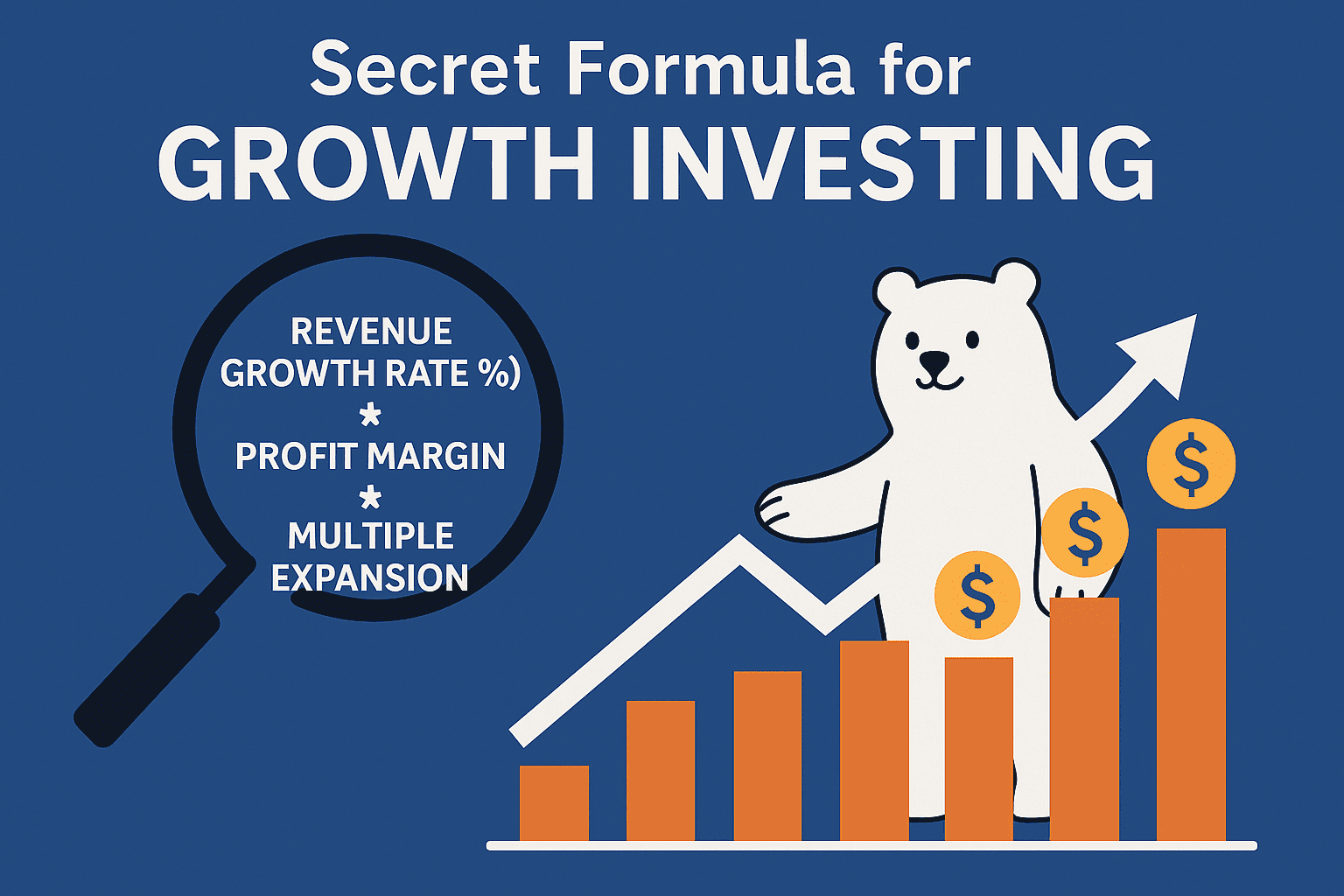
The Growth Investing Formula (Simplified)
Here’s a foundational growth stock filter I call the “5x5x5 Formula.” It helps identify companies with explosive potential across five key traits:
5x Revenue Opportunity
The company should be targeting a market (total addressable market or TAM) that’s at least five times bigger than its current annual revenue. For instance, if a startup generates $200 million per year, its total addressable market should ideally exceed $1 billion. Why? Because even if the company executes perfectly, it can only grow to match the size of the market it’s playing in. Companies that are operating in small, niche markets—even if they dominate—can quickly hit a growth ceiling. In contrast, a large, expanding TAM gives the company room to scale and compound over time. It also makes the company more attractive to institutional investors down the line.
5 Years of Compounding Growth
Next, look for a business that can grow its top line—whether revenue or free cash flow—at an annual rate of 25% to 40% for five or more consecutive years. This may sound ambitious, but it’s the kind of trajectory many successful companies followed in their early years. Sustained compounding over half a decade leads to 3x–6x revenue growth, which often translates into stock price appreciation—especially if margins are improving. It’s not just about growth for one year. Investors should seek consistency and visibility, often supported by recurring revenue models, high net retention rates, or large contract backlogs. These features add reliability to future earnings and reduce downside surprises.
5 Qualitative Moats
To become a long-term compounder, a business must build defensibility. There are five primary qualitative moats that can set a growth stock apart:
- Network effects: Products become more valuable as more people use them (e.g., social networks, marketplaces).
- Brand or IP advantage: Strong brand loyalty or proprietary technology makes customers choose them over alternatives (e.g., Apple, Nike).
- Data/AI moat: Exclusive datasets allow the company to build better, smarter products (e.g., Google, Palantir).
- Distribution advantage: Owning the sales channel or having exclusive partnerships lowers acquisition costs (e.g., Shopify, Square).
- Switching costs: Products are deeply embedded, and customers face friction or cost when moving to a competitor (e.g., Adobe, Salesforce).
A great company may not have all five, but having at least two strong moats is a powerful signal. Moats protect against commoditization and price wars, helping the company sustain its growth trajectory.
Quantifying Growth Potential: The Rule of 72 and PEG Ratio
Growth investing isn’t just about vision—it’s about numbers too. Two useful tools for evaluating growth potential are the Rule of 72 and the PEG ratio.
The Rule of 72 is a quick way to estimate how long it will take for a company’s earnings or revenue to double. You simply divide 72 by the annual growth rate. For example, a company growing at 36% annually will double its size in about two years. This helps you visualize the power of compounding and set realistic expectations for timelines.
The PEG ratio (Price/Earnings-to-Growth) is a refinement of the classic P/E ratio. It divides the P/E by the annual growth rate of earnings. A PEG ratio under 1 may indicate a company is undervalued relative to its growth potential. While it’s not perfect—especially for early-stage or unprofitable companies—it can be a useful cross-check when comparing similar businesses.
Used together, these metrics can help investors filter out overpriced hype and zoom in on true value-growth opportunities.
The X-Factor: Founder-Led Vision and Culture
One often-overlooked ingredient in long-term winners is visionary leadership. Many of the most successful growth companies were founder-led, at least during their critical growth years. Founders bring passion, long-term thinking, and a unique willingness to make uncomfortable decisions for the sake of vision.
Take Jeff Bezos, who relentlessly focused on customer experience and reinvested profits into Amazon’s infrastructure, cloud computing, and logistics. Elon Musk pursued seemingly impossible goals with Tesla and SpaceX, creating multi-decade category leaders. Jensen Huang, NVIDIA’s co-founder, led the company’s pivot into GPUs and AI acceleration long before Wall Street caught on.
Founder-led companies often:
- Prioritize innovation over short-term profits.
- Create cult-like internal cultures.
- Maintain high insider ownership, aligning incentives.
When evaluating growth stocks, check if the founder is still involved and how much of the company they still own. Look for signs of cultural durability and alignment with shareholders.
Red Flags to Avoid
Even if a stock fits the quantitative profile, beware of these qualitative red flags:
A company that lacks a clear path to profitability may be inflating revenue through discounts, marketing spend, or unsustainable customer acquisition. Watch for gross margin compression, as this can signal the company is losing pricing power.
Avoid companies built on hype rather than substance. If investor enthusiasm is driven by vague narratives, celebrity endorsements, or buzzwords like “AI” without product-market fit, proceed cautiously.
Pay attention to capital discipline. Look at the share count over time—if a company is constantly issuing stock to fund operations, it’s diluting your ownership. Excessive dilution, poor mergers and acquisitions (M&A), and ballooning debt levels signal trouble.
Lastly, examine retention. In software and subscription-based businesses, net dollar retention (NDR) above 100% is a great sign. If customers are churning or not expanding their usage, that’s a warning flag.
Real Case Study: Shopify (SHOP)
In 2015, Shopify reported just over $200 million in revenue. Its total addressable market, however, was massive: the global infrastructure for small- to mid-sized businesses to run online storefronts. The e-commerce boom accelerated post-COVID, but Shopify had already laid the groundwork years before.
With annual revenue compounding at ~50% for over five years, SHOP scaled into billions in sales. Its app store, theme ecosystem, and payments infrastructure created high switching costs. Developers, merchants, and partners were locked in.
Tobi Lütke, Shopify’s founder, remained CEO and guided the company through phases of extreme scaling. Early investors saw 50x–60x returns by 2021. The story exemplifies how a great product, founder vision, and market timing converge to deliver exponential returns.
Bonus: The “10x Checklist”
Before adding a stock to your growth portfolio, run it through this mental checklist. Each point reflects a core pillar of the 10x formula.
First, ensure the market size is big enough. Can this company realistically 5x–10x its revenue in the next 5–7 years? A company with $500 million in revenue but only a $600 million TAM is capped unless it can expand into new verticals.
Second, look at the growth rate. Is the company growing 30% or more each year—and can it sustain that pace? Consistency matters more than one-off spikes. Bonus points if the company can accelerate growth without bloating expenses.
Third, examine unit economics. Is the business model profitable per customer? Gross margins above 60% often indicate strong pricing power and scalability. Look for companies with improving operating margins over time.
Fourth, assess the competitive moat. What makes this company hard to replicate? Whether it’s proprietary data, brand loyalty, or an exclusive distribution network, moats preserve margins and fend off commoditization.
Fifth, study the leadership team. Is it founder-led? Does management own significant equity? Read shareholder letters and earnings calls. Vision, integrity, and transparency go a long way.
Sixth, evaluate customer loyalty. Look at retention metrics. High lifetime value (LTV), low churn, and customer expansion (upsells, add-ons) all suggest product-market fit.
Seventh, consider capital structure. Does the company rely heavily on equity or debt financing? Can it fund growth through cash flow? Avoid serial diluters who raise capital every quarter.
Eighth, seek optionality. Can the company launch new products or expand into adjacent markets? Amazon started with books; now it does everything from cloud computing to groceries. Optionality fuels long-term growth.
Ninth, check valuation multiples. Growth stocks may trade at high P/E or P/S ratios—but does it make sense based on forward growth? A company growing 60% annually can justify a P/S of 20+ if margins are strong.
Finally, ask yourself: Would I still be excited to own this stock five years from now? Long-term conviction helps you hold through volatility. If you wouldn’t feel comfortable adding during a dip, you may not truly believe in the company.
If a stock scores highly on 8 or more of these criteria, it’s worth a deeper dive.
Final Thoughts: Think Big, Start Small
Finding a 10x or 100x winner doesn’t happen every month—but it only takes one or two of them to transform a portfolio. The key is to think in decades, not quarters. Use frameworks to filter noise and focus on long-term vision, durable moats, and leadership execution.
The best growth investors blend data, conviction, and patience. They aren’t chasing trends—they’re building positions in transformative companies before the rest of the world catches on.
Start small. Let your winners run. And keep looking for asymmetric opportunities.



Leave a Comment