
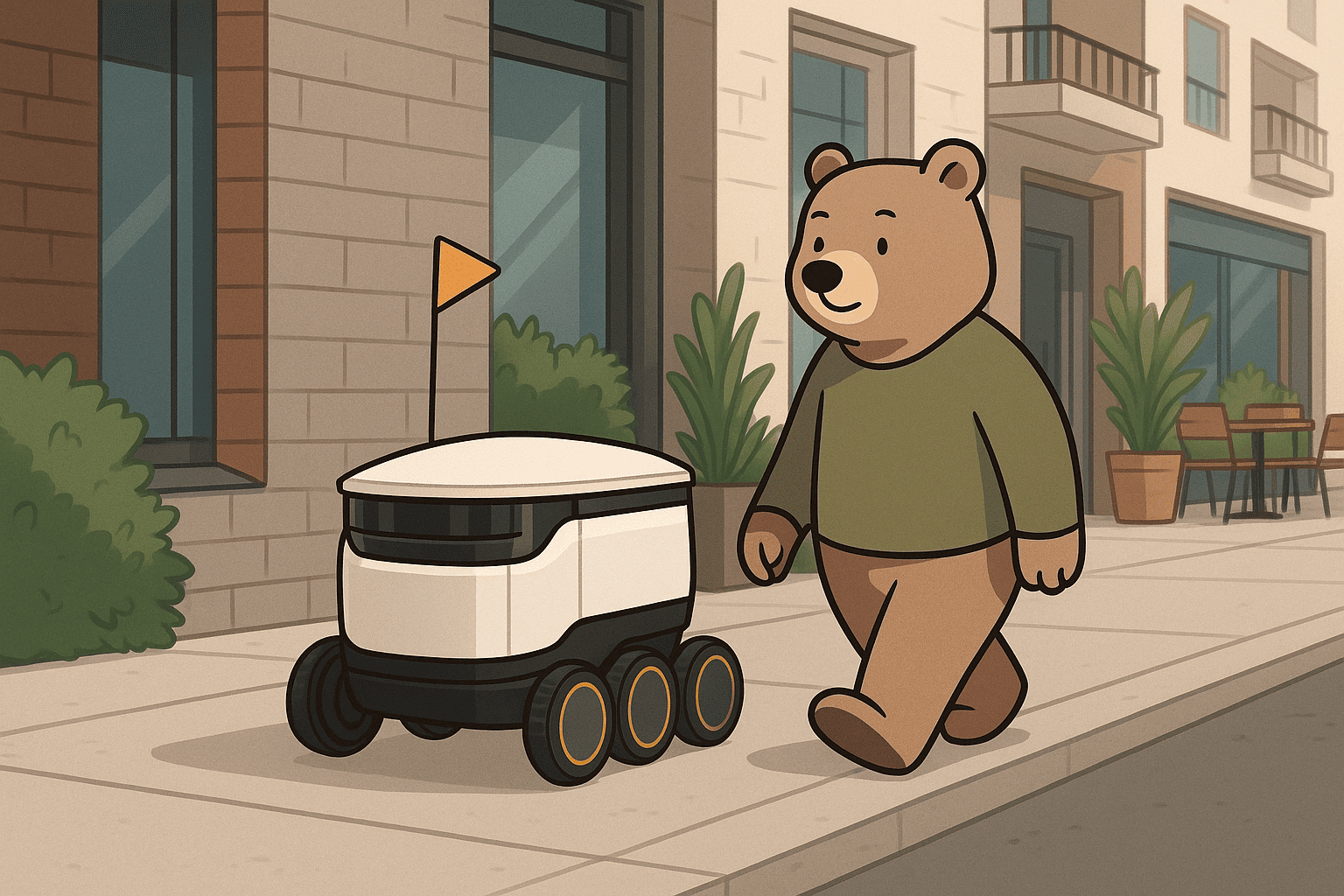
If you’ve ever ordered food, groceries, or a package to your doorstep, you’ve participated in one of the most expensive and inefficient problems in logistics: last-mile delivery. It accounts for up to 53% of total shipping costs and is riddled with delays, driver shortages, and margin pressure. But a technological revolution is unfolding—powered by artificial intelligence (AI) and robotics.
What Is Last-Mile Delivery, and Why Is It Broken?
Last-mile delivery refers to the final leg of a shipment’s journey—from a fulfillment center to the end customer. It’s the most complex and costly segment, especially in urban environments.
Key challenges include:
- Traffic congestion
- Limited delivery windows
- Labor shortages
- High failure rates (e.g., no one home)
- Low profitability for carriers
With e-commerce booming and consumer expectations rising for faster, cheaper delivery, solving this last-mile problem is no longer optional—it’s existential.
Enter AI and Robotics
Autonomous delivery robots are tackling these inefficiencies head-on. Startups and tech giants alike are deploying AI-powered robots and drones to deliver food, medicine, and parcels without human drivers.
Core technologies include:
- Computer vision & sensor fusion
- Lidar & radar for environment mapping
- Edge AI for real-time decision-making
- Predictive logistics and route optimization
These technologies promise to not only lower costs but also improve reliability, safety, and environmental impact.
Market Opportunity: How Big Can This Get?
The global last-mile delivery market was valued at $131 billion in 2021, with projections to grow to $424 billion by 2030 (Allied Market Research).
Driving factors:
- E-commerce growth
- Urban population surge (70% by 2050)
- Delivery app usage explosion
- Labor shortages across logistics sectors
- Climate regulations pushing for electric/robotic delivery
Even a 1–2% market share could mean billions in annual revenue for early movers. When paired with proprietary software and AI models, the value multiplies beyond delivery alone.
Real-World Examples of Traction
Serve Robotics (NASDAQ: SERV)
- Over 10,000 autonomous deliveries completed for Uber Eats
- Operating in LA, SF, and other dense metro areas
- Publicly traded; seeking scale through RaaS (robot-as-a-service)
Starship Technologies
- 5M+ deliveries across campuses and urban zones
- Robust navigation stack and remote monitoring system
- High customer satisfaction and NPS >70
Nuro
- Partnered with Kroger, Domino’s, FedEx
- Uses self-driving pods (larger than sidewalk bots)
- Valued at over $2B; one of the most well-funded private players
Zipline
- Focuses on drone delivery of medicine and e-commerce
- Highly successful in Africa; expanding to U.S. suburban routes
- AI-guided precision drop and logistics platform
These companies are already operating outside the lab, serving paying customers and gathering invaluable fleet data.
Why This Could Be a Multi-Bagger Investment Opportunity
With Serve Robotics currently valued at ~$600 million, it’s no longer a speculative microcap—but that doesn’t mean the upside is gone.
Let’s run some realistic scenarios based on projected market share.
Scenario 1: Captures 1% of the global last-mile delivery market
- Total market = $424 billion
- 1% share = $4.24 billion in annual revenue
- Applying a conservative 5x revenue multiple → $21.2 billion valuation
- Potential return = ~35x
Scenario 2: Captures 0.1% of the market
- Revenue = $424 million
- Valuation at 5x sales = $2.12 billion
- Potential return = ~3.5x
The Takeaway:
Serve Robotics may not be a 1000x moonshot at this stage, but it still offers meaningful upside. With expanding real-world deployment, strategic partnerships (like Uber Eats), and a growing lead in sidewalk-scale delivery, Serve remains one of the few public plays with a realistic shot at capturing a slice of a multi-hundred-billion-dollar market.
Even a fractional market share could translate into multi-bagger returns for long-term investors.
Barriers to Scale (And How They’re Falling)
1. Regulation
- LA, SF, Texas, and Arizona have legalized sidewalk bots
- Positive momentum in Canada, UK, EU
- Some cities mandate human remote operators (temporary)
2. Public Perception
- Surveys show over 60% of Gen Z and Millennials are open to robot delivery
- Bots are perceived as “cute” and safe
- Real-world interaction is improving social trust
3. Unit Economics
- Cost per delivery falling with each robot generation
- Battery efficiency, fleet uptime, and shared maintenance reducing RaaS costs
- Break-even point estimated at 500–1,000 bots per city
4. Technical Edge Cases
- AI is now capable of adapting to dogs, potholes, skateboards, and curb jumps
- Hybrid remote-assist models (e.g., human in loop for rare events) bridge the gap
In short, what seemed impossible in 2016 is rapidly becoming practical and scalable in 2025.
Investing Landscape
Public Plays
- Serve Robotics (SERV) – pure-play sidewalk bot operator
- Symbotic (SYM) – warehouse automation, Walmart partnership
- Amazon (AMZN) – owns Zoox, exploring last-mile autonomy
Pre-IPO / Private Watchlist
- Nuro
- Starship Technologies
- Zipline
- Cartken
- Refraction AI
For venture or angel investors, private companies hold massive optionality. But for retail investors, SRVR is among the only direct public options.
Comparative Advantage: Who Will Win?
Success likely depends on:
- Urban density dominance (early territory capture)
- Strong partnerships (e.g., Uber Eats for Serve)
- Fleet size and uptime
- Data network effects (robot behavior improvement)
- Recurring revenue via RaaS or SaaS
The best bets are building platforms, not just vehicles.
Key Risks
- Regulatory slowdowns in conservative cities
- CapEx for scaling fleets and operations
- High competition from Amazon, DoorDash, or Postmates clones
- Public market volatility for small-cap stocks
- Safety incidents could spark backlash (e.g., robot hitting a pedestrian)
As always, moonshot investing requires diversification and patience.
A Broader Vision: Beyond Delivery
Last-mile bots are Trojan horses for future urban services.
Possible future use cases:
- Trash and recycling bots
- Autonomous street cleaning
- Local errand services
- Remote vending and medical kits
- Elder care and accessibility support
Think of delivery as just Phase 1. Once the tech, trust, and territory are established, revenue models can multiply.
Final Thoughts
The convergence of logistics, AI, and robotics is one of the most exciting frontiers in tech investing today.
This is your “pre-iPhone” moment for last-mile automation. The infrastructure is being laid, partnerships are forming, and the first real world results are in.
Could it be a 1000x opportunity?
If the right player captures a fraction of a trillion-dollar market—and builds out AI-driven delivery as the new normal—absolutely.
The only question is: will you invest before the bots become boring?



Leave a Comment