
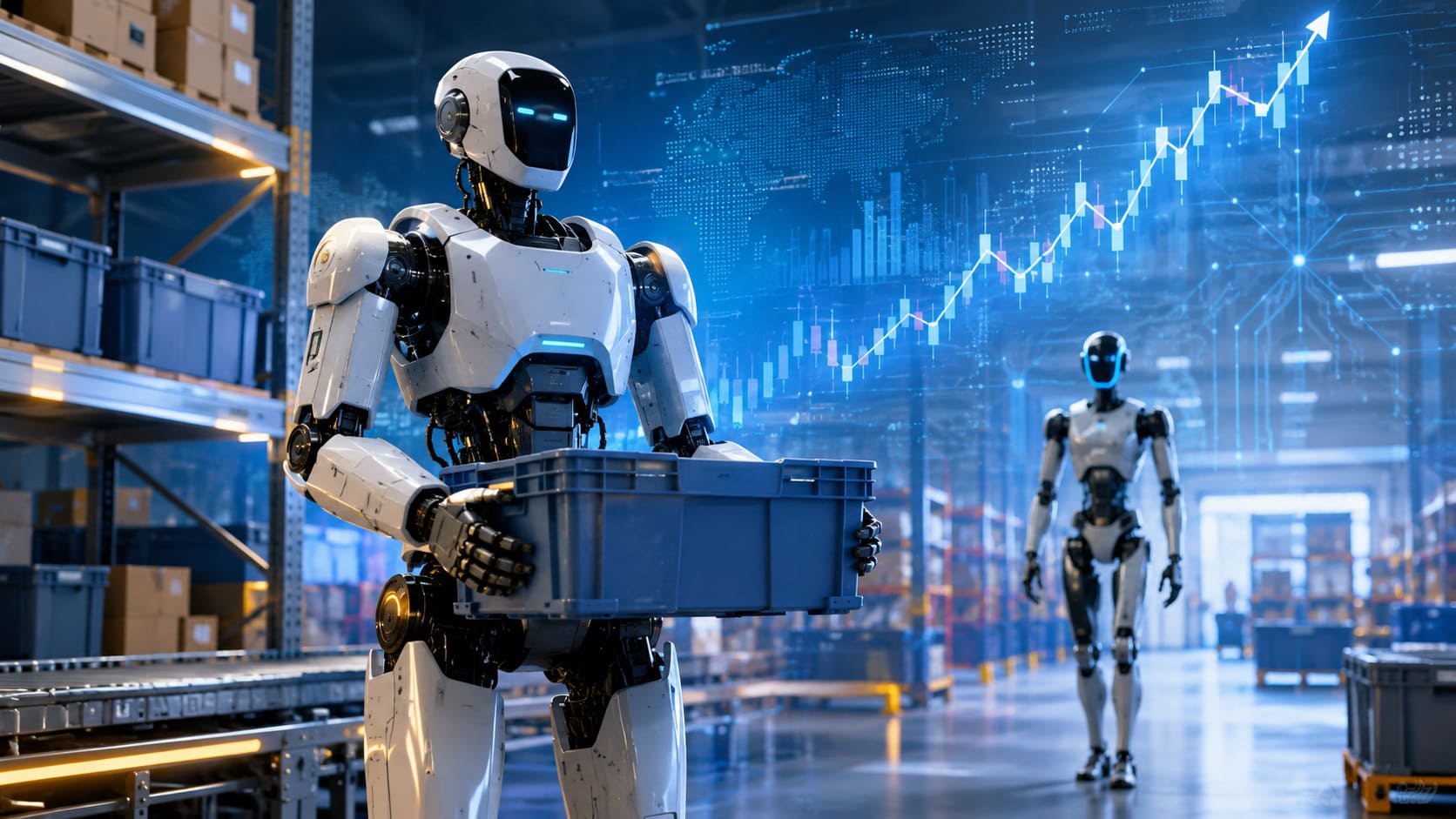
For years, humanoid robots were demonstration projects instead of investable companies.
Robots could walk, dance around, lift boxes and occasionally perform other carefully scripted tasks, but the gap between a cool robotics video and an industrial robot capable of thousands of hours of productive work inside a factory remained vast.
Today, that gap is finally starting to narrow.
Tesla, Figure AI, Apptronik, Boston Dynamics, China’s Unitree Robotics and Agility Robotics are racing to deploy robots capable of doing real physical work.
And the investment thesis extends far beyond simply selling robots.
If humanoid robots become mainstream, they could become another major computing platform—one combining AI, software, sensors, actuators and physical labor.
I find Agility Robotics especially interesting because the company’s approach appears less focused on building the coolest humanoid robot and more focused on answering one question:
Can a humanoid robot actually make money for the company that uses it?
That matters.
Agility’s Digit humanoid is already working inside commercial facilities. The company has built manufacturing infrastructure designed to support much greater production and is now planning to go public through a merger with Churchill Capital Corp XI (NASDAQ: CCXI).
If the proposed transaction closes, the combined company is expected to trade on Nasdaq under the ticker AGLT. Agility’s investor presentation currently targets a Q4 2026 closing, although the transaction remains subject to shareholder approval, SEC review and other closing conditions.
For investors looking for a relatively direct public-market humanoid robotics play, Agility Robotics is therefore becoming a company worth watching closely.
- Why Humanoid Robots Could Become a Major Investment Theme
- Agility Robotics Is Building Robots to Earn Money
- Digit Has Crossed My Demonstration-Video Rubicon
- Scale and Success Are Coming for Humanoid Robots
- Why Agility Robotics Has Another Moat Beyond Digit
- Humans Are Still by Far the Best Humanoid Robot
- Agility Robotics vs Unitree: Two Different Approaches to Humanoids
- Unitree Is Also Becoming an Investable Humanoid Company
- Humanoid Robots as Software: Agility Robotics’ Secret Weapon
- The $300 Million Number Matters More Than Another Robot Demo
- Humanoid Robots Could Become Computers That Do Work
- Our Definition of a Robot Is Changing
- How to Invest in Agility Robotics Through CCXI
- The Bear Case for Agility Robotics
- What I Will Be Watching From Here
- Final Thoughts: Humanoid Robots Could Become the Next Computing Platform
Why Humanoid Robots Could Become a Major Investment Theme
AI is already transforming digital work.
Now intelligence is moving from computers into the physical world.
Large language models can write text, generate images and produce software, but factories, warehouses and construction sites still depend on humans for enormous amounts of physical work.
Robots with a better understanding of their surroundings—and the ability to manipulate real-world objects—could bring AI into a much larger section of the physical economy.
Industrial robots already automate factories extremely well.
But these machines generally tackle highly structured activities.
A robotic arm can reliably weld the same section of a car thousands of times. An autonomous mobile robot can transport goods through a warehouse. Both can create massive productivity improvements, but the environment and workflow usually have to be designed around the machine.
Enter humanoids.
Factories, warehouses, tools, shelves, doors and workstations were largely designed around humans. A robot with roughly human proportions can potentially enter those environments without forcing companies to rebuild everything around the robot.
That is the big economic opportunity.
Instead of optimizing the world for robots, why not build robots optimized for the world we already have?
Fit robots to human environments instead of redesigning human environments for robots.
The addressable market could eventually become enormous if humanoids become reliable and affordable enough to deploy at scale.
Beyond manufacturing and logistics, potential applications could eventually include inspection, retail, healthcare, hospitality and even the home.
Exactly how humans and robots divide work will evolve over time, but commercial facilities that cannot be economically automated using traditional fixed robotics could represent opportunities for more flexible humanoid systems.
Of course, humanoid robots still need to master far more than walking before they dominate factory floors.
Reliability, dexterity, battery life, safety, cost and autonomous decision-making remain major engineering challenges.
Agility Robotics Is Building Robots to Earn Money
Agility Robotics’ approach is particularly intriguing to me because the company is attempting to solve these problems with an explicit focus on useful physical labor.
Agility was founded out of Oregon State University’s robotics research and eventually developed Digit, its bipedal industrial humanoid robot.
Digit is not designed to perfectly resemble a person.
Nor does Agility claim Digit can already do everything a human worker can.
Instead, Agility has optimized Digit around industrial environments such as warehouses, logistics facilities and manufacturing plants.
The currently deployed Digit v4 has a carrying capacity of approximately 35 pounds and a stated runtime of about four hours, with autonomous charging.
The upcoming Digit v5 is designed to increase carrying capacity to as much as 50 pounds while significantly improving charging efficiency and usable operating time. These v5 specifications remain management targets until the new platform is commercially released.
That distinction is important.
Agility does not need Digit to become a perfect artificial human tomorrow.
It needs Digit to become economically productive.
Digit Has Crossed My Demonstration-Video Rubicon
Watching a robot do a backflip is impressive.
Watching a robot complete its 100,000th boring warehouse task without becoming the center of attention is far more valuable to me as an investor.
Agility said in November 2025 that Digit had moved more than 100,000 totes at GXO’s Flowery Branch facility during a live commercial deployment.
Toyota Motor Manufacturing Canada has also moved beyond simply testing Digit.
Following a pilot, Toyota signed a commercial Robots-as-a-Service agreement with Agility in February 2026 to deploy Digit in its facilities and continue evaluating manufacturing, supply-chain and logistics applications.
Schaeffler has also invested in Agility and signed an agreement intended to deploy Digit robots across its global plant network.
This is where humanoid robotics starts becoming interesting to me.
Simply watching robots walk will eventually become table stakes.
Real-world operating data from deployed robots will be king.
Scale and Success Are Coming for Humanoid Robots
Humans remain extraordinarily difficult machines to replace.
We can walk over uneven surfaces, manipulate thousands of different objects, understand vague instructions, adapt to unexpected circumstances and learn new physical tasks extremely quickly.
And we do all of this using the same general-purpose body.
That is why humans are still the best “humanoid robot” available today.
But history shows that markets can pivot surprisingly quickly once a new technology crosses the right cost and performance thresholds.
Humans still perform millions of repetitive physical tasks because there is simply no cost-effective machine capable of doing something better.
That equation will gradually change as robotics improves.
And that is where Agility Robotics gets interesting.
Agility is not simply trying to build a humanoid prototype.
It is trying to build an industrial automation platform capable of deploying increasingly large numbers of robots inside customer facilities.
That gives investors something measurable to follow:
How many robots are actually working?
Why Agility Robotics Has Another Moat Beyond Digit
Which humanoid can lift the most weight?
How fast can it run?
How many degrees of freedom does it have?
Does it have articulated hands?
How long does its battery last?
I could keep going, but you get the point.
Hardware specifications matter.
But I suspect the long-term winners in humanoid robotics will need moats extending beyond specifications.
Agility Robotics has developed Agility Arc, its cloud platform for deploying, integrating and managing fleets of Digit robots.
Arc is designed to integrate Digit into existing customer workflows, coordinate robots and operators, monitor uptime and productivity, and help customers replicate deployments across multiple facilities.
That could matter enormously.
Software, deployment knowledge and real-world operating data may eventually become major competitive advantages.
A humanoid company operating thousands of robots could collect large quantities of proprietary information about how robots interact with objects, respond to unusual conditions, recover from failures and improve performance across different workflows.
Agility explicitly describes this as a deployment-driven data flywheel: more deployments create more operational data, which can improve embodied AI, unlock additional applications and potentially lead to even more deployments.
Robotic deployment data may become the physical-world equivalent of the enormous datasets that helped improve modern AI models.
Humans Are Still by Far the Best Humanoid Robot
One reason I remain cautious about making overly confident predictions is China.
America does not have an obvious manufacturing-cost advantage over China.
If anything, China has demonstrated repeatedly that it can scale complicated hardware supply chains extremely quickly.
Electric vehicles are an obvious example.
Humanoid robots could follow a similar path.
China has enormous domestic ecosystems around motors, batteries, sensors, electronics, manufacturing and increasingly AI.
Unitree is one of the clearest examples of what happens when those capabilities converge.
Should investors care about Unitree?
Short answer: absolutely.
Unitree could become one of Agility’s most important long-term competitors.
But I do not think humanoid robotics will simply become a race to manufacture the cheapest robot.
The advantage of American companies may increasingly come from areas such as enterprise integration, AI, software, safety systems, fleet management, customer relationships and deployment data.
Cheap hardware is enormously valuable.
But cheap hardware becomes even more valuable once companies can reliably deploy it to perform productive work.
That creates two very different potential winning strategies.
Agility could win by becoming extremely good at deploying robots into enterprises.
Unitree could win by making increasingly capable robots inexpensive enough for practically everyone to experiment with them.
Both strategies can work.
Agility Robotics vs Unitree: Two Different Approaches to Humanoids
China’s Unitree Robotics may be one of the most fascinating companies to watch as investors consider the humanoid robotics industry.
Unitree gained international recognition through its quadruped robots before expanding aggressively into humanoids including the H1, G1 and R1.
But Agility and Unitree currently appear to be approaching the humanoid opportunity very differently.
| Agility Robotics | Unitree Robotics | |
|---|---|---|
| Core strategy | Enterprise physical labor and industrial automation | Low-cost robotics hardware and broader platform adoption |
| Main humanoid | Digit | G1, H1 and R1 |
| Initial market | Manufacturing, logistics and distribution | Research, education, developers, industrial and broader applications |
| Business model | RaaS, robot ownership, software and services | Primarily hardware sales |
| Software platform | Agility Arc + embodied AI | Robotics software, controls and embodied AI development |
| Major advantage | Commercial deployment and enterprise integration | Hardware cost, manufacturing scale and vertically integrated components |
| Geography | United States | China |
| Public-market route | CCXI today; expected AGLT after merger completion | Shanghai STAR Market IPO, ticker 688836 |
The price difference is where Unitree immediately gets my attention.
Unitree currently lists the G1 at $13,500, while its R1 lineup starts from approximately $4,900. Unitree’s detailed R1 page currently lists the R1 Air at $4,900 and the standard R1 at $5,900.
Those prices would have sounded almost ridiculous for a capable humanoid robot just a few years ago.
This is China’s manufacturing machine turning its attention toward humanoid robots.
American investors should not ignore Unitree.
If Chinese manufacturers can push humanoid hardware costs down dramatically, the entire economics of deploying robots could change.
But lower hardware costs could ultimately be good for the entire industry.
Cheaper actuators, sensors, batteries and components should make increasingly capable humanoids economically viable for more tasks.
The winners may therefore be companies able to combine inexpensive hardware with the best software, reliability and deployment ecosystem.
Unitree Is Also Becoming an Investable Humanoid Company
Unitree itself is now moving toward the public markets.
The company priced its Shanghai STAR Market IPO at RMB150.80 per share, valuing Unitree at roughly RMB61 billion, or around US$9 billion.
Its retail offering attracted extraordinary demand, with the retail tranche more than 8,000 times oversubscribed according to Reuters.
Unitree generated approximately RMB1.7 billion of revenue in 2025 and, unlike many humanoid robotics startups, was profitable.
However, investors should separate Unitree’s impressive manufacturing economics from the broader question of humanoid deployment.
A significant portion of current humanoid demand still comes from research, education and demonstrations rather than robots replacing meaningful quantities of human labor inside commercial environments. Unitree itself has highlighted reliability, endurance, dexterity and generalization as barriers to widespread humanoid adoption.
That is why I think comparing Unitree and Agility is so interesting.
Unitree has already demonstrated that humanoid hardware can become surprisingly inexpensive.
Agility is trying to demonstrate that humanoids can become productive workers.
Humanoid Robots as Software: Agility Robotics’ Secret Weapon
Robotics companies traditionally make money by selling robots.
Agility wants more than that.
Its business model includes both outright robot ownership and Robots-as-a-Service, creating the possibility of recurring revenue from deployed robots.
Importantly, investors should understand that the economics presented by Agility are currently illustrative assumptions rather than published customer pricing.
In its June 2026 investor presentation, Agility uses an illustrative assumption of approximately $8,500 per month per Digit for its RaaS economics.
Under that scenario, Agility estimates approximately $100,000 of annual RaaS cost per robot and roughly $500,000 of cumulative revenue to Agility across an assumed five-year robot life, including a one-time deployment fee.
The RaaS subscription is expected to include access to Arc software and maintenance services.
Agility also offers an ownership model.
Under that structure, customers would purchase Digit upfront and continue paying for Arc software, maintenance and other services.
This is potentially important for the economics of the company.
Instead of simply selling a machine once, Agility wants to generate recurring revenue from the installed base while continuously improving the capabilities of the software running across that fleet.
Put differently:
Agility wants each deployed Digit to become more valuable over time while continuing to generate revenue.
The $300 Million Number Matters More Than Another Robot Demo
There is another figure that I think investors should pay attention to.
As of May 2026, Agility reported more than $300 million in committed multi-year orders for Digit v5.
According to the company’s investor presentation, this relates to approximately 1,000 Digit v5 robots under a three-year RaaS contract.
But there is an important qualification.
Agility specifically states that the orders depend on the achievement of contractual milestones and that the $300 million figure is not a measure of current-period revenue.
That distinction matters enormously.
I would therefore watch the conversion of:
Orders → deployments → operating hours → recognized revenue.
If those numbers begin scaling together, the Agility investment thesis becomes much stronger.
If orders remain orders without turning into large-scale deployments, the thesis becomes much weaker.
Humanoid Robots Could Become Computers That Do Work
America has a different set of competitive advantages.
Tesla is approaching humanoid robotics with its enormous AI, autonomy and manufacturing ecosystem.
Figure AI is developing its own Helix Vision-Language-Action models after ending its collaboration with OpenAI in early 2025.
Apptronik originated from the Human Centered Robotics Lab at the University of Texas at Austin and is now working with Google DeepMind on AI for its Apollo humanoid platform.
Agility is approaching the market from another direction: years of work in locomotion and robotics combined with industrial deployment, physical AI and fleet-management software.
Different companies are attacking different parts of the same problem.
And I suspect the eventual winners will combine all of them:
Hardware + AI + software + manufacturing + deployment.
The computer industry changed dramatically once computers evolved from specialized hardware appliances into general computing platforms.
Humanoids could eventually experience something similar.
The robot provides the physical platform.
Software determines what that platform can do.
If a single humanoid robot can learn entirely new jobs through software updates and additional training, its economic potential begins to look very different from traditional industrial machinery.
That is why I increasingly think about humanoid robots as:
Computers that can do physical work.
Our Definition of a Robot Is Changing
Ask 10 robotics experts exactly what counts as a robot and you may still get 10 slightly different answers.
Electric lawnmowers?
Self-driving trucks?
Stationary industrial arms?
Collaborative robots?
Warehouse AMRs?
No, I am not going to start calling my iPhone a robot.
The point is that our definition of robotics keeps expanding as machines become more autonomous.
I suspect humanoid robotics will experience a similar fragmentation.
Some companies will sell inexpensive hardware to developers, universities, consumers and businesses.
Unitree looks particularly well positioned for that market.
Others, including Agility, may focus much more heavily on making individual robots productive inside enterprise environments while generating ongoing revenue from software and services.
The market may ultimately be large enough for both approaches.
How to Invest in Agility Robotics Through CCXI
This is where the investment thesis becomes especially interesting.
Agility Robotics itself is not yet a publicly traded company.
However, on June 24, 2026, Agility entered into a definitive business combination agreement with Churchill Capital Corp XI, a special-purpose acquisition company trading on Nasdaq under the ticker CCXI.
The transaction gives Agility a $2.5 billion pre-money equity value.
Agility and Churchill expect the transaction to generate more than $620 million of gross proceeds, consisting primarily of Churchill’s cash held in trust—assuming no redemptions—plus approximately $200 million of PIPE financing priced at $10 per share.
Management currently expects the transaction to close in Q4 2026.
After completion, Churchill is expected to become Agility Robotics, with the combined company trading under AGLT.
There are currently three publicly traded Churchill securities investors may encounter:
CCXI — Common Shares
For most investors, CCXI is the simplest security.
These are Churchill Capital Corp XI Class A ordinary shares trading on Nasdaq.
Under the transaction structure, Churchill’s outstanding Class A shares are expected to convert on a one-for-one basis into common shares of the domesticated company before the merger closes.
Buying CCXI today therefore gives investors exposure to the proposed Agility transaction.
But it is important to understand what you are buying.
You are still buying a SPAC before the merger has been completed.
The transaction could be delayed, terms could change, shareholders could redeem shares, additional dilution could occur or the transaction could theoretically fail to close.
CCXIW — Warrants
There are also publicly traded warrants under CCXIW.
Each whole warrant currently gives the holder the right to purchase one Class A ordinary share at an exercise price of $11.50 per share, subject to the terms, redemption provisions and expiration conditions of the warrant agreement.
Warrants can offer substantially greater upside if the eventual Agility share price rises sharply.
They can also fall dramatically or become worthless.
I consider this a considerably more speculative way of expressing the Agility thesis.
CCXIU — Units
Finally, CCXIU represents Churchill units.
Each unit consists of one CCXI Class A ordinary share plus one-tenth of one redeemable warrant.
For someone specifically trying to gain straightforward exposure to Agility Robotics, I find the common shares easier to understand and analyze.
The Bear Case for Agility Robotics
Agility could very easily prove my thesis wrong.
Hardware is not simply software running on a different device.
Manufacturing matters.
Reliability matters.
Maintenance matters.
Unit economics matter.
And when a machine weighing tens of kilograms is operating around humans, safety matters enormously.
Companies like Unitree could put massive pressure on hardware pricing.
Tesla may eventually leverage its manufacturing scale to produce Optimus at economics smaller robotics startups struggle to match.
Figure, Apptronik and other competitors may develop superior AI or manipulation capabilities.
Traditional robots and automation could also remain cheaper than humanoids for many workflows.
And customer deployments may simply scale much more slowly than investors expect.
That is why I would not value Agility based purely on the size of the theoretical humanoid market.
I want to see evidence.
More customers.
More deployed robots.
More operating hours.
More workflows.
More recurring revenue.
And eventually, improving unit economics.
What I Will Be Watching From Here
Four things matter most to me.
1. Number of Deployed Digits
Orders are useful.
Operating robots are better.
I want to see Agility turn contracted demand into actual robots inside customer facilities.
2. Robot Uptime
A humanoid that works reliably for thousands of hours is economically very different from one that frequently requires technicians.
Reliability may eventually matter more than flashy demonstrations.
3. Revenue Per Deployed Robot
Agility’s RaaS model looks attractive on paper.
Now the company needs to prove those economics with real customers.
4. New Skills
Material movement is the beginning.
The real upside comes if the same Digit hardware platform can gradually learn additional workflows involving manipulation, machine tending, sorting, inspection and other industrial activities.
Each new capability potentially expands the addressable market without requiring Agility to invent an entirely new robot.
Final Thoughts: Humanoid Robots Could Become the Next Computing Platform
Nobody knows which humanoid robotics company will eventually win.
Tesla could dominate through manufacturing and AI.
Unitree could dominate through price.
Figure could build superior embodied intelligence.
Apptronik could become a major industrial platform.
Agility Robotics could emerge as the enterprise deployment leader.
More likely, several major robotics companies will coexist.
But the broader trend is becoming increasingly difficult for me to ignore.
AI is moving from screens into machines.
Unitree is demonstrating how rapidly humanoid hardware costs can fall.
Agility is attempting to demonstrate that humanoid robots can perform economically useful work inside real customer facilities.
Those are two sides of the same technological transition.
What makes Agility especially interesting to me as an investor is not that Digit can perform the coolest demonstration.
It is that Digit has started doing something much less exciting:
showing up for work.
If Agility can successfully move from tens or hundreds of deployed robots to thousands—and eventually tens of thousands—the company could evolve from a robotics manufacturer into something much larger:
a physical-labor platform.
We do not know how this technology will play out over the next decade.
But I increasingly believe humanoid robots could become computers that can do work.
And Agility has now passed one of my key tests for an investable emerging technology:
There is finally a clear route for public-market investors to own it.





Leave a Comment