

Are you looking for a Buffett Munger decision making book review? If yes, Peter Bevelin’s All I Want To Know Is Where I’m Going To Die So I’ll Never Go There might be the book you’re looking for. In this surprisingly funny, incisive book with the absurd title, the author compiles decades of advice from Warren Buffett and Charlie Munger.
What you get is not a book about how to pursue success. It is a book about avoiding stupidity.
Business, investing, careers, lifestyle: Bevelin covers all and distills it down to one core insight. The key is to avoid stupid decisions in each area of life. The result is a hybrid book about investing and, more generally, about living well.
Why the Book’s Title Matters
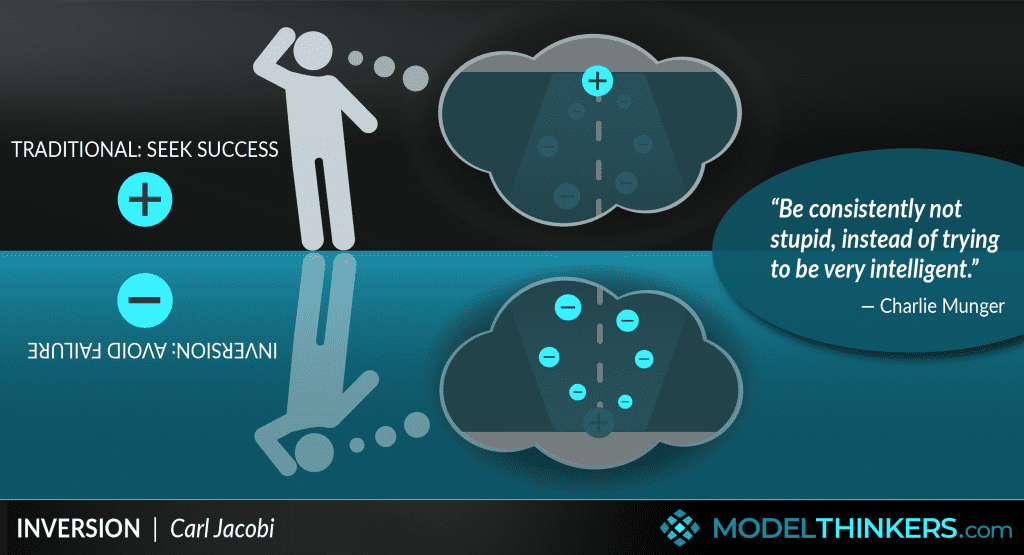
Buffett and Munger are big fans of inversion as a mental model: approach problems backwards.
Instead of looking for what makes people successful, look for what causes them to fail.
It’s a powerful mental trick that’s been central to Munger’s mindset for decades.
Buffett and Munger’s advice on avoiding errors has kept them out of many of the traps that other investors have fallen into. The book applies the habit of inversion to decision-making in all areas of life.
Lessons from the Book
There are four major themes:
Avoid stupidity
The easiest way to be successful is to avoid mistakes. This is true for everything in life, from investing to starting a business to careers and even lifestyle. Most of the book is taken up with these kinds of observations.
Example: Warren Buffett says
The first rule of investing is don’t lose money. The second rule is don’t forget rule number one.
Peter Bevelin generalizes it to
Rule 1: Do not do stupid things. Rule 2: Do not forget rule number 1.
Failures and mistakes are a gold mine of learning.
Buffett and Munger spend a lot of time studying the past and history is full of examples of what not to do and what will lead to failure. The biggest mistake you can make is to ignore those lessons. Another key Buffett and Munger mental habit is to treat past failures as case studies that can be endlessly analyzed.
Peter Bevelin takes these great investor examples and translates them into mental models for decision-making in any field.
Mental models: build a latticework
Munger once famously described how he and Buffett use a latticework of mental models for decision-making. What’s unique about Munger’s mental models is that they are drawn from multiple disciplines. You need to know the basic mental models from fields as diverse as biology and economics, and then use them at the appropriate times.
Bevelin breaks down various fields, and introduces the reader to some of his favorite mental models.
Keep things simple and be rational
This may be one of the most famous Buffett quotes of all time: “It’s better to be approximately right than precisely wrong.” The best investors and decision-makers often win not by being brilliant, but by avoiding catastrophic mistakes through common sense and simple logic. This is another core mental model that Buffett and Munger share with Bevelin and have applied throughout their lives. If you can’t explain your decision in a simple sentence to a layperson, you need to reconsider it.
Strengths of the Book
One of the things I like most about this Buffett Munger decision making book is its clarity. Peter Bevelin has a very simple style that is easy to understand. Many of these mental models and principles are drawn from complex fields like psychology and cognitive science, but Bevelin explains them in a way that is accessible to almost anyone.
The other strength is its emphasis on being practical. This is not a dry academic treatment of decision-making. It is a book that is packed with wisdom that can be applied immediately.
For example, a reader can take a specific principle–say, “avoid envy” or “stick to your circle of competence” or “buy and hold”–and immediately apply it to investing, business, career choices, or personal life. That kind of actionable value is one of the great strengths of this book.
Finally, the third strength is that it is timeless. I don’t mean that it has no weaknesses, which we will get to later. But as far as its value is concerned, this book offers wisdom that will never go out of style.
Weaknesses of the Book
This book is not perfect. One of its weaknesses, for example, is that it can feel a little repetitive. The message of “avoid stupidity,” for example, is repeated in different forms dozens of times throughout the book.
Secondly, and related to the previous point, the problem is that the book is very high on general wisdom and not as heavy on detailed applications. For example, an entrepreneur might wish for more on how to apply the inversion technique to a specific business decision.
A third minor weakness is that this book may be too heavy on mental models for a reader completely new to Buffett and Munger.
Who Should Read this Book
If you are wondering if you should read this book, ask yourself the following questions:
- Do you admire Buffett and Munger’s approach to clear, rational decision-making?
- Are you interested in mental models?
- Do you care about avoiding mistakes as much as you want strategies for success?
If you answered yes to all three, you should read this book.
The target audience is not just investors, but entrepreneurs, executives, students, and even everyday non-professional readers. The book has insights for anyone who wants to make better decisions.
Conclusion
In the quest for the best Buffett Munger decision making book, the answer is simple: if you want to make better decisions in your investing, business, career, and even life choices, read this book.
Peter Bevelin has distilled the investment wisdom of Warren Buffett and Charlie Munger into a set of rules and mental models to help us live a better life.
The result is a unique hybrid of a book: part investing manual, part how to manual for life. After reading it, you might decide that it is more the latter than the former.
What you’ll find is a collection of mental models that will help you think more clearly, avoid the traps and mistakes that ensnare others, and live a more rational life.
What Bevelin does in the book is show that at the heart of Buffett and Munger’s investment success is their mindset about avoiding mistakes at all costs. This Buffett Munger decision making book reveals that this obsession with inversion and a simple focus on avoiding stupid mistakes may be even more important to success than most people realize.
Bevelin has a knack for explaining complex mental models in a simple way that is easy to understand. He is also excellent at picking those models that have maximum value and relevance to anyone interested in decision-making in any field.
The book is clear, practical, and filled with actionable value. There are no charts, graphs, or complex academic explanations. It is as close to a direct distillation of Buffett and Munger’s investment wisdom into practical and actionable mental models as you can find.
Peter Bevelin goes beyond the investment field and applies these same mental models to other aspects of life as well. The book as a whole reads almost like a hybrid of advice about living a better life, from the perspective of two of the greatest investors of all time.
Buffett has famously said that success in investing is not so much about being brilliant as it is about not being stupid.
In the end, this is the most powerful lesson of the book, and it is this: in decision-making, it is not enough to seek strategies for success. You also have to have a plan to protect yourself from errors.
Overall Rating: 9/10

Overall, I would highly recommend Investment Mistakes to anyone who is interested in learning more about investing.
The information and advice that are contained within its pages are of very high quality, and the book is also well-written and easy to understand.
If you are just getting started in the world of investing, or if you are simply looking for a refresher course, then this book is definitely worth checking out.
Keep learning: courses on this topic
Self-paced courses to put this article into practice.
 Udemy
Get Out of Debt, SAVE, Increase Wealth, Invest In The Future
Personal Finance, Investing, and Retirement: Get Out of Debt & Get Your Money to Work For You. Do you work hard for your money? Get your…
View course
 Udemy
From Welfare to Wealth: Earn Online & Invest Wisely
If you're living on a low income, receiving benefits, or stuck in survival mode — this course is for you.“Financial Independence on a Low…
View course
 Udemy
Best Way to Invest: A Step-by-Step Guide to Building Wealth
Are you ready to take control of your financial future and start building lasting wealth with confidence, clarity, and proven strategies?…
View course




Leave a Comment