

Winning the lottery is a dream come true for most people. The trouble is, a lot of lottery winners end up bankrupt in just a few years. That’s because it’s really hard to handle sudden wealth responsibly. So the most crucial question to ask when you win the lottery is not what would I buy? Instead, it’s how to invest Powerball winnings?
Let’s say I just won $1.8 billion in Powerball (yeah, I know, it’s a long shot but indulge me). Before I think about private jets or yachts, I would consider security, strategy, and longevity.
The thing about this much money is that the goal isn’t just to live well — it’s to build generational wealth.
In this post, I’ll detail the exact strategy I would use to invest $1.8 billion of Powerball winnings. You’ll see the specific allocations, the thinking behind them, and a granular breakdown across asset classes.
Step 1: Protect Before You Invest
One of the biggest mistakes lottery winners make is haste. You must build a professional team before investing even a single dollar. This team should include:
- A fiduciary financial advisor
- Tax attorney
- Accountant
- Estate planner
Yes, these experts are expensive, but with this much money on the line, the right people will save you hundreds of millions in taxes and litigation.
The next thing to decide is the lump sum vs. annuity question.
Powerball gives winners two options: take all the money as a lump sum (after taxes and fees, about 55–60% of the jackpot) or get 30 years of annuity payments.
With $1.8 billion, the lump sum would be about $1 billion after taxes. It would give much more flexibility and, if invested correctly, almost certainly outperform the annuity.
Trusts, LLCs, and other legal structures also provide asset protection from lawsuits, privacy around family wealth, and tax efficiency.
Think of this stage as the foundation of a skyscraper. Without it, even the most enormous fortunes can come crashing down.
Step 2: Create a Safety Net
It’s a good idea to have a sizeable pool of ultra-safe, liquid investments. I would set aside $100 million in U.S. Treasury bills, money market funds, and FDIC-insured savings accounts.
This nest egg gives me access to cash for lifestyle expenses, charitable giving, and emergencies. It also prevents me from having to liquidate long-term investments at a loss during market downturns.
Step 3: Build the Core Portfolio with Index Funds
The foundation of my Powerball investment strategy would be low-cost, broad market index funds. They’re boring relative to private equity, but they work.
Empirically, even the richest families ultimately depend on index exposure for consistent, compounding growth.
Here, I would invest $500 million in a globally diversified mix of:
- 40% U.S. equities (Total Market Index or S&P 500) – exposure to companies like Apple, Microsoft, and Tesla
- 20% international equities – Europe, Japan, and emerging markets like India
- 20% bonds and Treasuries – a defensive ballast for market volatility
- 20% alternative credit – higher-yielding substitutes for traditional bonds
This core set of index funds provides global growth exposure without excessive concentration in a single market.
Step 4: Add a Diversified Real Estate Portfolio
Real estate is not only about high-profile mansions and villas.
With $250 million in real estate, I would build a diversified portfolio of:
- Commercial real estate in growing U.S. markets (Austin, Miami, Dallas)
- Multifamily housing in urban areas with increasing rental demand
- International real estate in stable markets like London, Singapore, and Tokyo
- REITs – for passive exposure to the real estate sector
The reason? Real estate provides attractive cash flow and a hedge against inflation. Tenants will continue paying rent even when stocks fall.
Step 5: Invest in Private Equity and Venture Capital
Private markets is where some of the most explosive wealth creation occurs. With $200 million, I would back both established and early-stage companies:
Private equity funds with track records
- Venture capital in emerging industries like AI, clean energy, biotech
- Direct investments in businesses solving global problems like water scarcity or renewable energy storage
The risk here is much higher. Many of these bets could fail. But a few huge winners can turn $200 million into $1 billion. Uber, SpaceX, Moderna all had early investors.
Step 6: Dedicate $150 Million to Philanthropy
Money can make the world a better place, not just my life. I would allocate $150 million to philanthropy and impact investing:
- Create a foundation for scholarships, climate action, and healthcare access
- Impact funds that invest in companies delivering measurable social benefits
- Direct giving to organizations with transparent results and delivery capacity
My fortune would be about much more than consumption – it’s about contribution.
Step 7: Add Alternative Investments
Diversification also means alternative assets. With $100 million, I would put a small portion into:
- Gold and silver – traditional inflation and crisis hedges
- Infrastructure – toll roads, pipelines, data centers
- Cryptocurrencies – a very small Bitcoin and Ethereum hedge for exposure to the digital future
This bucket acts as portfolio insurance. Alternatives don’t tend to move in lockstep with stocks and bonds, providing ballast.
Step 8: Dedicate $50 Million to Lifestyle and Enjoyment
With $1.8 billion in the bank, I can also have some fun without guilt. I would earmark $50 million for lifestyle:
- Luxury properties in New York, Paris, and Singapore
- Travel around the world with family and friends
- Collectibles like art or classic cars
The key is moderation – enjoying wealth without eroding the core portfolio.
Step 9: Build Structures for Legacy Planning
True wealth is what remains after we’re all dead. With a few billion in the family, legacy planning becomes a priority.
Multi-generational structures like:
- Generation-skipping trusts for grandchildren and beyond
- Perpetual endowments for universities and hospitals
- Family governance councils for educating financial literacy and responsibility
- Build structures now so the money works for future generations instead of undermining them.
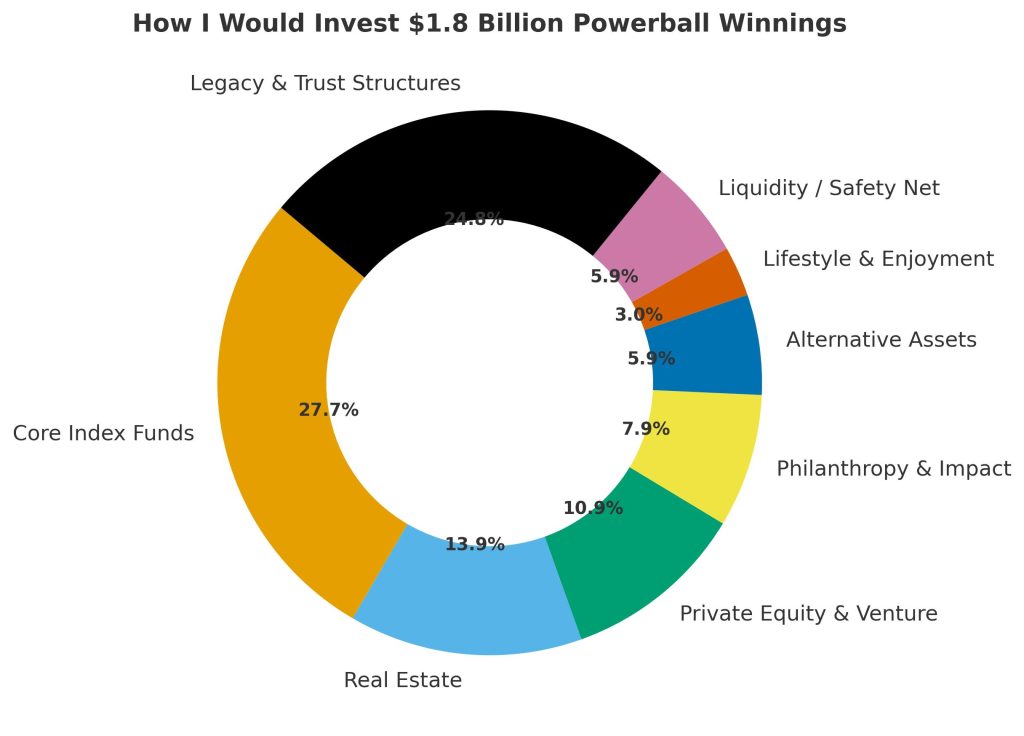
Investment Allocation Breakdown
| Category | Allocation ($) | Percentage |
|---|---|---|
| Core Index Funds | $500,000,000 | 28% |
| Real Estate | $250,000,000 | 14% |
| Private Equity & Venture | $200,000,000 | 11% |
| Philanthropy & Impact | $150,000,000 | 8% |
| Alternative Assets | $100,000,000 | 6% |
| Lifestyle & Enjoyment | $50,000,000 | 3% |
| Liquidity / Safety Net | $100,000,000 | 6% |
| Legacy & Trust Structures | $450,000,000 | 25% |
| Total | $1.8B | 100% |
Final Thoughts
How to invest Powerball winnings goes beyond self-protection from profligacy and conspicuous consumption. Thoughtful diversification across equities, real estate, private equity, philanthropy, and legacy planning leads to both personal enjoyment and generational wealth.
Lottery winners with $1.8 billion or more still make that “last one home” with reckless spending. But that doesn’t have to be the outcome. A long-term view that manages risk, diversifies, and plans for both the future and afterlife creates a sustainable fortune.
The lessons are useful for all of us, not just lottery winners and billionaires. Invest for growth. Hedge your downside. Make sure your money is working hard for you and the future.
Keep learning: courses on this topic
Self-paced courses to put this article into practice.
 Udemy
How To Invest In Stocks In 15 Minutes?
This is for anyone who wants a quick lesson on stocks and want to start trading stocks today—Within 15 minutes. This beginner guide will…
View course
 Udemy
How to Invest in Stocks, Mutual Funds & ETFs for Beginners
Are you ready to take charge of your own investment accounts? Make informed decisions about how to manage your money and let it work for…
View course
 Udemy
Penny Stocks Masterclass: Trade & Invest Penny Stocks
When you think of penny stocks the first thing that comes to mind is probably fraud, right? You're probably thinking about the Wolf of Wall…
View course


Leave a Comment