

Saving only $100 a month feels pointless.
It doesn’t sound like much. You won’t wake up rich overnight. Heck, it doesn’t even feel like it’ll change your future. Most people believe saving really starts at $500 or $1,000 a month.
But that thinking is flawed.
Saving $100 a month is worth it. Here’s why.
- …and What It Can Grow Into
- Does Saving $100 a Month Even Make a Difference?
- What Does Saving $100 a Month Do Over Time?
- Should You Save or Invest $100 a Month?
- Who Should Start With $100/month?
- How to Save $100 Automatic Each Month
- When You Should Save More Than $100/month
- How Saving $100/month Usually Becomes More
- The $100 Challenge Most People Overlook
- Closing Thoughts
…and What It Can Grow Into
Saving $100 a month is the start of something great. It won’t happen overnight, but given enough time, that $100 keep turning into something bigger.
Here’s what you need to know:
- Why saving $100 a month is valuable.
- Exactly how much your $100 grows with time.
- How and when to save more than $100.
Does Saving $100 a Month Even Make a Difference?
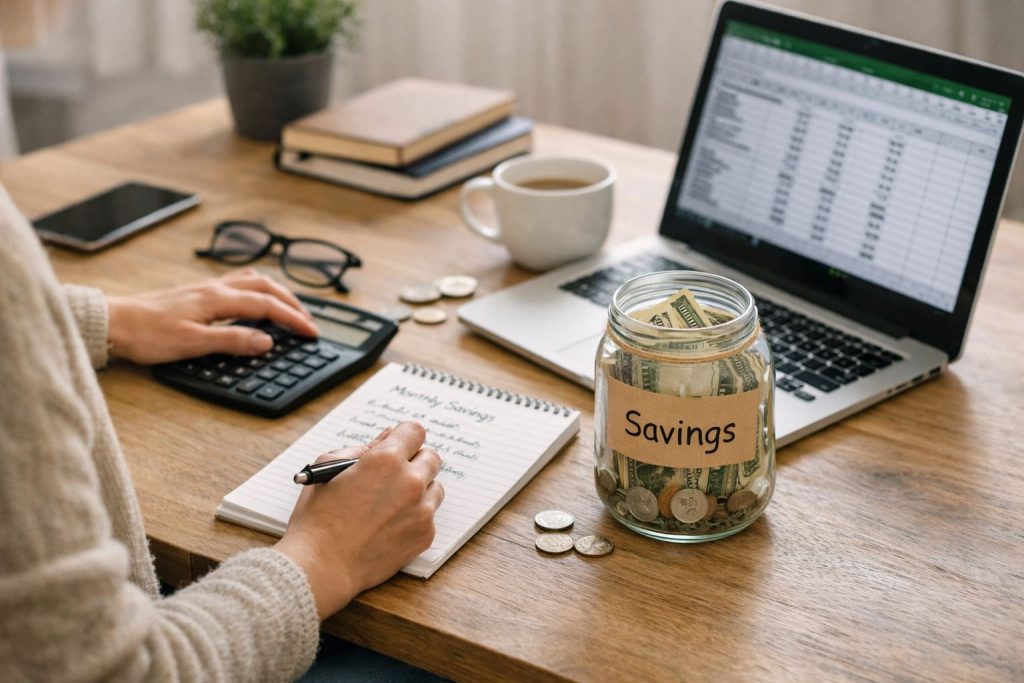
Saving $100 feels weak.
I get it. When you first start thinking about getting your financial life together, it feels like you should be doing more. Saving $100 doesn’t exactly flex wealth-building muscles.
Here’s the thing: financial growth is almost never this dramatic. Real changes come from keeping the course. They come from patiently letting your money accumulate.
See, when you save $100/month, you’re really saving $1,200/year.
And while that number might not impress anyone, adding “I make a habit of paying myself first” to your financial resume does.
The average person who struggles with their personal finances didn’t fail by not earning enough money. They failed because they never committed to a system that automatically saved money month after month.
Committing to save $100 a month is the first step towards that type of system. It’s low barrier to entry, and it won’t feel intimidating.
And once the habit is there, you can always increase your contributions.
What Does Saving $100 a Month Do Over Time?
Forget speculation. Let’s talk cold, hard numbers.
If You Save $100/month
Let’s say you start saving $100 per month in a plain old savings account:
- After 5 years, you’ll have $6,000
- 10 years: $12,000
- 20 years: $24,000
- 30 years: $36,000
That might not get you to financial independence. But it can sure cover emergencies, transitions, or large purchases. Truth be told, many people never get to this point.
If You Invest $100/month
Now let’s say you don’t just save your $100. Instead, you invest it in a diversified portfolio that earns an average of 7% per year.
- After 10 years, you’ll have ~$17,000
- 20 years: ~$52,000
- 30 years: ~$113,000
Magic? Nope. Interest rates at work.

This is compound interest in action. And it’s why saving small matters if you’re willing to be patient.
Should You Save or Invest $100 a Month?
Should you save that $100 in an emergency fund or invest it?
Both actions are desirable, just not always at the same time.
If you have no emergency fund, focus on saving first. An emergency fund keeps you out of debt when unexpected expenses arise. Having $1,000 – $3,000 set aside can also relieve a lot of stress.
If you have an emergency fund sitting pretty, start investing. Investing your money lets it work for you, rather than collecting dust in a bank account.
Many people do both. They save up for a few months, then start shifting that $100 towards investments.
There’s no right answer here. As long as you’re consistently setting that money aside, you’re doing something right.
Who Should Start With $100/month?
Here are a few groups of people who can benefit most from starting to save $100/month.
Newbies who feel overwhelmed by personal finance.
If you’re new to budgeting, finances, and money in general, starting small is smart. Starting with $100 helps alleviate fear and procrastination.
Early-career folks who just started earning a decent salary.
We naturally become better earners as time goes on. (Unless you’ve hit a peak earning salary. Feel free to explode that bubble.) What builds early on, tends to stick. So starting to save now can pay off in the future.
Individuals rebuilding their finances after a setback.
Got divorced? Lost your job? Was your business wiped out by COVID-19? Some life events can destroy your confidence when it comes to money. Starting small can help you regain your footing.
If you fall into any of these categories, forcing yourself to save more than $100 isn’t a glorious feat. It’s unnecessarily punishing yourself.
How to Save $100 Automatic Each Month
Like any other good financial habit, saving $100 should be automatic.
On payday, set up your bank account to automatically transfer funds into your savings account the day after you get paid. Don’t wait until the end of the month and hope you have something left over. That strategy rarely works.
You should treat that $100 like any other bill. Rent is due on time each month. Your savings should be too.
After you set it up, don’t think about it anymore. Let your consistency do the heavy lifting for you.
When You Should Save More Than $100/month
Saving a $100 a month is great…but only to a certain point.
If you have high-interest debt like credit card bills, you’re probably better off paying that off instead. Same thing if you’re hopelessly behind on retirement and are already in your 40s/50s. In these scenarios, $100 should be your starting point, not your end game.
Starting small isn’t the problem. Continuing to stay small is.
How Saving $100/month Usually Becomes More
And here’s the part most people don’t see coming.
By forcing yourself to save $100 a month for six months to a year, you’ll change your mindset. You’ll start thinking of ways to increase that number.
Got a bonus at work? That’s extra money to save. Canceled that subscription? Nice! Throw those savings into your fund as well.
Going from $100 to $200 doesn’t feel as daunting as going from $0 to $100. And once you start seeing your progress, you’ll start believing you can continue growing your income.
That’s how most people experience true financial change.
The $100 Challenge Most People Overlook
When you first start learning about personal finance and money management, everyone wants to throw big numbers and flashy investments in your face. Make $10,000. Invest in Bitcoin. Save $1,000/month.
But none of that matters if you don’t see yourself as a saver.
Saving $100 a month is more about changing your identity. You evolve from someone who wants to save money to someone who saves money. It’s a small shift, but it has big consequences.
When you see yourself as a saver, other money-friendly habits start falling into place. You spend with more intention. You feel motivated to reach your financial goals.
That’s why saving $100 is more powerful than it may initially seem.
Closing Thoughts
Saving $100 a month is possible. And yes, it is worth it.
It’s worth it because the compound stability, financial discipline, and options it provides over time. It’s worth it because starting now is better than waiting until you CAN save $500+/month.
If $100 is all you can comfortably set aside each month, please start there. Focus on building that routine and trust me, the rest will follow.
The most important part isn’t how much you save. Starting is.




Leave a Comment