
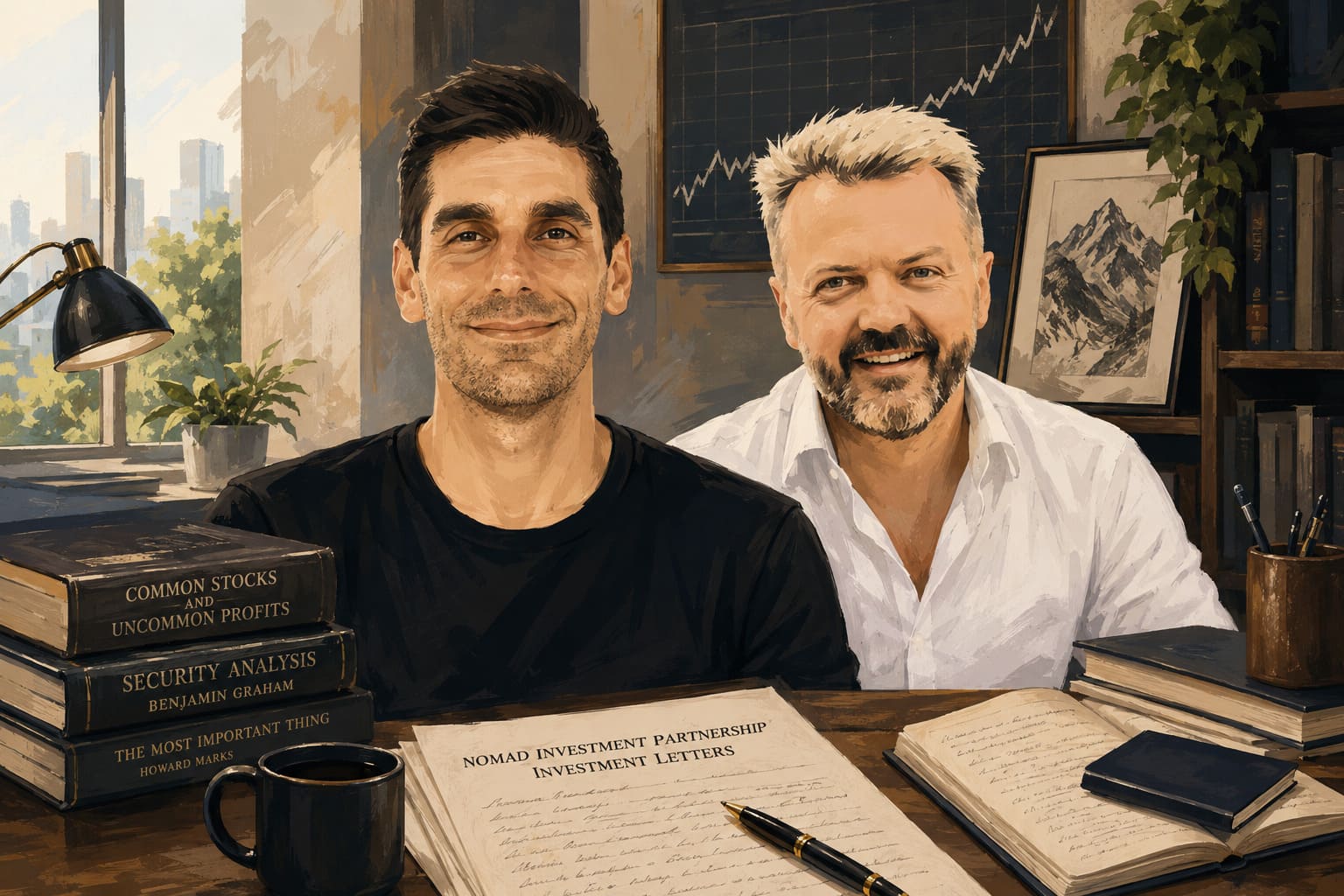
Most investors chase stock tips. Quarterly earnings insights. Hot takes on X. Finfluencers.
I spend far too much time doing those things as well. But for the better portion of my investing journey, I’ve learned most by reading long-term investors who have thought deeply about the process of compounding wealth over decades.
That’s one reason I became such a fan of the Nomad Partnership investment letters. Written by Nicholas Sleep and Qais Zakaria of Nomad Investment Partnership, the letters have a cult following among serious investors. While the fund itself has since shuttered, the letters live on for investors who appreciate patience and a knack for explaining business quality.
Compare the Nomad letters to Buffett or Munger and you’ll notice one glaring difference. You won’t find many stock predictions. But what you will find are lessons about how great businesses make a lot of money for long periods of time.
Another reason the Nomad letters are so powerful? Sleep and Zakaria talk about a lot of ideas years before they become “common knowledge”. Ideas like economies of scale shared customers, customer obsession, compounding at long duration, and platform businesses are common themes throughout their letters.
Below are some of my favorite lessons from both investors.
- Great Businesses Share Their Scale Benefits With Customers
- Long-Term Investing Works Best When You Hold Exceptional Companies
- Management Quality Matters More Than Most Investors Think
- Customer Obsession Is Often a Better Signal Than Profit Margins
- Patience Is a Competitive Advantage
- Simplicity Often Beats Complexity
- Market Volatility Is Normal
- Compounding Requires Time More Than Brilliance
- Avoid Businesses Fighting Commodity Economics
- Investing Is As Much Psychological As Analytical
- Final Thoughts
Great Businesses Share Their Scale Benefits With Customers
Perhaps the most valuable lesson from the Nomad letters was “scale economies shared.”
This concept shifted the thinking of many investors on competitive advantage.
Most businesses become large and simply keep the profits. The rare business turns those advantages into lower prices, quicker delivery, or superior service for the customer.
Repeated over time, this can create a flywheel that’s extremely hard for competitors to stop.
Costco was the quintessential example made famous in the letters.
Rather than charge the highest prices possible, Costco keeps costs low for members. They pay less than elsewhere which leads to more loyal customers that buy more often = more volume. More volume -> better purchasing power -> even lower costs.
Amazon would later become another super visible example of this approach.
I share this lesson because investors often mistake businesses that seem “too low margin.” Sometimes low margins are a weapon.
Long-Term Investing Works Best When You Hold Exceptional Companies
Most investors trade way too much.
Over and over again the Nomad letters stated that massive fortunes in investing are built by owning extraordinary businesses for extremely long periods of time.
It sounds easy, but it’s very difficult psychologically.
Everyone wants to sell a stock that doubles. Everyone panics and sells during market crashes. But some of the biggest wealth accumulations occur many years (or even decades) into the compounding process.
The letters focused on businesses that reinvested capital at high rates of return for decades.
That is why Nomad investors who patiently owned Amazon, Costco, and Berkshire Hathaway for long stretches of time absolutely crushed the performance of those who traded frequently.
A stock can trade for years at “expensive” prices and continue to produce astronomical returns if the business continues to compound.
Newer investors often struggle to fully appreciate this concept.
Management Quality Matters More Than Most Investors Think
One topic the Nomad letters covered at length was behavior of management.
All CEOs are not created equal.
Some CEOs only care about hitting quarterly numbers. Others are focused on building lasting franchises that generate value for decades.
The math on that difference grows wildly exponential over time.
Typically excellent management teams exhibit a few traits:
- Disciplined capital allocation
- Transparent communication
- Long-term focus
- Obsession with customers
- Self-control when markets go crazy
- Accepting short term pain for long term gain
That’s part of the reason you often see founder CEOs vastly outperforming peers over long stretches of time.
Because founders think like owners instead of employees.
If you’re an investor that focuses solely on financial metrics and ignores management…you’re missing the big picture entirely.
Customer Obsession Is Often a Better Signal Than Profit Margins
One of the lessons I loved from the Nomad letters:
Companies that are obsessed with customers generally generate better long-term shareholder value.
This goes against your instincts.
Wall Street loves profit. Customer-obsessed companies often sacrifice near-term margins to delight their customers.
That builds trust.
Trust compounds trust.
Amazon is the obvious example. Investors complained for years about Amazon’s lack of profitability. But Amazon persisted in its focus on everything it could do for the customer.
Logistics. Infrastructure. Pricing. Convenience.
The result was a moat that’s impossible for rivals to cross.
Profits-focused investors missed the big picture.
The Nomad letters hammered home the importance of seeing if your customers are getting happier as a function of time.
That can be more important than quarterly profit swings.
Patience Is a Competitive Advantage
Speed is rewarded in today’s markets.
Social media encourages investors to react to news headlines, rumors, and price changes instantly.
The Nomad letters do the opposite.
They embrace patience as an edge.
Most investors don’t stay patient long enough to let compounding do its work.
It’s even harder to stay patient when stocks trend sideways for years or when market sentiment gets negative for a while.
The letters demonstrated over and over that INACTIVITY often creates wealth, notactivity.
That doesn’t mean holding on to losing companies forever. But it does mean knowing the difference between short-term volatility and long-term business decline.
Doing nothing can be the best move you make.
This is easy to say but very hard to do when everyone else is panicking.
Simplicity Often Beats Complexity
One reason I enjoy reading the Nomad letters is because many of the foundational ideas are refreshingly simple:
You don’t have to understand esoteric financial engineering to be a successful investor.
The letters emphasized investing in understandable businesses with simple, compelling economics.
This is key, because smart investors can fall into the trap of confusing complexity with smarts.
Obscure investment theses can conceal flimsy fundamentals.
But many of the greatest businesses of all time were wonderfully simple:
- Retailers with strong brand loyalty
- Platforms that benefit from network effects
- Subscription businesses with predictable recurring revenue
- Asset-light software businesses
- Companies with durable cost advantages
The hard part isn’t finding complex investments.
The hard part is having the discipline to own ridiculously simple businesses for long enough.
Market Volatility Is Normal
Volatility is something else the Nomad letters teach us about.
Far too many investors believe investing should provide smooth returns.
It won’t.
Even wonderful companies go through brutal drawdowns.
Amazon has suffered massive drawdowns multiple times over its history. So has Netflix. So does Meta Platforms.
Temporary price decreases are not the definition of your investment thesis being invalidated.
Nomad’s letters help investors realize they should care less about stock prices day-to-day and focus more on the underlying business.
If the business continues to improve, volatility is actually your friend because it presents buying opportunities.
This mentality is crucial to have during a bear market when fear is prevalent in the news.
Compounding Requires Time More Than Brilliance
A deep insight from the Nomad letters:
Amazing investing results aren’t necessarily built by being a genius year after year. They are often built through duration.
Many investors make too much of discovering the “next big thing”.
…but give compounding enough time and even modest returns will become life changing.
The math of compounding is straightforward, but few can emotionally hang in there.
….5% better than average returns compounded over 30 years is a huge amount of money.
That is why preserving capital and staying invested are so critical.
Endurance beats excitement. The Nomad letters hammered this point home.
Avoid Businesses Fighting Commodity Economics
A related lesson that came up many times in the letters was to stay away from businesses caught in a vicious cycle of competition.
Many commoditized industries suffer because everyone is trying to undercut each other on price.
That erodes margins over time.
Great businesses often have some sort of moat:
- Brand
- Network effects
- Switching costs
- Cost advantage
- Customer loyalty
- Distribution
Without differentiation, businesses can quickly find themselves in a cycle of destructive competition.
That’s why many prefer quality software, platform, or consumer ecosystem businesses vs a “pure play” in a commoditized industry.
The letters kept bringing up buying companies with economic moats vs low valuations.
Investing Is As Much Psychological As Analytical
If there is one big theme from the Nomad letters, it’s that investing is a psychological game.
Almost all mistakes are made with poor emotions dominating your decision-making.
Fear causes people to sell during market crashes.
Greed causes people to buy speculative rubbish during bubbles.
Envy causes people to make highly speculative trades after watching others enrich themselves on TV.
The best investors are the ones who develop processes which minimize emotional trading.
I remember the letters hammering home themes of thinking for yourself, being rational, and having discipline over your emotions.
This is difficult now with constant noise from financial media and social networks.
But the fundamentals don’t change.
Staying level headed, thinking long term, and avoiding emotional extremes is likely more important than financial engineering.
Final Thoughts
There’s not many better places to learn about investing than reading the Nomad Investment letters.
They’re straight to the point, offer unique insights and are easy to understand.
What makes them so effective is that they don’t try to predict markets or promote active trading schemes.
Here are some of the key principles they cover:
- Own great businesses
- Think for the long-term
- Believe in compounding
- Be patient
- Buy businesses with great management
- Value customer obsession
- Don’t listen to the noise
Many of those concepts sound obvious when you read them.
But actually following through and doing them is extremely hard.
Hence why most investors underperform over the long-term.
For me the most important lesson from reading the Nomad letters is that good investing looks boring from the outside. It’s about having the patience to wait and letting great businesses compound.
In today’s society where everyone wants to get rich quick talking loudly about what stock is going to blow up next. That lesson is probably the most valuable one.
Keep learning: courses on this topic
Self-paced courses to put this article into practice.
 Udemy
Stock Market for Beginners: Start Smart, Invest Wisely
A self-paced video course on investing basics and stock investing, with practical lessons you can apply right away.
View course
 Udemy
How to Invest in Green Energy Stocks
In this course, you will learn how to approach investing in green energy in a structured and practical way. You will begin by understanding…
View course
 Udemy
Stock Trading: Invest and Trade Safely with Stock Sector ETF
Stock Lovers, Traders, Investors, Stock Market Aficionados! Master the basics of trading ETFs. NO NEED to pick and choose individual…
View course




Leave a Comment