
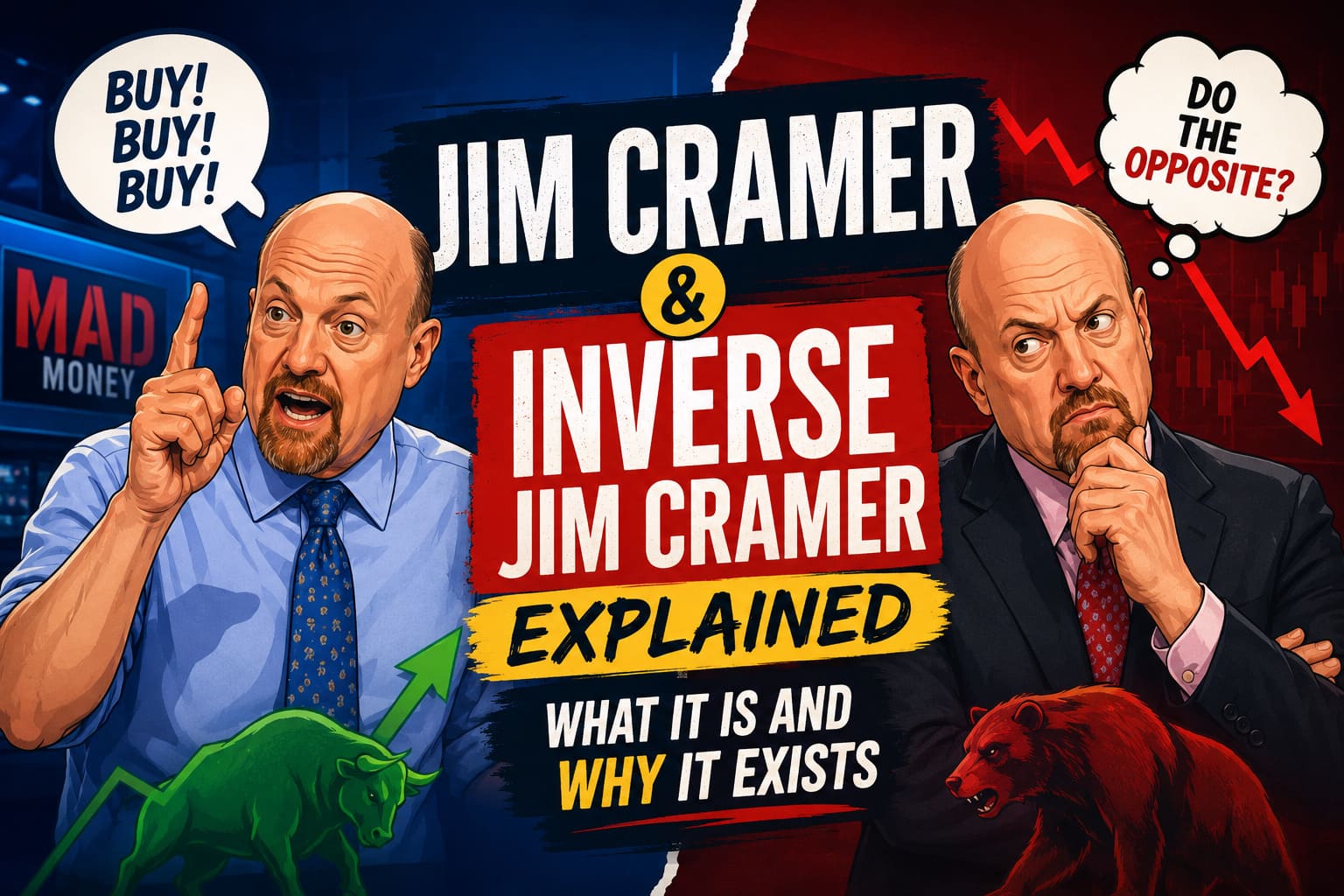
If you’ve spent any amount of time meandering through investing-focused corners of the internet — Reddit forums, X (formerly Twitter), financial news-focused Discord servers — chances are you’ve seen the term “inverse Cramer” tossed around. It’s partly a meme and partly, for some investors, a legitimate investing strategy.
To know why “inverse Cramer” is a thing, though, you have to know who Jim Cramer is, what he does and why seemingly half of the retail investing space thinks fighting against his advice is the best course of action.
Who Is Jim Cramer?
CNBC stock picker James J. Cramer. Does that name ring a bell? James J. Cramer just might be the most famous face on financial television. After graduating Harvard Law, he was a successful hedge fund manager who co-founded TheStreet.com in 1996. Fast-forward to 2005 and he’s hosting CNBC’s flagship financial show Mad Money.
On Mad Money, Cramer spouts quick-fire stock picks and screams “BUY BUY BUY” or “SELL SELL SELL” while utilizing sound effects and props to make the world of stock analysis seem more like Las Vegas than a Bloomberg terminal.
His pedigree is absolutely real. Before his television career, Cramer owned and operated his own hedge fund named Cramer, Berkowitz & Co. and apparently had some pretty nice years. The guy knows what he’s talking about. He’s not your average pundit. He’s been running his own money and trading the markets for decades. But he’s also wildly popular and one of the most influential voices when it comes to retail investing. So influential, that he can move individual stocks just by talking about them on air. Heck, that’s why they call it The “Cramer Effect.”
So here’s my question… if Jim Cramer is such a seasoned investor, and such a BIG influence in the markets… why do people love to tell you to “do the opposite of what Cramer says?”
What Is the “Inverse Cramer” Strategy?
Inverse Jim Cramer, put simply, involves doing the opposite of whatever Jim Cramer says to do in the public sphere: Buy his stock picks, and sell them. And when he’s telling people to sell a stock or trades bearishly, buy that stock. The theory: Over time, Cramer’s stock picks have tended to underperform — or absolutely collapse — soon after he publicly endorses them.
Stock moves inspired by the Inverse Jim Cramer philosophy bubbled up into mainstream financial media lexicon around the year 2022, but had been circulating as an idea for years prior. It became such a pervasive joke that asset manager Tuttle Capital Management went so far as to file with the SEC that year for a bona fide ETF called — yep — the Inverse Cramer ETF (ticker: SJIM).
Per its filing, its goal would be to bet against Cramer’s public stock picks. Another ETF, the Long Cramer ETF (ticker: LJIM), was also filed — for people who wanted to piggyback Cramer’s moves — essentially letting the market decide the joke once and for all.
Come March 2023, both ETFs launched. Early returns, well, weren’t great for fans of either philosophy, which I suppose speaks to the challenge of weaponizing a meme.
Why Do People Think Inverting Cramer Works?
There’s no single reason; there are several theories. Some of them are mutually exclusive; others may be complementary.
The Timing Problem
By the time Jim Cramer chimes in with a stock recommendation on live national television, it’s likely that institutional investors and algorithmic traders have already accounted for whatever news/event/set of information Cramer is reacting to. Big price moves on stock exchanges are generally no longer driven by retail investors watching Mad Money. They’ve gotten the news recommendation after the fact.
Think of it as tiered information flow: by the time retail sees Cramer touting a stock,smart money has already long-queued trades to capitalize on the imminent move based on their own superior information networks. That’s what moves markets. Once those trades begin to fill, Cramer goes on TV and entices retail buyers to pile in.
This “Cramer Effect” leads to a short-term spike as retail investors pile into a stock en masse — only to see the stock pullback sharply as institutional traders use that influx of retail liquidity to sell off their now-overvalued positions.
Basically: Cramer helps big investors sell their stock.
The Recency Bias in Coverage
Cramer recommends hundreds of stocks every year. When his recommendations age poorly, they get clipped and shared online as proof he knows nothing about the stock market. When he’s right, his tweets rarely get any attention.
It’s easy to find examples of Cramer being wrong; it’s hard to find examples of him being right. Confirmation bias does the rest.
Some of his more notable recent misses include:
- Telling viewers they should keep their money in @BearStearns until further notice just days before the company would effectively collapse in 2008.
- Bullishly hyping stocks throughout 2021–2022 just as they’d begin falling sharply.
- Predicting “magaflation” would send the market reeling. Within weeks, the market reached new all-time highs and Cramer was proven wrong.
But on the internet, these highlights will live FOREVER.
The “Curse” Dynamic
Others have taken a more quantitative approach. Researchers at financial publication Unusual Whales published an analysis in 2022 showing that, backtested over a multi-year period, the hypothetical “Inverse Cramer” portfolio would have beaten the S&P 500. The study was popularized on social media and contributed to momentum behind actually launching an ETF that does just that.
This is not to say that so-called “Cramerading” won’t work; backtested results are never guaranteed to extend into the future. But remember: this data covers a time period when a large number of bullish stock calls would have been destined to fail simply due to the unpredictable pandemic market.
The Entertainment- vs Advice problem
Mad Money is meant to entertain. While Cramer may have the best of intentions when it comes to giving stock advice on television, remember that his job is to rack up high viewership ratings — not to maximise your portfolio returns.
Big, bold, attention-grabbing calls on stocks make great TV. “Based on X,Y, and Z, I’m 70% confident in this stock…but if you have a shorter time horizon, you may want to avoid it” does not.
This conflict of interest can lead Cramer to make inherently riskier television – and by extension, stock recommendations – than what you might see from a more behind-the-scenes, data-driven portfolio manager.
Is the Inverse Cramer Strategy Actually Smart?
This is where fair-minded analysis is important. The answer is: likely not as a bona fide investment strategy, even if the prank has statistical validity.
Why? Allow me to explain.
Markets don’t tend to move inversely in predictable ways. If Inverse Cramer worked (and was known to work – and it now is), arbitrageurs would eliminate the opportunity. Any persistent, publicly-known market edge gets arbitraged away once it’s public knowledge.
Also, SJIM’s performance was underwhelming. The actual Inverse Cramer ETF had relatively low assets under management, and hasn’t markedly outperformed since inception. Deploying the strategy in the real world (i.e. with management fees, transaction costs, and inability to trade precisely when Cramer makes his recommendations) is much more difficult than the backtested performance would indicate.
Survivorship bias, selection bias. The stocks Jim Cramer talks about tend to already be well-known, large-cap stocks. There’s a limited informational advantage to trading either side of what Cramer covers.
The bigger lesson of the Inverse Cramer phenomenon is one that’s true about financial media in general: TV entertainment and thoughtful investing advice aren’t interchangeable, and using the former as the latter is a recipe for retail investor disappointment.
What Can Investors Actually Learn From This?
Whether you think the Inverse Cramer meme is hilarious or over-simplistic, there are some real investing lessons in there.
Do Your Own Research. Whether it’s Jim Cramer, a guy on Reddit, or your cousin at a dinner party, if you buy or sell something simply because someone told you to and you don’t understand the business, valuation, and risk…you’re going to lose money. Period.
Beware of high conviction short term predictions. Markets aren’t easy. If someone sounds 100% certain about what a particular stock is going to do over the next few days, they either don’t know what they’re talking about…or they are just yanking your chain.
Know the difference between entertainment and advice. Watch Mad Money for entertainment value. Enjoy your financial advisor’s advice (assuming you have one) and know that they are held to a fiduciary standard that doesn’t apply to cable television.
Media timing can be your worst enemy. If you’re always buying and selling after news has been shared with the world, you’re likely reacting to the market, not trading ahead of it.
The Bigger Picture: Media, Influence, and the Retail Investor
Jim Cramer represents the great irony of modern investing. Brokers have democratized access to information: You can sign up for a brokerage account in minutes. You can stream real-time data on your phone. You can even pay for hourly commentary from people who think they know what they’re doing.
But democratized information isn’t the same thing as good information. Just because you can trade doesn’t mean you should.
Retail investors should take the skeptical lesson of the Inverse Cramer meme to heart every day, not just when CNBC is on. The best investors don’t look to TV for their trading ideas. They know how to evaluate the businesses they own. They think long-term. And they don’t allow a slick narrator to override their own instincts.
Inverse Cramer isn’t really about Jim Cramer. It’s about learning to think for yourself.
Conclusion
Jim Cramer is a real, legitimately trained financial market expert who made a television career popularizing stock-market advice. The Inverse Cramer playbook is based on a recurring theme of his public recommendations performing poorly, exaggerated by internet memes and validated (somewhat) by third-party assessments. An ETF even sprang up based on the concept, making it one of the strangest ways finance and meme economy have collided yet.
Do you want to inverse Cramer? As a continuing strategy, unlikely. But are you wary of anyone yelling stock tips in your face? You should be. Here’s the trade you should make: Invest in your financial education. Something, at least, Jim Cramer can get behind.
Keep learning: courses on this topic
Self-paced courses to put this article into practice.
 Udemy
From Welfare to Wealth: Earn Online & Invest Wisely
If you're living on a low income, receiving benefits, or stuck in survival mode — this course is for you.“Financial Independence on a Low…
View course
 Udemy
Investing For Beginners: How To Invest With Confidence
This Course is for you if ...1. You know nothing about investing.2. You are new to stock market investing and looking for a place to…
View course
 Udemy
How To Invest In Stocks: Value Investing Course
A self-paced video course on value investing and stock investing, with practical lessons you can apply right away.
View course





Leave a Comment