
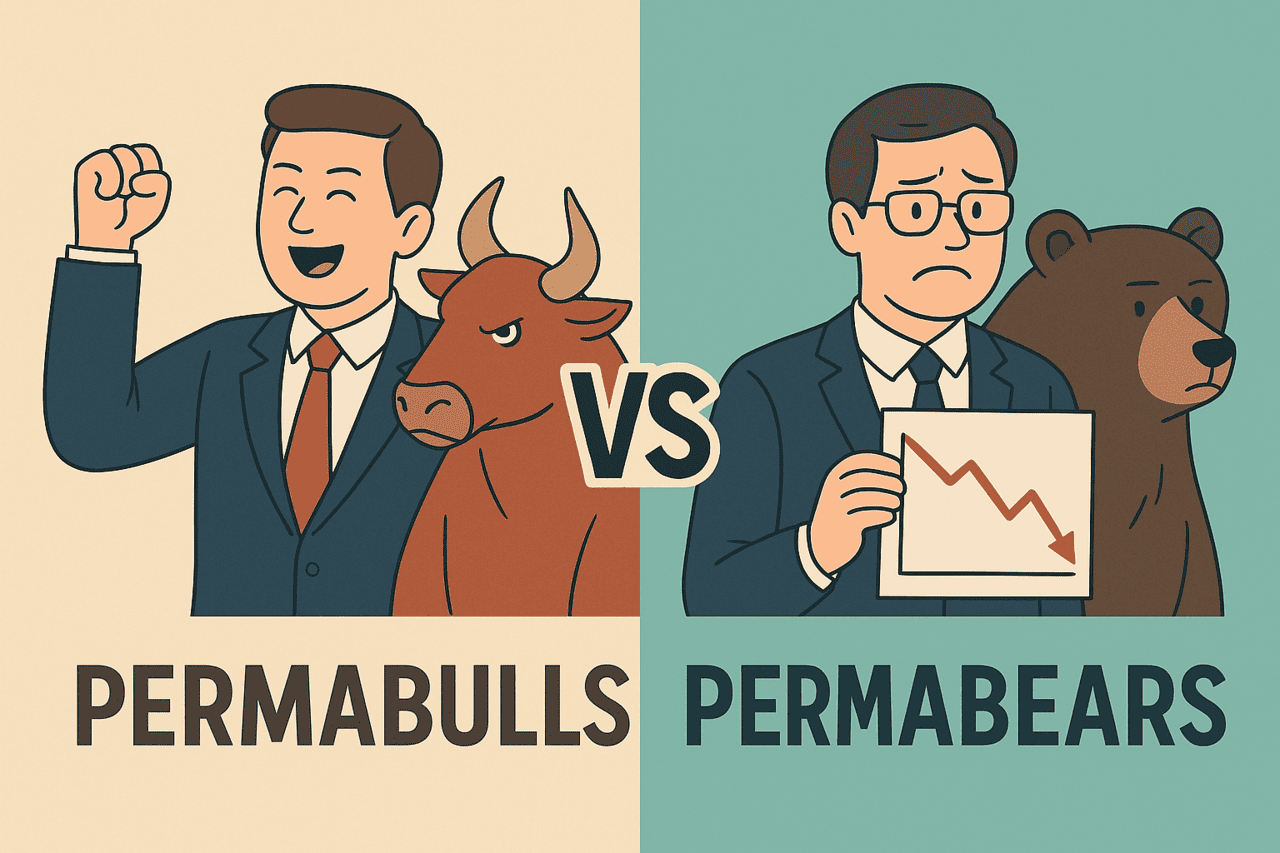
If you spend any time on investing message boards or X, you’ll notice two tribes warring at all times: permabulls and the purveyors of bear porn.
Perma-bulls worship the cult of “the market always goes up” while bear pornists gorge themselves on apocalyptic market crash and recession predictions.
Both sides make good content, but neither extreme is helpful to long-term investors. In this post I will cover:
- The psychology behind permabulls and bear porn
- Why they are so attractive to follow
- How to cut through the noise and invest like a smart investor
What Are Permabulls?
Permabulls are extreme optimists who are eternally bullish on the stock market, no matter what. When the market is expensive, permabulls call dips “buying opportunities”, “time in the market beats timing the market”, and generally don’t pay attention to valuations.
Characteristics of a permabull include:
- Belief in the long-term growth of equities no matter the current valuation.
- A high degree of faith in the powers of innovation, productivity growth, and capitalism’s ability to self-correct.
- A tendency to dismiss or downplay risk factors like debt bubbles, inflation, or geopolitical risk.
Permabulls are often fond of quoting Warren Buffett’s famous quote: “The American economy will do fine over time.” The problem with this philosophy is that it tends to overlook risks.
What Is Bear Porn?
Bear porn is the opposite of permabulls. This term was coined by philosopher-economist Mark Ames to describe the seemingly never-ending flow of end-of-the-world market predictions.
Bear porn includes:
- Predictions of market crashes, housing market collapses, currency meltdowns, etc.
- Chart overlays of “history repeating itself” (1929 market crash chart overlays are a popular favourite).
- Attention-seeking influencers and thinkers who try to make a name for themselves by stoking fear, such as the folks who make bold calls like “Dow 50% lower this year”.
Bear porn is popular content because it taps into the powerful emotions of fear and anxiety. A headline about an impending market crash or new recession is naturally more attention-grabbing than a story about slow and steady gains. For a real-world example of how repeated crash calls play out, see Michael Burry’s crash warnings since 2017.
Why Investors Gravitate Toward Extremes
Permabulls and bear porn both tap into important parts of human psychology:
- Confirmation bias. Both bulls and bears prefer to hear narratives that confirm their pre-existing beliefs.
- Emotional security. Optimists are reassured by bullishness, while skeptics feel validated hearing about risks.
- Simple stories are easier to understand than complex analysis. It’s much easier to digest a world that is “always going up” or “always going down” compared to the messiness of grey areas.
But reality is messy. Financial markets are complex systems that rarely trend in a single direction. Reality is usually somewhere in the middle.
The Problem with Permabulls
Optimism is great for investing over the long term. But blind bullishness becomes a problem when it causes investors to:
- Overpay for assets by ignoring valuation metrics.
- Underestimate or dismiss risk. Risk does exist! 2000 dot-com bubble and 2008 financial crisis are proof of that.
- Fail to diversify their portfolio, overexposing themselves to stocks or speculative assets.
Even companies with a solid long-term business can take decades to recover from a bubble-induced drawdown. Cisco trades below its 2000 highs even though it is a real business with actual revenue.
The Problem with Bear Porn
Constantly reading about impending doom has its own set of problems:
- Missing out on potential gains. The stock market has trended up over the long run. Staying on the sidelines waiting for “the big crash” usually destroys wealth.
- Emotional exhaustion. Consuming bear porn creates anxiety and makes it hard to make clear-headed decisions.
- Loss of credibility. The bear case is easy to argue. But if someone has been making the same crash call for years, how do you know they are right this time?
- The saying goes “bears sound smart, bulls make money”.
How Smart Investors Can Navigate the Middle
The smarter approach is to avoid both extremes and chart your own course in the middle. Here is how I’d do it:
- Acknowledge that markets move in cycles. There will be good times and bad times. Prepare for both.
- Diversify your portfolio. Don’t put all your eggs in one basket whether it be stocks, bonds, real estate, or alternative investments.
- Have valuation discipline. Learn to recognize when markets are expensive or cheap and adjust your risk accordingly.
- Stay flexible and willing to shift allocations, but don’t overbet on either extreme.
- Keep some cash reserves. Dry powder is your friend. Cash allows you to take advantage of opportunities that arise.
Historical Lessons
Permabulls in 1999: Many believed that tech stocks had nowhere to go but up. The tech stock crash that wiped out trillions of dollars should have taught us all a lesson about valuations.
Bear porn in 2010–2012: After the financial crisis many forecasters and expert advisors predicted an “inevitable double-dip recession”. The actual outcome: the S&P 500 tripled in the next 10 years.
The pandemic crash of 2020: Permabulls were caught off-guard by the quick drawdown, while the purveyors of bear porn predicted depression-era levels of misery. Actual outcome: tech stocks led a sharp recovery.
History has repeatedly shown that extremes are wrong.
The Balanced Investor Mindset
Smart investing is about managing probabilities, not making predictions. I focus on trying to avoid the following:
- Expecting volatility and drawdowns.
- Avoiding leverage that can destroy capital.
- Recognizing that both optimism and skepticism have a place in investing.
Long-term investing success is about neither always being bullish nor bearish, but instead about adjusting your strategy based on how the facts change over time.
Final Thoughts
Permabulls and bear porn have been around since markets first began. While entertaining to watch, chasing one side or the other almost always leads to underperformance.
Balance is key: optimistic enough to invest for the long term, but cautious enough to protect yourself against downturns. Ignore the extremes, embrace the grey areas, and remember that in investing moderation almost always wins.
Keep learning: courses on this topic
Self-paced courses to put this article into practice.
 Udemy
How to Invest in Stocks, Mutual Funds & ETFs for Beginners
Are you ready to take charge of your own investment accounts? Make informed decisions about how to manage your money and let it work for…
View course
 Udemy
Investing For Beginners: How To Invest With Confidence
This Course is for you if ...1. You know nothing about investing.2. You are new to stock market investing and looking for a place to…
View course
 Udemy
Personal Finance from Zero: Budget, Save, Borrow & Invest
Money touches every day of your life, yet almost nobody is taught how it works. Where does your pay go between payday and the end of the…
View course





Leave a Comment