

If you’re looking for a way to generate consistent income from the stock market—without relying solely on dividends or price appreciation—the Options Wheel Strategy is one of the most practical systems you can use.
It’s simple in structure, powerful in results, and perfect for investors who want to get paid while waiting to buy a stock, get paid while holding it, and get paid when they sell it.
In this article, we’ll cover:
- What the wheel strategy is (in plain English)
- A real-world example using NVIDIA (NVDA) at $139
- How theta and delta drive the math
- The difference between cash-secured vs. naked puts
- Common FAQs to help you get started
Let’s break it down.
What Is the Options Wheel Strategy?
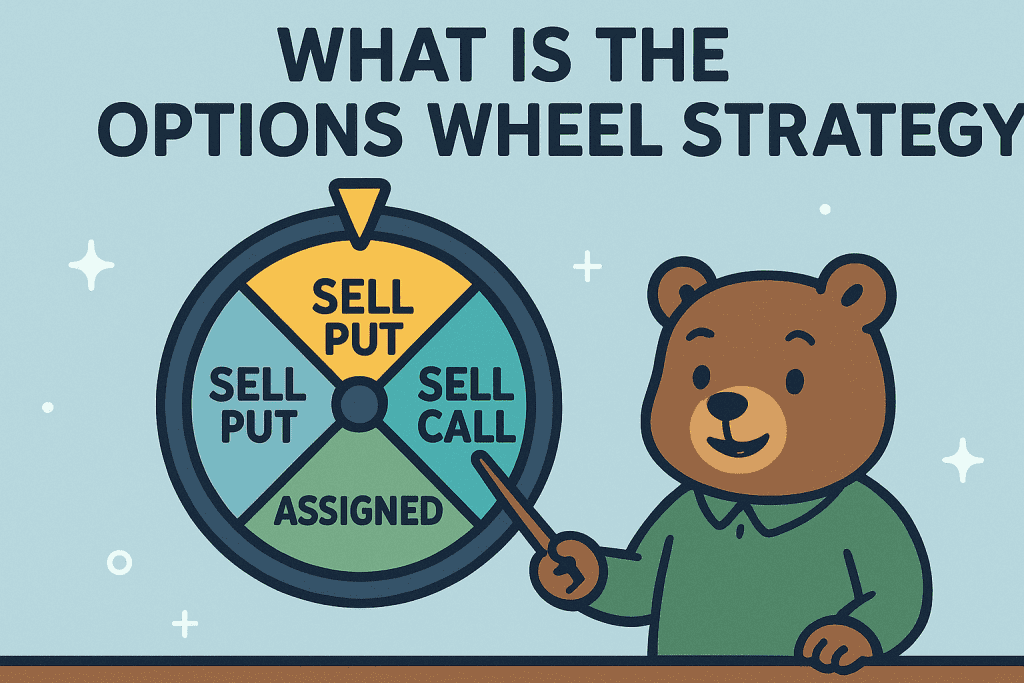
The Options Wheel is a 3-part, repeatable system:
- Sell a put option on a stock you’d like to own.
- If the stock stays above the strike, you keep the premium. If it drops, you’re assigned shares.
- Once assigned, sell a covered call to generate income on the shares you now own.
- If the stock gets called away, take your profit and repeat step 1.
It’s called a “wheel” because the process rolls continuously. Each cycle either earns premium or locks in gains.
Why It Works: Time Decay (Theta) and Assignment Probability (Delta)
Theta: You Get Paid for Time
When you sell an option, you benefit from theta, the Greek that measures time decay. Every day that passes reduces the value of the option you sold—as long as the stock stays in a favorable range.
With the wheel, time is your friend. Whether the stock moves a little or not at all, the options you sold lose value with each passing day. You can close them early or let them expire—either way, you’re collecting “rent” on your capital.
Delta: Measuring Your Risk and Reward
Delta measures how much the option price will move relative to the stock, and also loosely represents the probability of assignment.
- Selling a put with –0.20 delta = ~20% chance of getting assigned
- Selling a call with +0.30 delta = ~30% chance of having shares called away
In the wheel, traders often sell puts with delta –0.20 to –0.30 and calls with delta +0.25 to +0.35. This gives a solid premium with a balanced risk profile.
Real-World Example: Running the Wheel on NVIDIA (NVDA) at $139
Let’s walk through a real example with NVIDIA—currently trading at $139 per share.
Step 1: Selling a Cash-Secured Put
You’d love to own NVDA, but at a slight discount. You sell a 1-week $135 put, which gives you:
- Premium: $1.60 per share = $160
- Delta: –0.25
- Collateral needed (cash-secured): $13,500
- Effective purchase price if assigned: $133.40
If NVDA stays above $135, you keep the $160 and repeat next week. If it dips below $135, you’re assigned the shares—at a price you were okay with.
Step 2: Selling a Covered Call
You now own 100 shares of NVDA at $135. To generate more income, you sell a 1-week $140 call:
- Premium: $1.50 per share = $150
- Delta: +0.30
- Max capital gain if called: $5 per share ($135 → $140)
- Effective sale price: $141.50 (strike + premium)
If NVDA stays below $140, you keep the shares and the premium. If it rises above, your shares are sold at a gain—and you repeat the wheel.
Outcome of One Full Wheel Cycle
If assigned then called away:
- Put Premium: $160
- Call Premium: $150
- Capital Gain: $500
Total Profit in 2 weeks: $810 on $13,500 capital (~6%)
What’s the Difference Between a Cash-Secured Put and a Naked Put?
This is a critical distinction that affects both risk and broker permissions.
Cash-Secured Put
When you sell a cash-secured put, you set aside enough cash to buy 100 shares at the strike price.
- Safe and suitable for most investors
- Required in retirement accounts (e.g., IRAs)
- No leverage used
- Maximum loss = Strike price × 100 – premium
In our NVDA example, selling a $135 put means you hold $13,500 in your account to back that position.
Naked Put
When you sell a naked put, you do not reserve the full amount of cash required to buy the stock. You’re relying on margin or buying power instead.
- Higher risk
- Requires margin approval
- If assigned, you must purchase shares—even if your account doesn’t have the full cash
- Broker may issue a margin call or auto-liquidate
Beginners should avoid naked puts. Always use the cash-secured version, especially when you’re just getting started.
What Stocks Work Well With the Wheel?
You want:
- High options liquidity
- Stable fundamentals
- Attractive premium yield
- Stocks you’re happy to own
Good candidates:
- NVDA
- AMD
- KO
- JPM
- AAPL
- QQQ / SPY / IWM ETFs
Avoid meme stocks, low-float names, and companies with upcoming binary events (like earnings) unless you’re experienced.
Wheel Strategy vs. Just Holding: Which One Performs Better?
One of the most common questions investors ask is:
“Why bother with the options wheel? Why not just buy and hold the stock?”
It’s a fair question—especially if you’re investing in great long-term companies like NVIDIA or Apple.
Here’s how they stack up:
Buy-and-Hold Strategy
- You purchase shares and hold through all market cycles.
- Returns are based entirely on capital appreciation and dividends (if any).
- It’s hands-off and simple.
- Your downside is the same as the wheel: you can still lose if the stock declines significantly.
- You don’t generate income during sideways or flat markets.
Options Wheel Strategy
- You earn premium income consistently, regardless of whether the stock goes up, down slightly, or trades sideways.
- You still benefit from capital appreciation if shares are called away at a higher price.
- Requires more active management (selling puts/calls each week or month).
- If done right, your cost basis is continually reduced through premium collection.
- You may miss some upside if shares are called away early during a rally.
Let’s Compare Returns Using a Realistic Example
Imagine two investors: Jane and Mark.
- In January, both look at NVIDIA trading at $135.
- Jane buys 100 shares at $135 and holds.
- Mark runs the wheel strategy using $13,500 in capital.
After 6 months:
Jane’s NVIDIA shares have risen to $150.
- Gain: $15/share = $1,500
- No dividends paid
- Total return: ~11%
Mark runs the wheel over 6 cycles, collecting:
- ~$150 per put premium
- ~$140 per call premium
- 3 wheel cycles completed, with stock called away once at $145
Total premiums collected: ~$900
Capital gain from assignment: $1,000
Total return: ~$1,900 (~14%)
So Which Is Better?
It depends on the market environment:
- In flat or choppy markets, the wheel strategy often outperforms buy-and-hold by generating cash flow while others wait.
- In strong bull markets, you may trail slightly if your shares are called away too early (unless you adjust strikes higher).
- In bear markets, both strategies experience drawdowns—but the wheel’s premiums soften the impact and reduce breakeven points.
The wheel is not about beating growth during a raging bull run. It’s about turning volatility and time into income—especially useful for conservative investors, retirees, or anyone who wants cash flow from their capital.
In short:
- If you want maximum exposure to long-term growth, buy-and-hold works.
- If you want income + strategic ownership, the wheel often wins—especially in sideways markets.
FAQs About the Options Wheel Strategy
1. Is the wheel strategy safe for beginners?
Yes, when using cash-secured puts and covered calls. Stick to high-quality stocks and don’t use margin. Understand assignment and manage position sizes.
2. What if I’m assigned during a market drop?
You now own the stock at a lower price—but you can continue selling covered calls to reduce your cost basis. If your thesis is broken, consider exiting the position.
3. Can I use the wheel in an IRA?
Yes! Most major brokers allow cash-secured puts and covered calls in IRAs and Roth IRAs. This is an excellent strategy for tax-advantaged passive income.
4. Should I use weekly or monthly options?
Weekly options offer more flexibility and compounding opportunities. Monthly options offer fatter premiums and fewer trades. Choose based on your bandwidth and goals.
5. What happens if I sell a naked put and can’t cover?
If the stock drops sharply and you don’t have enough cash, your broker may issue a margin call. If you fail to add funds, they may force-sell other holdings or close the position at a loss.
Avoid this by using cash-secured puts unless you’re an advanced trader with a solid risk management plan.
Final Thoughts: The Wheel Strategy Is Boring and That’s Exactly Why It Works
The options wheel isn’t about YOLO trades or market timing. It’s about generating steady, reliable income using a rules-based system.
- You get paid to wait to buy
- You get paid to hold
- You get paid to sell
That’s not luck—that’s market math. And it works especially well with fundamentally strong, option-rich stocks like NVIDIA.
Start small. Stay consistent. And let the wheel turn in your favor.
Keep learning: courses on this topic
Self-paced courses to put this article into practice.
 Udemy
Invest Like a Pro: Your First Steps in Wealth Creation
A self-paced video course on budgeting, saving and investing and investing basics, with practical lessons you can apply right away.
View course
 Udemy
Complete Personal Finance Course: Earn, Save and Invest
A self-paced video course on budgeting, saving and investing, with practical lessons you can apply right away.
View course
 Udemy
2025 Personal Finance Blueprint: Budget, Save, Invest & Grow
Ready to take control of your financial future? This course is your all-in-one guide to building wealth with clarity and confidence—no…
View course





Leave a Comment