
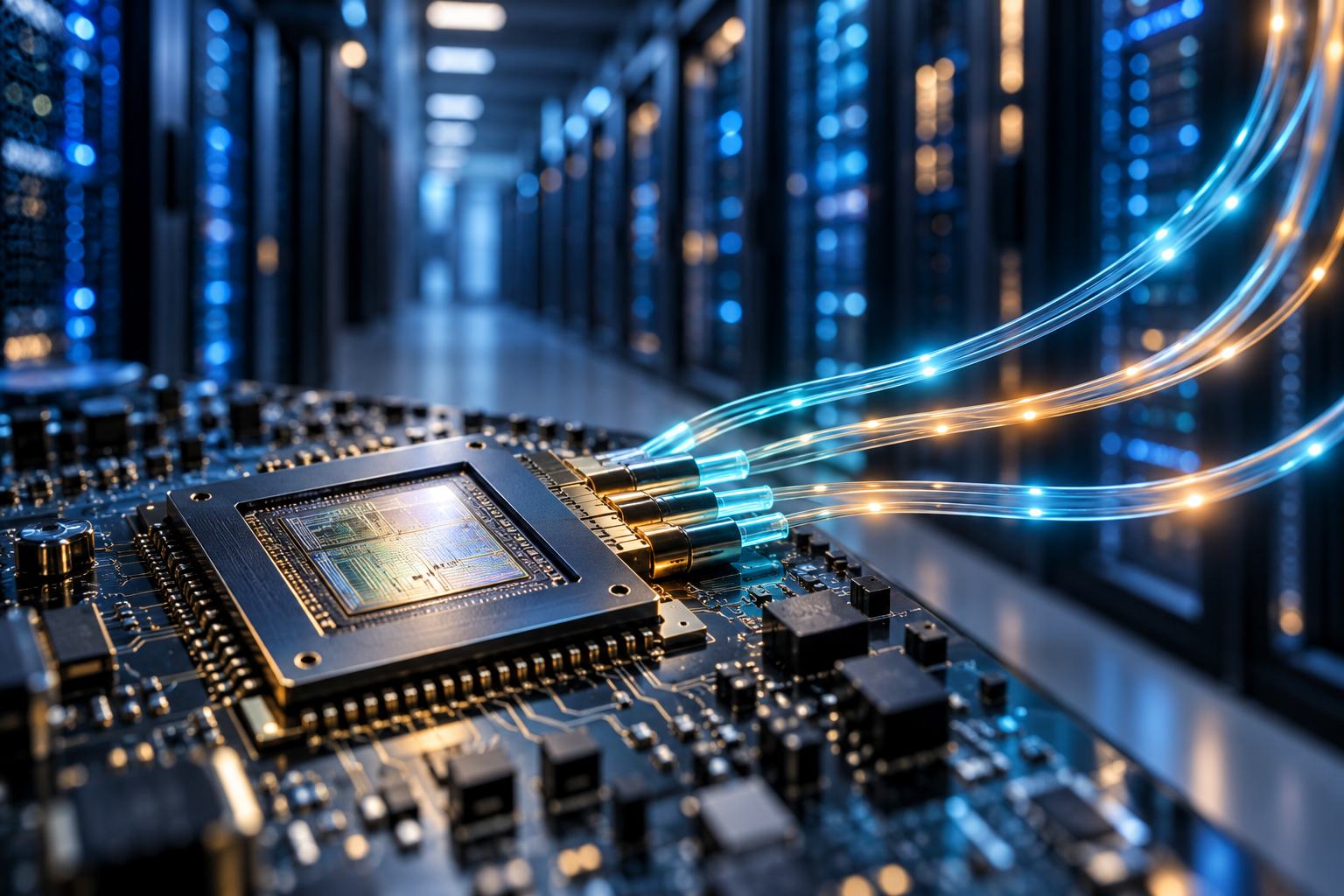
Sivers Semiconductor has become one of the more interesting small-cap names in the photonics and semiconductor space. The Swedish company is developing laser and wireless technologies for markets that include AI data centres, optical communications, satellite communications, fixed wireless access, defence and sensing.
That combination has attracted attention because AI infrastructure is running into a physical problem: moving data between processors, memory and servers consumes enormous amounts of power and creates bandwidth bottlenecks. Optical interconnects, which use light rather than electrical signals to move data, could become increasingly important as data-centre operators scale AI systems.
The bullish argument is straightforward. If Sivers can convert its development projects into high-volume production programs, revenue could grow dramatically from a relatively small base. The company reported a USD 1.2 billion opportunity pipeline in July 2026, up 268% from the end of 2025, and said it expects its transition toward a product-led business to become visible in late 2026 and accelerate through 2027.
But an opportunity pipeline is not the same as revenue, and revenue is not the same as profit. For Sivers Semiconductor stock to rise five to ten times by 2027, investors would need to see several difficult things happen in sequence.
What does Sivers Semiconductor do?
Sivers operates through two broad business areas: Photonics and Wireless.
The Photonics business develops components such as laser arrays and other optical technologies used in data communications, AI infrastructure, sensing and FMCW LiDAR. Its technology is relevant to optical I/O, optical transceivers and other systems designed to move data more efficiently.
The Wireless business develops millimetre-wave and RF technologies for applications such as satellite communications, fixed wireless access and defence. This gives Sivers exposure beyond AI data centres, although the investment narrative has increasingly focused on photonics and the potential demand for optical connectivity.
The company is not a finished-product brand selling directly to consumers. It is a component and technology supplier that must qualify its products with customers, support system integration, scale manufacturing and ultimately win repeat orders. That distinction is important. A promising technical demonstration may be valuable, but it does not automatically create a large, profitable business.
Why are investors interested in SIVE stock?
There are three main reasons investors are watching Sivers.
First, the company operates in markets connected to AI infrastructure. As AI models become larger and workloads become more distributed, data movement is becoming almost as important as compute performance. Optical technologies could help address bandwidth, latency and power-consumption challenges.
Second, Sivers has a small revenue base relative to the potential size of the markets it serves. Its 2025 annual report reported record annual revenue of approximately SEK 307 million, while the company’s 2026 opportunity pipeline reached USD 1.2 billion. Even a small conversion rate from that pipeline could have a material effect on reported revenue. (see Sivers’ 2025 annual report)
Third, the company has announced several customer and partner developments that could support future production. These include an USD 8.2 million production order from ALL.SPACE for Ka-band beamforming ICs, a USD 3.4 million program with SemiNex for InP light sources used in AI data centres, a collaboration with Jabil on a 1.6T optical transceiver module, and a strategic collaboration with GlobalFoundries on silicon photonics solutions.
These developments are encouraging, but they should be treated as evidence of commercial progress—not proof that Sivers will capture the entire opportunity pipeline.
What would a 5× return require?
Using a share price of roughly SEK 26.62 and about 331.7 million shares outstanding as a reference point on 7 September 2026, Sivers’ equity value is approximately SEK 8.8 billion. Market data can change quickly, so this calculation is only an illustration, not a live valuation.
A 5× increase from that starting point would imply an equity value of approximately SEK 44 billion before considering future dilution. That is a substantial valuation for a company whose 2025 revenue was about SEK 307 million and which reported negative adjusted EBITDA in Q2 2026.
For a 5× outcome to become plausible, Sivers would probably need to demonstrate most of the following:
- Several customer programs moving from development or qualification into recurring production.
- Product revenue growing much faster than the legacy NRE revenue that the company is deliberately reducing.
- A meaningful improvement in gross margin as production volumes increase.
- A credible path toward positive adjusted EBITDA and eventually positive free cash flow.
- Evidence that the USD 1.2 billion pipeline is converting into purchase orders rather than remaining a collection of early-stage opportunities.
- Additional production wins in both Photonics and Wireless, reducing dependence on one customer or one AI program.
The key signal would be a sustained sequence of quarters in which product revenue grows, backlog or production orders increase, losses narrow and cash consumption falls. One large announcement would not be enough. Investors would need to see execution repeated over several reporting periods.
What would a 10× return require?
A 10× outcome would be far more demanding. At the same illustrative starting point, it would imply a market value of approximately SEK 88 billion before dilution. That would require Sivers to become more than a promising small supplier. It would need to establish itself as a strategically important component provider in a rapidly expanding market.
For that to happen by 2027, the company would likely need a major design win or multiple design wins tied to high-volume AI infrastructure. The products would have to be designed into systems that customers actually deploy at scale, not merely evaluate. Sivers would also need manufacturing capacity, reliable yields, competitive pricing and enough working capital to support growth.
A 10× scenario may therefore require a combination of operating growth and valuation expansion. Investors could assign a higher multiple if Sivers begins to look like a high-growth, recurring-revenue photonics company rather than an R&D-heavy semiconductor developer. That change in perception can be powerful, but it is also fragile. If production ramps are delayed, the valuation could contract just as quickly.
It is worth noting that management’s own stated long-term financial model is focused on 2028 onwards, according to the Q2 2026 announcement. This suggests that 2027 may be the year of commercial validation and ramp preparation rather than the year in which the full earnings power is already visible.
The most important catalysts to monitor
Product revenue growth
In Q2 2026, Sivers reported product or hardware revenue growth of 13% year over year, or 18% on a constant-currency basis, even as total net sales declined 12% because of lower NRE activity and revenue timing. This is strategically important: the company is accepting weaker short-term revenue in an attempt to build a more scalable product business.
The transition must eventually show up in total revenue. Product growth that remains too small to offset declining development revenue would not support a 5× thesis.
Customer production ramps
Sivers has stated that several programs are progressing toward production and that the effects should become visible from Q4 2026 and accelerate during 2027. Investors should watch for language changing from “development,” “evaluation” and “qualification” to “production,” “volume shipments” and “repeat orders.”
Pipeline conversion
The USD 1.2 billion opportunity pipeline is one of the most important figures in the Sivers story, but it needs to be interpreted carefully. A pipeline may contain opportunities at very different stages, with different probabilities of success and different potential revenue-recognition timelines.
The most useful updates will be new production orders, customer names where disclosure is permitted, expected shipment schedules and the proportion of the pipeline that has progressed beyond early development.
Cash and dilution
High-growth semiconductor companies often need capital before they become self-funding. Sivers announced directed share issues amounting to approximately SEK 825 million in gross equity capital in Q2 2026. The company also disclosed outstanding employee options and other potential sources of dilution in its annual report.
New capital can strengthen the balance sheet and help fund manufacturing. However, it also means that the company’s market capitalisation may grow faster than the value attributable to each existing share. Any SIVE stock forecast should therefore use a realistic future share count rather than assuming no dilution.
The risks that could prevent Sivers from 5–10×
The largest risk is execution. Semiconductor customers can take years to qualify a component, and a project can be delayed, redesigned or cancelled even after a supplier has invested heavily.
Customer concentration is another concern. A small company may receive a large percentage of its future revenue from a handful of programs. Losing one customer, facing a delayed launch or encountering a competing technology could have an outsized effect.
There is also a funding risk. Sivers reported negative adjusted EBITDA of SEK 35.5 million in Q2 2026 and negative operating cash flow of SEK 70 million for the quarter. Although the company raised capital and later reported additional financing developments, investors should continue to monitor cash burn, working-capital needs and the possibility of future equity issuance.
Competition is intense. Sivers is operating alongside much larger and better-capitalised companies in optical components, lasers, networking and semiconductor manufacturing. A technically strong product does not guarantee attractive economics if customers force prices down or if alternative architectures become commercially viable.
Finally, valuation risk should not be ignored. The stock has already experienced a dramatic re-rating from its 2025 levels, according to available market data. When expectations become very high, even good news may be insufficient if it falls short of what investors have priced in.
Is Sivers Semiconductor a buy for a 5–10× return?
Sivers Semiconductor could become a significant beneficiary of the move toward optical connectivity in AI infrastructure, but the 5–10× thesis remains a high-risk scenario rather than a base-case forecast.
The 5× case requires successful production ramps, rapid product-revenue growth, improving margins, disciplined capital allocation and substantial pipeline conversion. The 10× case requires all of those factors plus at least one exceptional outcome: a major AI-data-centre design win, several large customers adopting Sivers products, or a strategic event that dramatically changes the company’s scale and market perception.
My view is that Sivers is best analysed as a speculative execution story. The technology and market opportunity are interesting, but the investment case should be updated after each earnings report using actual product revenue, production orders, cash flow and share-count changes. I would be particularly cautious about treating the opportunity pipeline as guaranteed revenue or assuming that a sharp share-price rise proves the business has already been de-risked.
For investors who choose to own SIVE stock, position sizing matters. A company can have genuine 5–10× potential and still decline sharply if a customer ramp is delayed, financing is required or the wider photonics trade loses momentum. The upside is attractive precisely because the outcome is uncertain.
Final thoughts
Sivers Semiconductor has a credible opportunity to participate in the next phase of AI infrastructure, especially if optical connectivity becomes essential for scaling data-centre performance within power and bandwidth constraints. The company’s growing pipeline, product-led strategy and production-related announcements make 2027 an important year to watch.
However, a 5–10× return will not come from the theme alone. Sivers must turn technical capability into repeatable shipments, turn shipments into profitable revenue and do so without excessive dilution. Until that happens, the stock should be viewed as a promising but speculative semiconductor investment—not as a guaranteed AI winner.
Keep learning: courses on this topic
Self-paced courses to put this article into practice.
 Udemy
Investing For Beginners: How To Invest With Confidence
This Course is for you if ...1. You know nothing about investing.2. You are new to stock market investing and looking for a place to…
View course
 Udemy
How to Invest in Stocks, Mutual Funds & ETFs for Beginners
Are you ready to take charge of your own investment accounts? Make informed decisions about how to manage your money and let it work for…
View course
 Udemy
How to invest in stocks like a pro. The Complete Course!
Learn from a professional portfolio manager. This course teaches you how to properly invest in the stock market in the style of Warren…
View course



Leave a Comment