

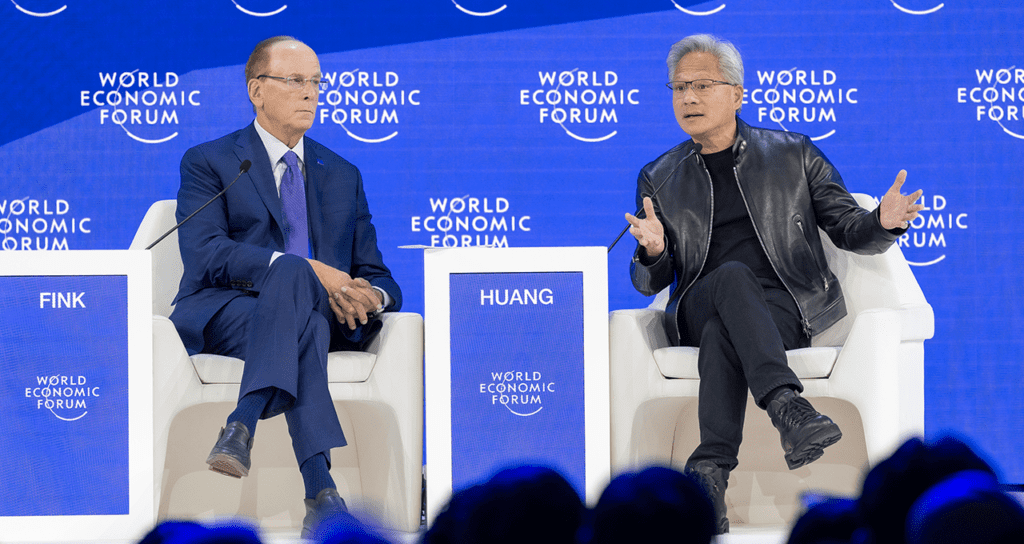
At World Economic Forum in Davos in 2026, Jensen Huang characterized AI as “the largest infrastructure buildout in human history.” His framework for AI investment is that AI isn’t a product category or a short-lived trend, but a five-layer cake made up of:
- Energy
- Chips and computing infrastructure
- Cloud datacenters
- AI models
- Applications
Why is this useful for investors? Because it connects technology innovation and improvements directly to capital markets and capital allocation.Each layer of this AI cake will:
- Have different market sizes
- Grow at different rates
- Have different risk-return profiles
Asking where a company fits in the stack is often more valuable than simply asking if it “does AI.”
- The AI Five-Layer Cake (Through the Lens of Jensen Huang)
- Layer 1: Energy & Power (The Foundation)
- Layer 2: Chips & Computing Infrastructure (Computing)
- Layer 3: Cloud Data Centers (Infrastructure)
- Layer 4: AI Models (Intelligence)
- Layer 5: Applications (The Surplus Layer)
- Investment Implications of the AI Five-Layer Cake
- AI Bubble? Not If You Use Jensen’s Cake Framework
The AI Five-Layer Cake (Through the Lens of Jensen Huang)
In his remarks, Jensen broke out the AI stack into five big categories:
- Energy & Power
- Chips & Computing Infrastructure
- Cloud Data Centers
- AI Models
- Applications (Where “Value is Realized”)
Each section below digs into what is included in each layer, the size of each market today, and how fast each segment might grow.

Layer 1: Energy & Power (The Foundation)
AI doesn’t begin with cloud services. It begins with electricity.Powering, cooling, and operating modern AI systems will require vast amounts of energy — some of it from grid upgrades, and some from AI-specific generation.
What This Layer Includes
- Power generation and grid upgrades tailored to AI load growth
- Data-center power infrastructure buildout
- Cooling, transmission, and storage
- Generation (nuclear, gas, renewables) linked to projected AI demand
Estimated Market Size
- Energy & power spend today: ~$1.5T–$2T annually, worldwide
- AI-driven incremental spend in the early 2030s: several hundred billion per year
Expected Growth
- Annual power growth from AI/digital twin (DT) demand alone: 15–25% CAGR in regions with heavy AI adoption
- Demand for data-center electricity is expected to double in less than a decade
Investor Takeaway
This is probably the least “sexy” AI stack layer, but it may also be the most inevitable. AI aspirations are only as big as power availability. Constraints here will cascade up through the stack.
Layer 2: Chips & Computing Infrastructure (Computing)
Want to talk about Nvidia? This is their layer.Running AI workloads requires specialized chips — GPUs, AI accelerators, high-bandwidth memory, and more — which themselves must be built at massive scale and cost.
What This Layer Includes
- AI accelerators and GPUs
- Memory and network interconnects
- Semiconductor manufacturing and equipment
- Systems-level integration
Estimated Market Size
- Compute hardware market today: ~$150B–$200B
- Could approach $500B–$600B by the early 2030s
Expected Growth
- 15–35% CAGR through the end of the decade
- Expansion fueled by:
- Model scaling
- Demand for inference
- New AI workloads (physics simulation, robotics, tactile/embodied AI)
Investor Takeaway
Much of the early-cycle capital intensity is captured in this layer. But so can massive returns. Be careful of supply constraints as well as demand.
Layer 3: Cloud Data Centers (Infrastructure)
Most businesses can’t build their own AI infrastructure. They rent it.Layers 1–2 become usable when you can access them on-demand at scale — which is where cloud providers come in.
What This Layer Includes
- Hyperscale cloud providers
- AI-optimized data centers
- Networking, orchestration, and storage services
- AI cloud platforms and microservices
Estimated Market Size
- Global infrastructure-as-a-service (IaaS) market today: ~$600B–$700B
- Potential to push beyond $1.5T by the early 2030s with added AI-driven spend
Expected Growth
- “Core” cloud growth: 15–20% CAGR
- Infrastructure supporting AI workloads: growing >30% annually
Investor Takeaway
Cloud is the toll road of the AI economy. You’ll pay a premium for the growth (relative to electricity/power), but the margins are more durable. As AI usage becomes ubiquitous, cloud usage and revenue compound quietly in the background.
Layer 4: AI Models (Intelligence)
Where does intelligence live? Here.This is the layer where inputs are turned into outputs. But increasingly, this layer does not capture where profits accrue.Building and training state-of-the-art AI models is extremely expensive. Within a few years, many AI capabilities will be commoditized.
What This Layer Includes
- Large language and multimodal models
- Foundation models
- Vertical or domain-specific fine-tuning
- Commercial model licensing and APIs
Estimated Market Size
- Model building/licensing revenue today: ~$30B–$50B
- Possibility of $150B–$250B revenue in the coming decade
Expected Growth
- Hard to predict, but likely 30–40%+ near term
- Model training ROI will come under pressure as competition and open source drive margin compression
Investor Takeaway
Most investor excitement (and venture dollars) will be directed at this layer. Strategic importance is high — but long-term, profitable businesses are scarce here unless paired with a platform or sticky applications.
Layer 5: Applications (The Surplus Layer)
Welcome to the top of the cake. “This is ultimately where economic benefit will happen,” Jensen Huang said.Application companies don’t create the AI. They use it to drive productivity, revenue, and results.
What This Layer Includes
- Enterprise AI applications (business software)
- Vertical AI applications (healthcare AI, financial AI, industrial AI)
- Copilots and workflow automation
- Consumer applications and products
Estimated Market Size
- AI applications market size today: ~$100B–$150B
- Total addressable market: $1T+ if AI models are embedded into every industry
Expected Growth
- Higher-than-cloud growth: 35–45%+ through the next decade
- Driven by ROI and enterprise economics, not just capex cycles
Investor Takeaway
This layer represents long-term surplus. Survivors can control categories, become platforms, and realize extreme operating leverage.
Investment Implications of the AI Five-Layer Cake
Investors tend to make the mistake of thinking about AI as one thing. Or one trade.Breaking the market into this five-layer stack forces you to ask better questions:
- Does this company provide AI infrastructure? Or capture its economic surplus?
- Are they dependent on capital expenditure cycles? Or do they benefit from productivity improvements?
- Are margins sustainable, or temporarily inflated by shortages?
How can investors build a balanced AI portfolio?
- Don’t put all your eggs in one layer.
- Look for opportunities in lower layers for first-cycle participation.
- Look to upper layers for long-term compounding.
AI Bubble? Not If You Use Jensen’s Cake Framework
Jensen Huang’s framing of AI is powerful for two reasons:
- It isn’t just a software cycle. AI will remake entire industries over the next decade — starting with energy and compute.
- It matters how you think about it.
If you view this through the lens of the five-layer cake:
- Sky-high capital requirements aren’t so crazy.
- Even eye-popping valuations start to make sense.
- And the enormous opportunity becomes obvious.
The question isn’t whether AI is overhyped. The question is whether we are investing enough money in AI at the right layers at the right time.




Leave a Comment