
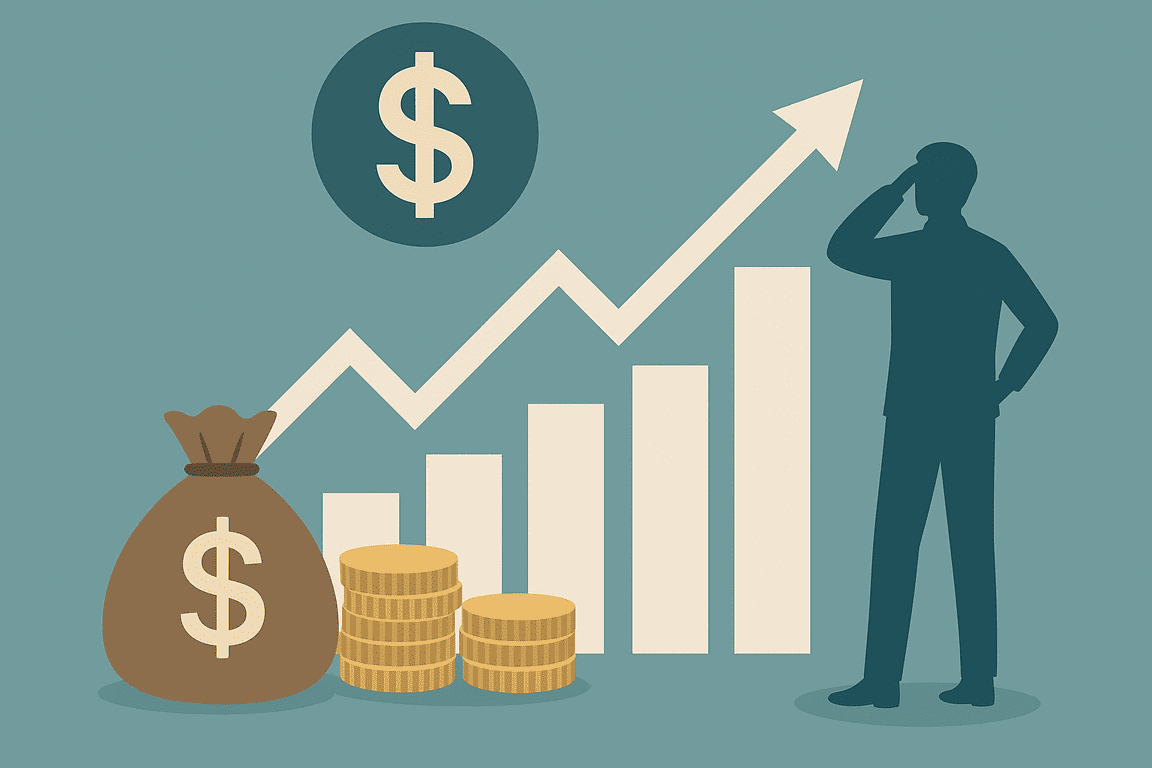
Crossing a one million dollar portfolio feels otherworldly. For as long as you can remember you may have been tracking every paycheque, every DCA deposit, and every market downturn. Then you wake up one day and open your brokerage app to a figure starting with a one and six zeros. A soft milestone with no fireworks, no congratulations banner. And yet, it is a number that carries a heavy emotional weight.
If you asked many people, they would say they always imagined crossing that point brings instant confidence and peace. But often the opposite happens. A tidal wave of conflicting emotions floods the brain: pride, anxiety, uncertainty, loss of identity all at once. Crossing a million in investable assets is not the finish line. It is not the end of the marathon. It is a launchpad into a new phase of investing, and life, that demands a different mindset, new systems, and a more mature relationship with money.
This post will break down the mindset shifts that occur naturally after crossing one million, how to understand them and manage them, and how to continue with your journey with renewed clarity and confidence.
You start thinking in percentages, not dollars
Before your portfolio was at one million, moves of five thousand dollars felt large. Good months in the market could have added you a few thousand, but bad months could have eaten up several paycheques in a week.
Once your portfolio hits one million, you start to feel market movements differently. On any normal day in the market, your portfolio can swing ten thousand to twenty thousand dollars without anything materially significant happening. During big macro events, your portfolio could very easily move fifty thousand dollars or a hundred thousand dollars in a matter of hours. This volatility is to be expected when you have a seven figure portfolio.
This is the natural moment where the mindset shift kicks in. You stop thinking in absolute dollars and naturally start thinking in percentages. A one percent move is a ten thousand dollar swing. A five percent drawdown is fifty thousand. These numbers, that once felt earth-shattering, now simply form part of the scenery. Percentages help you keep a level head and avoid emotional overreaction.
You realise that the goalpost will always move unless you control it
At two hundred thousand your goal was probably five hundred. At five hundred, your goal was probably one million. Now that you are at one million, your brain automatically wants to jump to 1.5 million or two million. This is completely normal. Ambition is a trait that expands as a person grows.
If you allow this to happen unchecked, you can easily fall into the “never enough” trap. Milestone after milestone passes, but you never give yourself time to savour the achievement. After you cross one million, you must consciously define your own finish line. You must define for yourself what wealth actually looks like for your life. At what point can you say to yourself that you are financially stable, that you are set for life. At what point can you scale back?
If you do not take control and consciously define that, then the market will tempt you to shift your goalpost farther and farther out in the distance.
You become more conservative with risk, not less
Many people think that the moment you hit one million, you suddenly become a fearless investor. If you do not manage it, the reality is almost always the opposite. You now have more to lose. You used to take bold risks when your portfolio was small because you had little downside. Now a twenty percent drawdown erases two hundred thousand dollars.
Crossing the one million milestone usually results in investors becoming more conservative with risk. It does not come from fear, but from a different priority: wealth preservation becomes more important than wealth doubling. This is a healthy mental shift. It shows that you have started to think about the long game.
The key is to intentionally adjust your risk profile. You may still want growth but you will likely rebalance, reduce over-concentration, or rethink position sizing. You start to view your portfolio as something to be protected, not a vehicle for gambling.
You start viewing financial freedom as a lifestyle, not a number
Before you reach one million, the conversation is all about the numbers. How much to save every year. What rate of return you need. How many years until you reach a particular figure.
After one million, the conversation changes. You start thinking more about lifestyle. What type of work brings you joy. How much time do you want to spend with family. What parts of your life you want to expand, and which you want to simplify.
This is when you start moving away from a purely numerical approach to financial independence, and start designing a life. True financial independence is not a specific number. It is a feeling of control over your time.
Crossing one million gives you a small taste of that feeling of freedom. You start to realise that you can make decisions and choices from a position of strength, not from a position of fear.
The fear of losing it all becomes very real
Ironically, your million feels both very powerful and very fragile all at the same time. When your portfolio was small, losing fifty percent would be a gut punch but not a life-changing event. Lose fifty percent of a one million portfolio and that is half a million dollars. This number really does hit different.
This fear is a natural emotion. It is a sign that you care about the work you have put in. It also nudges most people to becoming wiser investors. You start paying more attention to risk concentration, portfolio liquidity, and downside protection. You start building a system for the long-term rather than swinging with the emotional tides of the market.
The key is not to try to suppress the fear, but to manage it with structure. A well-considered allocation helps you sleep at night, even during a volatile market.
You may feel a little lost, after chasing the goal you have worked towards for years
Many investors chase one million for five years, ten years, even fifteen years. If you are anything like me, during that time your identity starts to get wrapped up with the chase. You lose weight, get stronger, invest in better habits, personal finance becomes a central part of your life. Then one day you finally hit your goal. The North Star is in your reach, and you realise you have no idea which mountain to climb next.
A state of aimlessness and loss of direction. It is one of the most common emotional states to hit an investor after a big milestone. The temptation is to move the goalpost again, go for a 1.5 million or two million target. That is not the solution. The solution is to find purpose.
Ask yourself:
- What do you actually want money to help you do with your life?
- If you stopped growing your portfolio today, what would you regret not doing?
- What new challenge now excites you?
You can harness the momentum you have from crossing one million to design a more intentional second chapter.
You start viewing work differently
When your portfolio was growing from zero to one million, work felt like a means to a singularly important end. You needed every paycheque to buy more shares. But after you cross one million, you realise that your portfolio itself may be generating more yearly returns than your salary. This realisation changes how you view work.
You stop feeling trapped. You start thinking about meaning, and personal growth. You get more confidence to say no to toxic jobs, and more courage to pursue opportunities that feel better. You feel more agency to choose work, not because you need it for survival, but because you want it to help design your life.
This is probably one of the most liberating mental shifts of them all.
You start prioritising sleep, health, and family over maximising returns
One fallacy about wealth is that it changes everything. The truth is that it often changes what you value. After you cross one million, you start realising that money has a point of diminishing returns. Your health, sleep, and family start contributing more to your happiness than an extra one percent on annual returns.
This is when you start:
- Sleeping better
- Spending more time with family
- Travelling more
- Investing in experiences over material things
- Saying no to unnecessary stress
Money starts to feel like a tool to live a better life, not a scoreboard to rank you against others.
How to move forward after crossing one million
Reaching one million can feel like a liminal moment, on the cusp of a new phase of your life. How to step forward with clarity and purpose?
1. Redefine your life goals
Do not let your self-worth be tied to the size of your portfolio. Instead, use this moment to ask yourself what you actually want from life. This could include time flexibility, career freedom, family prioritisation, or personal exploration.
2. Build a safety structure around your portfolio
Now that you have a million to manage, your wealth requires protection. Consider building:
- A well-diversified sensible allocation
- An emergency fund that is separate from your investable portfolio
- A policy for how much you will allow yourself to withdraw
- A policy for rebalancing
- Clear risk limits
This structure will help you stay calm during market volatility.
3. Accept that your needs will change over time
Your one million dollars today will serve your portfolio in different ways as you move through different chapters of your life. Be flexible. Adapt your investing strategy as your personal life goals shift and evolve, rather than rigidly adhering to a rulebook you put together in your twenties or thirties.
4. Don’t fall into lifestyle inflation that erases the milestone
Crossing one million should not tempt you into over-spending. Enjoy the fruits of your success, but remain grounded. Lifestyle inflation can wipe out ten years of disciplined effort in a few years.
5. Start thinking in terms of legacy and meaning
With a reasonably safe portfolio, you can now start to think about legacy and meaning. What values do you want your money to reflect? What habits do you want your children to model? What causes do you care about?
Money becomes meaningful when it starts to reflect your deeper values.
Final thoughts: Million is a milestone, not a finish line
Crossing a one million milestone is an incredible achievement. It is the result of years of discipline, sacrifices, long nights, decisions that required courage, and moments of choosing to continue when things felt very uncertain. But it is not the end of your story. It is the start of a new chapter that demands emotional maturity, a clearer sense of purpose, and a deeper understanding of the meaning of money in your life.
Your second chapter is about building a life of freedom, balance, and intention.
If you would like some help keeping track of your journey, running projections, or modelling your path to full financial independence, check out the BearSavings tools. The one million dollar milestone is a proud moment to be savoured. The next years are where the real personal growth happens.


Leave a Comment