
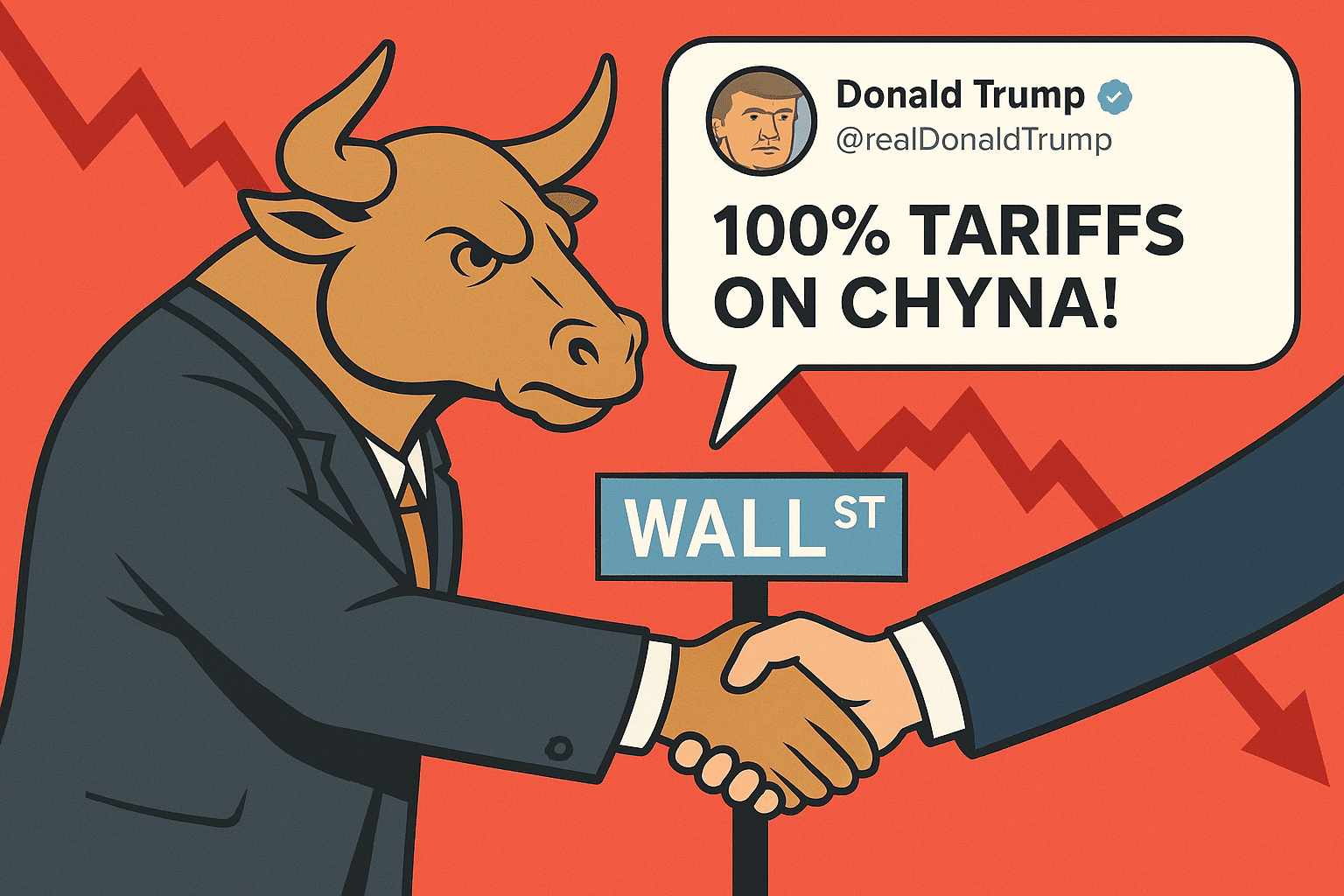
For the S&P 500 (SPX), last Friday was a wild one. The index finished down 2.71%, marking its worst one-day percentage decline since late April. The reason? Former President Donald Trump’s 100% tariff increases on “ChyNA” and the potential cancellation of a meeting between Trump and Xi Jinping.
The subsequent plunge in equities has sent the S&P 500 back toward its 40-day exponential moving average (EMA) — a popular place for short-term support in a market pullback.
Sound familiar? You can’t predict when the next correction will occur, but it always occurs when most people least expect it. Short-term volatility will always scare many investors. But if you keep a level head, the 40-day EMA can serve as a quality buying opportunity when fear, uncertainty, and doubt (FUD) push prices lower.
The Market Panic Script: Trump Edition
If you invest long enough, you realize that market cycles really do rhyme, if not repeat.
- Step 1: Trump tweets out something inflammatory, whether it’s calling an assassination into question or proposing an absurd tariff.
- Step 2: Markets sell off for a few days. Unprofitable algorithmic trading and margin calls punish those who are overleveraged or simply let their emotions get the best of them.
- Step 3: Commentators and advisors like Bessent flood the airwaves trying to reassure everyone, going out of their way to spin how President Trump is “flexing his strategic brilliance.”
- Step 4: Trump reverses course or secures a “deal.”
- Step 5: Markets rebound and often post new all-time highs.
Sound like a broken record? It’s basically the same story, only with different headlines.
As a long-term investor, I welcome these brief bouts of market madness. They serve as catalysts for investors to be “all in” by buying high-quality businesses that may get temporarily punished for something completely unrelated to their long-term fundamentals.
Why I Love Macro-Driven Selloffs
When markets plunge over political developments or media-driven sentiment, they’re rarely responding to any new information about company fundamentals. The business, its profit, its free cash flow, and its competitive advantages are all still there.
That’s why these are the exact times where rational value investors who focus on fundamentals have a massive advantage. While many get gripped by fear and lock up in cash, long-term investors accumulate at a discount, all while quality businesses compound earnings right under their noses.
Let’s use UnitedHealth Group (UNH) as an example. The healthcare services giant dropped 3.59% on Friday, yet what does UNH have to do with tariffs on China? Tariffs have no direct impact on the healthcare insurance industry and UNH doesn’t import medical devices from Shenzhen or depend on manufacturing from China. Yet, emotions and momentum traders sent UNH along for the algorithmic plunge.
There are few other situations where the gap between a company’s long-term fundamental value and its short-term market price is more extreme. If you buy high-quality companies and hold long enough, these short-term, non-fundamental-driven market drawdowns should end up being a very blip on the screen of your long-term returns.
The Rational Investor’s Checklist When Corrections Occur
Market corrections are normal and even necessary. They re-prime market valuations and clear out speculative froth. But if you react emotionally and haphazardly, you risk creating your own speculative froth, one that could become permanent.
How do you avoid this and keep investing rationally during volatility and corrections? I use this checklist:
1. Invest in high-quality businesses
First, I only buy strong, long-term businesses with durable economic moats, consistent profitability, and high return on equity. Those are the companies that can withstand bouts of volatility and continue compounding earnings during good and bad times.
2. Buy below your intrinsic value
Buying has to make sense relative to your understanding of the company’s value. Wait for the price to drop below your intrinsic value estimate (with a nice margin of safety) and buy near or at key technical support levels if you can.
Don’t chase prices — wait for better prices.
3. Stay away from leverage
The biggest mistake any investor can make in a volatile market is to use leverage. If you buy on margin, you’ll get forced out of a position if volatility spikes, even if you’re holding the best business in the world.
Stay away from leverage to play high-quality businesses, no matter how much volatility spikes.
4. Diversify across 10–20 quality stocks
No one knows in advance which industry or sector will outperform. And while diversification is far from a “winning” strategy (nobody knows that either), it’s usually the best way to reduce idiosyncratic risk (company-specific risk) while maintaining broad exposure to multiple compounding machines.
5. Average into quality companies when you can
You can’t know or predict the bottom. Nobody can. That’s why a margin of safety is so important.
Instead of waiting for the exact bottom, the smarter move is to add small positions as prices approach key support zones or when you spot early price reversal patterns.
You never want to catch a falling knife, but that also doesn’t mean you should wait for macro conditions to be “right” to buy quality businesses at a discount.
Remember: Markets have a memory longer than the news cycle.
Why Value Investors Win in the Long Run
Market moves over the short term are usually an emotional overreaction.
But over time, stock prices tend to revert to the mean and reflect the intrinsic value of the business behind them.
This is why the stock market can feel so dull. While short-term traders panic over Trump’s tweets or a headline over a temporary trade war, long-term investors compound wealth through discipline and rationality.
If you buy companies that generate consistent free cash flow and that have durable moats, volatility is your friend. In fact, it’s what presents you with an opportunity to buy more of what you love, at an even deeper discount.
Final Thoughts: Stay Rational and Stay Invested
Friday’s selloff was not the end of the bull market. In fact, it’s nothing more than another chapter in the never-ending saga between politics and the markets.
So, instead of panicking, the smart move is to stay disciplined, diversified, and data-driven.
The next couple of days will likely see more volatility, but remember, the fundamentals of a great business do not change because of one tweet.
In fact, the news and media-driven market volatility over short-term events are the very reason long-term investing works.
While most sell in fear, you’re calmly collecting more quality — and that’s how you build true wealth.
Keep learning: courses on this topic
Self-paced courses to put this article into practice.
 Udemy
Investing For Beginners: How To Invest With Confidence
This Course is for you if ...1. You know nothing about investing.2. You are new to stock market investing and looking for a place to…
View course
 Udemy
How To Invest In Stocks In 15 Minutes?
This is for anyone who wants a quick lesson on stocks and want to start trading stocks today—Within 15 minutes. This beginner guide will…
View course
 Udemy
Value Investing: How to Invest Wisely Like Warren Buffett
Finally, You'll Become a Wiser Unstoppable Investor and Start Kicking Off Your Investment Journey In Just 2 Hours. Results That Speak for…
View course


Leave a Comment