
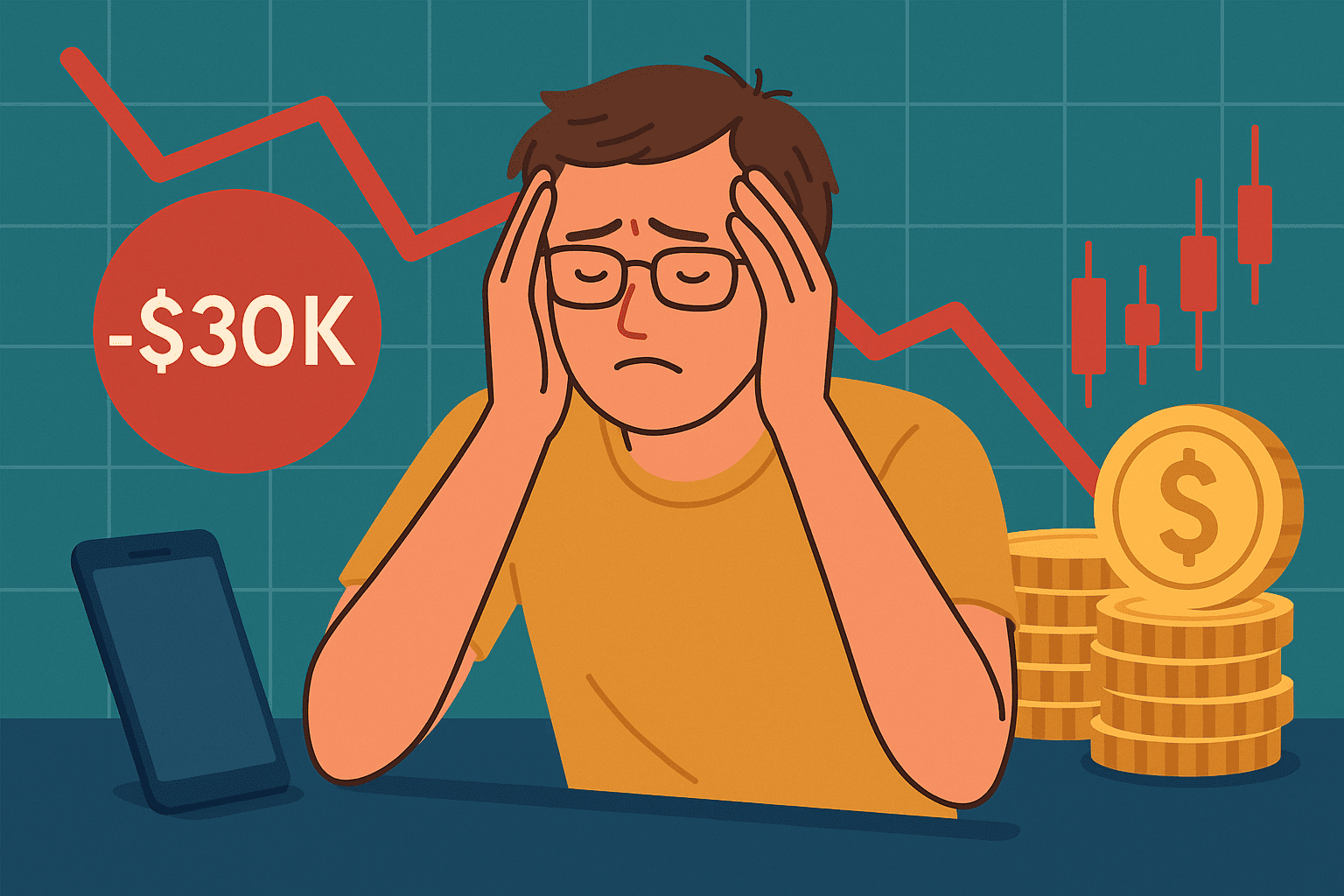
There are few things in investing that make you feel more physically sick than watching a big position spiral down into the red. That was exactly what I was going through when I lost $30,000 on a single stock. It wasn’t just the money — it was the emotional rollercoaster, the constant self-doubt, and the sickening realization that even the smart-sounding theses can go very wrong.
In hindsight, of course, that painful experience taught me more than any investing book, podcast, or news article ever could. But back then, my investing journey was just beginning, and I had to learn the real lessons the hard way.
So today I want to share the hard lessons that I learned as a growth investor after losing that money. If you’re just starting your investing journey or managing your own portfolio, perhaps these insights will help you avoid the mistakes I made and find a healthier approach to investing.
The Growth Story Seduction
First off, let me tell you about the company I invested in (we will call it XXX Robotics for this post):
- Massive total addressable market (TAM).
- Good revenue growth.
- Visionary CEO who sounds like a Silicon Valley tech bro.
In short, this was everything a growth investor dreams about. As a result, this was the kind of stock that financial media outlets covered. Analysts were calling this the “next Tesla” of its sector, and I told myself I was getting in early before the Wall Street caught on.
The problem? I was listening to the story more than the numbers.
Lesson 1: A great story does not equal a great stock
I know the importance of telling a good story. And many, if not most growth companies are master storytellers. I know very few surefire ways to make investors feel excited about a stock than to paint a picture of a future of endless expansion.
So I realized that the real question I should have been asking myself was:
- Is the business model profitable?
- Is this cash flow positive?
- Can it scale without burning investors’ money?
Profitability, cash flow, and margins do not sound sexy, but they matter way more than an exciting growth story.
The Position Size Fallacy
The second mistake I made was the size of the position. Instead of testing the waters with a small position, I put all my eggs in this one basket, holding a concentrated stock position that made up more than 20% of my portfolio. Needless to say, when the stock dropped, I felt the pain in my entire portfolio.
Lesson 2: Never risk more than you can emotionally handle.
Yes, it hurt. Losing $30,000 hit me not just on a financial level but also mentally. I was not sleeping, checking the stock price every hour, and making emotional, impulsive decisions. Diversification is not a sexy strategy, but it’s the life jacket that will keep your portfolio afloat when a single holding implodes.
The Valuation Trap
The third and most important mistake I made was ignoring valuation metrics. All too often, growth investors love to say, “This stock is expensive today, but future earnings will make it cheap.” I was guilty of this myself, ignoring traditional metrics like the price-to-earnings (P/E), price-to-sales (P/S) ratio and blindly following the growth without a second thought.
Lesson 3: Valuation still matters, even in growth investing.
Yes, I know the success stories. Amazon, Nvidia, Tesla. They grew into their lofty valuations. But for every success story, there are dozens (if not hundreds) of growth darlings that never recovered. So while you should always leave room for innovation and disruption, anchoring your analysis in something tangible like free cash flow, price-to-sales ratio, and gross margin is crucial.
Emotions Rollercoaster..
Of course, the hardest part of this whole process was handling my emotions. At first, I was over the moon when the stock went up by 20% in one month. I then entered the phase of denial when the price started dropping by 30%. Then there was utter despair when I realized that the fundamentals had not improved yet, and I was still holding in the hopes that the stock would go back up.
Lesson 4: Detach emotions from your investments.
Sure, investing is supposed to be a rational thing. But humans are emotional creatures by nature. I learned that to stay on the right path, I need to set some rules for myself:
- Set stop-loss or trailing stops.
- Write down the reasons for buying a stock and the conditions for selling.
- Don’t fall in love with a company (it will never love you back).
Investing in Market Cycles
What made my loss even more painful was bad timing. I bought the stock aggressively at the peak of a bull market, at record highs for growth stocks. Then, interest rates started to rise, inflation spiked, and the market rotated away from the riskiest growth names.
Lesson 5: Macro matters more than you think
Ok, I will be honest. I am not an expert in monetary policy and interest rate cycles. So the way markets got crushed a few months after my $30,000 loss was baffling to me. I had to learn, though, that even the best-performing stock will struggle if the market is in the wrong cycle.
As a growth investor, you need to learn that things like monetary policy, interest rates, and investor sentiment can make even solid companies with great business models get crushed in the market even if their fundamentals are not reflecting this.
Upside to Losing $30,000 in One Stock
Ok, ok, I know what you are thinking. But is this a thing? Is there an upside to losing money? And yes, it might sound strange, but I am actually thankful that I lost that money.
If this was my first stock, I may not have come back to investing at all. The loss forced me to reevaluate my strategy, build some discipline, and, most importantly, approach investing with a sense of humility. This is what I do differently now:
Sector and asset class diversification. I still invest in growth stocks, but I balance it with dividend stocks, ETFs, and safer blue-chip names.
Do my due diligence. I look beyond the hype and the press releases to scrutinize the financial statements, unit economics, and other hard data.
Act long-term but think rationally. Not every stock is a “forever hold” just because it has a sexy growth story.
Position sizing discipline. No single stock position gets more than 10% of my portfolio.
Final Words
Losing $30,000 on a single stock was one of the worst experiences I had as an investor. But, I also realized that I was lucky to have made the mistake at the beginning of my investing journey and learn these lessons the hard way.
To all growth investors out there, let these be a friendly reminder: the story is seductive, but the numbers tell the truth. Diversification is a boring term, but it is what saves portfolios in times of crisis. Discipline is not sexy, but it will save your sanity.
The market will always throw shiny new things at you: “The Next Tesla,” “The future of Autonomous Delivery” are all variations of the same theme. The big question for you is whether you can afford to play along.
Keep learning: courses on this topic
Self-paced courses to put this article into practice.
 Udemy
How to Invest in Stocks, Mutual Funds & ETFs for Beginners
Are you ready to take charge of your own investment accounts? Make informed decisions about how to manage your money and let it work for…
View course
 Udemy
Personal Finance 101: Budget, Save & Invest
Do you ever feel like you’re working hard but not getting ahead? Do you get to the end of the month and wonder where all your money went?…
View course
 Udemy
From Welfare to Wealth: Earn Online & Invest Wisely
If you're living on a low income, receiving benefits, or stuck in survival mode — this course is for you.“Financial Independence on a Low…
View course




Leave a Comment