
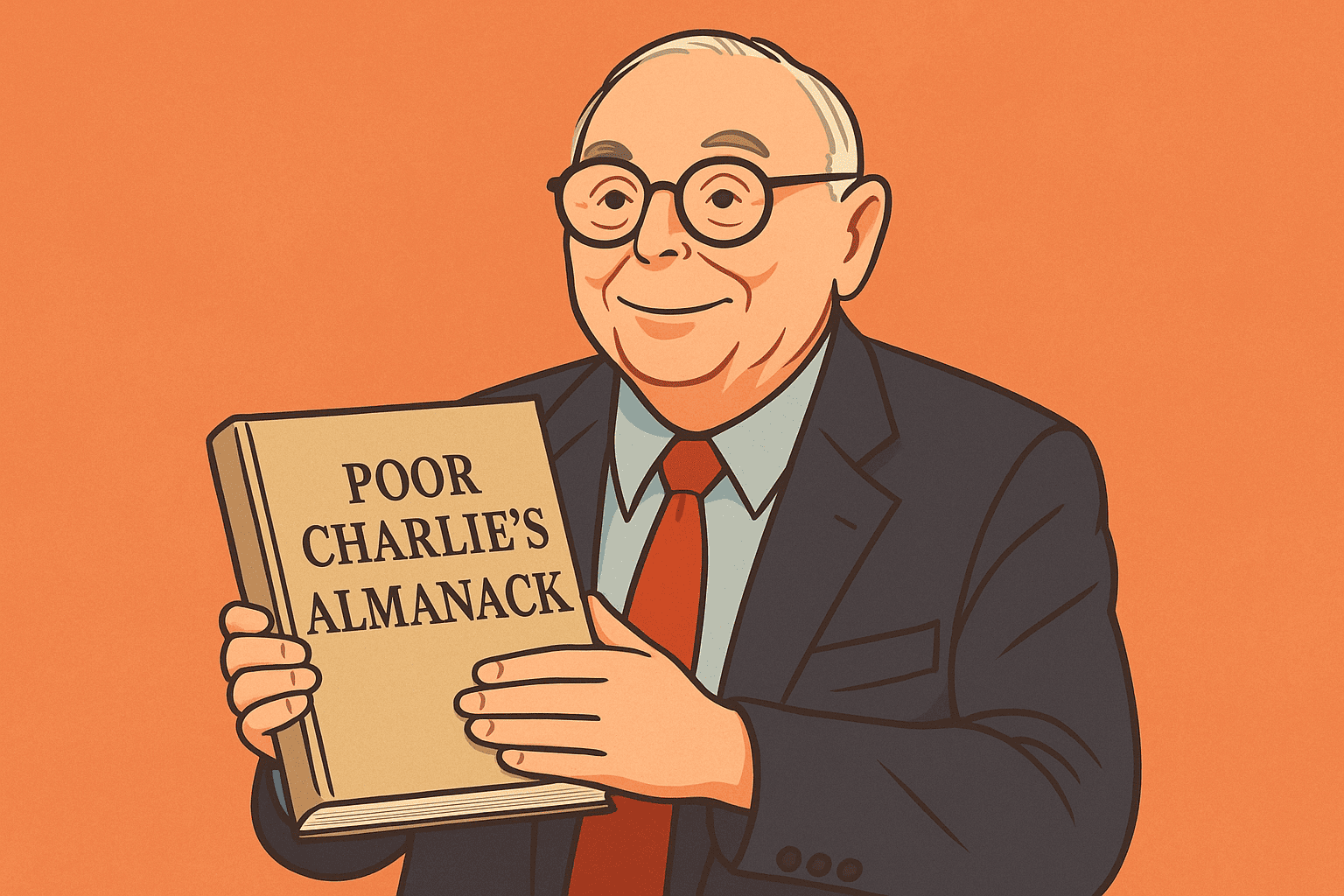
Believe it or not, I didn’t think Poor Charlie’s Almanack would have this much impact on me. It’s a large hardback book, filled with speeches and illustrations. At first, it feels like you picked up a coffee table book. But as soon as you crack open the spine and start reading, it becomes clear that Poor Charlie’s Almanack is much more than a book about investing. It’s a book about living a better life through clarity, discipline, humility, and reason.
Written about (and by) Charlie Munger, the longtime vice chairman of Berkshire Hathaway and Warren Buffett’s longest and closest business partner, Poor Charlie’s Almanack distills his most important ideas, speeches, and mental models.
But it is one of the most rewarding books I’ve ever read — and a book I return to every year. In this review, I wanted to distill the key lessons for me that have become part of the way I think about money, life, and decision-making.

Lesson 1: Build a Latticework of Mental Models
If there’s only one idea you take away from Charlie Munger, let it be this: the best thinkers don’t think within a single box. They borrow and learn mental models from many different fields.
You can’t improve how you think by only reading one subject. We have to be multidisciplinary thinkers. We need multiple frames of reference and mental models to solve problems, assess risk, and avoid blind spots.
Munger argues that people who only study, say, economics or finance or finance will have a narrow and limited understanding of the world. They’ll be great in their own silo, but in a complex and ever-changing world, that’s a recipe for missing important signals and making dumb mistakes.
To think and reason more broadly, we need a latticework of mental models that include physics, biology, psychology, mathematics, history, philosophy, and more.
The idea is that each field has its own lessons and models for understanding the world, so the more of them you can understand, the more “lenses” you have to look at the world.
For example, here are a few models Munger borrowed:
- Probability. When thinking about business, investing, or life, we should be probabilistic thinkers — mentally weighing odds, not thinking in black and white, and always questioning our assumptions.
- Psychology. Understanding human nature is a big part of Munger’s framework. He borrowed heavily from social psychology to learn about cognitive biases, social proof, status, loss aversion, overconfidence bias, and much more.
- Evolution. Munger and Buffett both have a deep understanding of evolution and selection pressures. They borrow the idea that systems and organisms adapt (or fail to adapt) to changing conditions — and you can use it to understand business, investing, and even biology.
- Opportunity cost. Munger borrows this economic idea to show that the true cost of something isn’t its price tag. It’s the value of the best alternative. This applies to every decision we make, from small to large.
Munger’s lesson is that the world doesn’t care if you’re a trivia master or can recite entire industry reports. It only cares if you think.
The good news is, in a world awash in information and trivia, thinking better is not that hard. It’s just a question of building a simple mental tool kit of ideas. And the beauty of it is, that advantage compounds over time.
Lesson 2: Invert, Always Invert
Munger’s second favorite tool for understanding the world (after mental models) is a simple idea called inversion.
It’s a straightforward principle: If you want to solve a problem or achieve a goal, look at the opposite.
If you want to be successful, don’t ask “how do I make money?” Ask “how do I lose money?” Then do the opposite.
If you want to live a good life, don’t ask “what should I do?” Ask “what would ruin my life?” Then avoid that.
Munger borrowed the principle from mathematics (invert a function by reflecting it), but he applies inversion to every field: Investing, psychology, business, decision-making, and more.
Inversion is a form of intellectual humility. It’s the idea that instead of starting with optimism and hope and trying to figure out how to succeed, you start by trying to avoid obvious pitfalls. And that alone puts you ahead of most people.
Lesson 3: Avoid Foolishness, Not Genius
If there’s one quote from Poor Charlie’s Almanack that changed the way I think, it’s this one:
“It is remarkable how much long-term advantage people like us have gotten by trying to be consistently not stupid, instead of trying to be very intelligent.”
Munger said this, and I love it. I love it so much.
Why? Because it’s liberating.
If you’re waiting to be a genius before you act, you’ll never do anything. You can never know enough. You’ll always feel like you’re missing a piece of the puzzle. But that’s not how life works. We have to live. We have to act.
Munger is saying: Don’t wait to be the smartest person in the room. Just be less stupid than everyone else.
In investing, that means you don’t have to predict the future or pick the exact bottom. You just have to avoid being egregiously wrong.
Don’t overpay.
Don’t overleverage.
Don’t chase fads.
Don’t trust people with bad character.
The goal is not to be the smartest person in the room. It’s to not get fired. To stay in the game.
Survival first. Excellence second.
I know this sounds basic, but for me, this lesson was a psychological shift. It took me a long time to absorb it and let it sink in. Once I did, I found that I was much less stressed about the future and much more focused on just avoiding obvious traps.
And by avoiding foolishness (overly optimistic bets, speculative investments, shady companies, etc.) and letting time and compounding work its magic, you can do very well.
Lesson 4: The Power of Incentives
One of Charlie’s favorite points throughout the book is how incentives structure behavior — even when those incentives are invisible or misaligned.
“The way you incentivize people is the way they behave. Show me the incentive, and I’ll show you the outcome.”
You’ll see this quote throughout the book, and for good reason. Munger is obsessed with how incentives drive decision-making. From how we set up businesses and organizations to how we measure performance to how we evaluate risk, getting incentives right is the key to success.
You can see this idea in action everywhere. Corporate fraud is often the result of bad incentives. Bankers taking outsized risks on Wall Street often had powerful incentives to do so (sales targets, bonuses, promotions, etc.). Government workers often face perverse incentives to be inefficient.
All this is to say that people will behave however they need to in order to get what they want. So if you want a certain outcome, you need to make sure the incentive system is lined up in that direction. You need to make sure you’re rewarding the right behaviors and not rewarding the opposite of what you want.
It’s also one of the most powerful mental models for Munger and Buffett’s investing: When you see a company or industry that has distorted or misaligned incentives, you have to ask yourself, who benefits from that? And are they going to be able to get away with it?
This lesson made me start thinking about incentives everywhere. From how we run teams at work to how we pay people to how we motivate children. I looked at the world differently after reading Poor Charlie’s Almanack.
Lesson 5: The Psychology of Human Misjudgment
In one of the most well-known and oft-cited chapters in the book, Munger lists 24 cognitive biases that cause humans to make irrational decisions. This was his way of summarizing the “psychology of human misjudgment.”
The chapter is long, but it’s worth reading (especially if you’re not familiar with cognitive bias and behavioral psychology).
Here are some of Munger’s favorites:
- Confirmation bias. The tendency to seek out information that confirms your preexisting beliefs.
- Social proof. We do what other people are doing because it feels safer.
- Loss aversion. We fear losses more than we value gains.
- Authority bias. We obey and follow those in authority even when they are wrong.
- Overconfidence bias. We are smarter than we think we are.
Again, the lesson here isn’t to try to eliminate all cognitive bias. That’s a fool’s errand. But by being aware of it and the mental shortcuts we all take, we can avoid its worst excesses.
For me, this list made me much more skeptical (in a good way), more analytical, and more deliberate in how I make decisions. It also helps me be more compassionate and patient with others who make mistakes. I don’t assume they’re stupid. I assume they’re human.
Lesson 6: You Must Read Constantly — and Learn Relentlessly
Buffett was famous for reading 500 pages a day, but you know who was reading at least that much and probably more? Charlie Munger.
Unlike Buffett, though, Munger was more of a private reader. He doesn’t do interviews as often. He’s not on social media. He’s not active on Twitter. He’s reading and thinking quietly all day, every day. Reading across many different fields.
Munger doesn’t read to be entertained or distracted. He reads to build a worldview. To learn from failure. To understand human nature and how the world works. To build context, not trivia.
The fact that Charlie Munger and Warren Buffett have been reading constantly their whole lives is not a secret.
In the book, Munger states: “In my whole life, I have known no wise people who didn’t read all the time — none, zero.”
Holy crap did that hit me hard.
I used to feel guilty for reading all these hours of nonfiction, and I thought it was unproductive. I’d ask myself, what am I really getting from this? Can’t I learn faster just by watching videos and podcasts?
No, you can’t. You have to read.
Munger and Buffett read so much because it’s the single most productive thing you can do.
That is, if you’re a lifelong learner. If you read to build a worldview. If you read to fill in gaps and build context across different fields.
If you read like Munger, to learn to think better. If you read across disciplines and subjects. If you read to develop judgment. If you read to live a better life.
It’s the cheapest and most powerful way to keep getting smarter.
Lesson 7: Know Where You Have an Edge
Charlie has one of the longest “circle of competence” warnings in the book. It’s not just don’t touch tech. Don’t touch biotech. It’s don’t touch anything outside your circle of competence.
Venturing outside your circle of competence can be like stepping off a cliff. Just because a stock is cheap or a business sounds exciting doesn’t mean you know enough about it to understand the risks.
Charlie’s advice is simple: only invest where you have an informational edge. Don’t invest just because you think something is cheap or undervalued. Don’t invest just because everyone’s piling in. Don’t invest in fads. Only invest where you truly have an edge in terms of knowledge and analysis.
In investing, this means stick to sectors and business models you understand. Stick to places where you know the economics, the business model, and the industry. Stick to what you know.
I’ve taken this lesson to heart. I won’t say I never venture outside my circle of competence, but I am much more honest with myself about where I don’t know enough. I’m also much pickier in how and where I invest. I focus on industries and businesses I understand.
Lesson 8: Character Matters More Than Intelligence
Charlie has a tendency to name drop. But throughout the book, you get the sense that Charlie actually cares about people more than their net worth or IQ.
He cares more about their ethics, their humility, their honesty, their temperament.
The people Charlie admires are not the richest or smartest. It’s not about money or IQ. He spends time in the book talking about people he admires for their generosity and character — and for people he doesn’t admire.
I thought this was a surprisingly touching and endearing quality about Charlie, Buffett, and Berkshire Hathaway.
For two men who are billionaires and revered all over the world, you never get the sense they’re egoists or worship wealth or intelligence. In today’s world, where so much culture worships the hustle and the deal, it’s a grounding message: Be a good person first, a smart person second.
Final Thoughts: Why You Should Read Poor Charlie’s Almanack
This book is a beast. It’s not one you read quickly or in one sitting. It’s one of those books that rewards multiple re-reads.
But Poor Charlie’s Almanack is full of brilliant ideas that will change the way you think and reason about the world. It’s full of insights about life, investing, business, decision-making, and psychology.
For me, it’s not just a book about money or investing. It’s a book about how to live better. If you’re an investor or a founder or a student or a person trying to make better life decisions, Poor Charlie’s Almanack will help you do that.
Charlie has many more lessons and quotes, of course. This was just a distillation of the big ideas that stuck with me and changed the way I think.
The bottom line is: if you want to learn how to invest, Poor Charlie’s Almanack will not teach you. Don’t read it for that reason. Invest in low-fee index funds and move on.
If you want to learn how to live, though, this is the book. If you want to learn how to think and reason, this is the book. If you want to live a better life, this is the book.
If you’re not ready to take that commitment, don’t worry. Read it in pieces. Learn one lesson. Put it down. Read a few pages every day. But get into it. Pick a lesson and work on it. Invest in it. Read his speeches and interviews. It’s worth it.
Keep learning: courses on this topic
Self-paced courses to put this article into practice.
 Udemy
From Welfare to Wealth: Earn Online & Invest Wisely
If you're living on a low income, receiving benefits, or stuck in survival mode — this course is for you.“Financial Independence on a Low…
View course
 Udemy
Value Investing Bootcamp: How to Invest Wisely
A self-paced video course on value investing and stock investing, with practical lessons you can apply right away.
View course
 Udemy
Stock Trading: Invest and Trade Safely with Stock Sector ETF
Stock Lovers, Traders, Investors, Stock Market Aficionados! Master the basics of trading ETFs. NO NEED to pick and choose individual…
View course





I love how ‘Poor Charlie’s Almanack’ stresses the importance of building a mental model latticework. It’s such a powerful way to approach decision-making by integrating diverse perspectives, rather than relying on one narrow way of thinking.